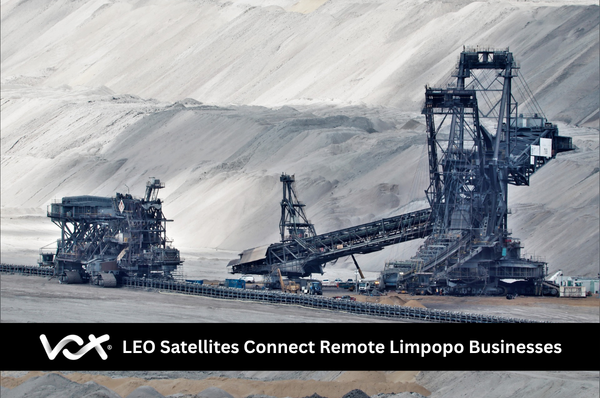
How low-latency LEO Satellite internet connectivity keeps Limpopo’s mines, farms, game parks and guest lodges online where Fibre and Wireless can’t reach
Limpopo’s mines sit deep in the Bushveld, with its farms stretching across thousands of hectares of subtropical valleys and open plains, and its sought-after game lodges tucked away in wilderness areas hours from the nearest town. These are the places where Fibre does not always reach and Wireless coverage can be thin or non-existent.
When Fibre or Wireless connectivity is unavailable, low-latency Low Earth Orbit (LEO) Satellite connectivity from Vox can keep Limpopo’s mines, farms and guest lodges online and operational.
Limpopo, South Africa’s northernmost province, is economically important – it ranks fifth in South Africa in both surface area and population – and yet simultaneously quite remote. The province’s economy rests on three pillars including mining, agriculture and tourism, which are all largely based in rural areas, and far from the metropolitan Fibre networks that urban businesses take for granted.
Externally, Limpopo borders Mozambique, Zimbabwe and Botswana, and internally it borders the provinces of Mpumalanga, Gauteng and North West. Limpopo has a varied geography, containing true Bushveld country and unspoiled wilderness, majestic mountains and aged indigenous forests, not to mention the northern half of the fabled Kruger National Park in the east.
Through our partnership with Q-KON, Vox brings LEO satellite connectivity to businesses across South Africa, giving organisations in Limpopo a fast, low-latency and reliable connection, no matter how far off the beaten track they might be.
Why Limpopo Businesses Can Benefit from Satellite Connectivity
Rolling out Fibre to a handful of users spread across a mining concession, a fruit estate or a private game reserve generally does not make commercial sense. Wireless links also depend on line-of-sight towers and backhaul infrastructure that can be exposed to cable theft, power outages and weather damage, and that struggle in mountainous terrain.
LEO satellite connectivity sidesteps these limitations. Because it beams connectivity directly from orbit, it works regardless of terrain, distance or local infrastructure. There are no civil works and no landlord approvals required, and with solar power or a UPS in place, the service keeps running through power outages.
For businesses in Limpopo, this translates into:
- Speeds of up to 100Mbps per terminal, fast enough for everyday operations, not just emergency backup.
- Latency typically under 70 milliseconds, supporting video conferencing, cloud applications and real-time data transfer.
- Business-grade security, including advanced encryption and compatibility with VPN and SD-WAN.
- Quick-installation terminals, managed and monitored by Vox.
Let’s look at how Limpopo’s key industries can benefit from LEO satellite connectivity.
Mining: Keeping Remote Operations Safe and Productive

Mining operations are generally concentrated in regional and remote areas. A single connectivity failure can halt automated systems and put workers at risk. LEO satellite connectivity offers remote mining operations a stable primary connection, or a resilient backup alongside existing Fibre or Microwave links.
Mining is the primary driver of Limpopo’s economy. The province is rich in mineral resources, and mining contributes over 20 percent of the province’s economy. Limpopo has reserves of the platinum-group metals, including platinum itself, as well as coal, copper, diamonds, gold, iron ore, nickel, rare earth minerals and tin.
Many of these mining operations in Limpopo are located far from reliable terrestrial connectivity networks. Yet modern mining depends on connectivity for automation, remote monitoring, safety systems and communication with head office. Satellite connectivity can connect remote mine sites, facilities, teams and systems to business applications and enterprise networks when terrestrial infrastructure cannot reliably reach the operation.
LEO satellites can power remote communications, asset tracking and autonomous operations, as well as delivering high-speed, low-latency connectivity needed for real-time Industrial Internet of Things (IIoT), automation and remote control.
Satellite connectivity today is powering autonomous equipment and real-time analytics across the world’s most remote mining areas. In addition to the older and more-established technology of Geostationary (GEO) satellites, which orbit much higher above the Earth’s surface and provide wide, stable coverage ideal for fixed infrastructure, LEO satellites have an important role to play as digital mining enters a new phase
The answer could very likely lie in a combination of satellite technology types, to work in tandem for different applications to maximise uptime, improve operational safety and keep mission-critical operations connected.
Smart Farming Relies on A Constant Flow of Data

Soil sensors, irrigation systems, livestock tracking, cold-chain monitoring and farm security all depend on an always-on link. With reliable LEO satellite connectivity, off-grid farms can act on their data in real time, manage exports and payments and keep security systems online, even on properties far beyond the reach of Fibre.
In terms of agriculture, Limpopo enjoys a rich fruit and vegetable production. Its climate allows for double harvesting seasons, making the province the largest producer of a range of crops.
The list of Limpopo’s agricultural produce riches is extensive, including mangoes, papaya, tea, citrus fruits, bananas, litchis, avocados, tomatoes, potatoes, coffee, nuts, guavas, sunflowers, maize, wheat and grapes. Extensive tea and coffee plantations around Tzaneen are major employers, and the Bushveld is cattle and game ranching country. From a non-food perspective, Limpopo is also a producer of sisal, cotton, tobacco and timber.
Farmers in Limpopo could also benefit out in the field (and not only within agricultural buildings) from the type of solution outlined by American agricultural machinery manufacturer, John Deere, which has used satellite technology in its planters, combines and sprayers. This enhanced connectivity out in the field allows farmers to maximise data-sharing and connectivity, leading to enhanced efficiencies.
For example, as outlined here, when crop spraying is interrupted by high winds, another worker in a different vehicle can return to the exact spot where their colleague left off and continue with this vital crop task quickly, accurately and efficiently because data can be accurately captured and shared while out in the field. This is just one example of how satellite connectivity can improve practical agricultural tasks on the ground.
Tourism: Connecting Limpopo’s Remote Beauty Spots

Today’s travellers expect reliable Wi-Fi wherever they stay. In remote guest and game lodges and hotels, a reliable internet connection supports everything from online booking and point-of-sale systems to guest Wi-Fi and remote working. Lodges and hotels also need dependable connectivity for bookings, card payments, guest management and staff communication.
Limpopo’s natural beauty is a major drawcard, and many of its most remarkable destinations are also among its most remote. Today’s LEO satellite connectivity makes it possible to deliver a high-end, connected guest experience across the province’s key tourism regions:
- The Waterberg District: A malaria-free savanna region known for private game reserves, hiking and the Big Five, along with Bela-Bela, famous for its natural hot mineral springs and wellness resorts.
- Magoebaskloof, Haenertsburg and Tzaneen: Magoebaskloof is a lush, misty mountain region known for beautiful indigenous forests, hiking trails, canopy tours and scenic mountain passes. Nearby Tzaneen is a green base for exploring waterfalls, baobab trees and local plantations.
- The Kruger National Park: South Africa’s largest, oldest and most famous game park, covering nearly 20 000km² across Limpopo and Mpumalanga, with its northern half lying in Limpopo.
- Hoedspruit and Phalaborwa: Hoedspruit is the eco-tourism gateway to private game reserves such as Timbavati and the western edge of the Kruger National Park, while Phalaborwa, Limpopo’s tourism capital, sits right on the park’s border for easy wildlife safaris.
- Polokwane: The provincial capital is a central hub for business travellers and visitors heading further north.
- The Far North and Mapungubwe National Park: Mapungubwe is a UNESCO World Heritage Site known for its ancient Iron Age kingdom, dramatic sandstone hills and rich history. Further east, deep in the Venda mountains, lie Lake Fundudzi and the Thathe Vondo Forest, which are sacred cultural and natural sites.
In addition to offering a high-end, connected guest experience within game lodges and bush hotels, LEO satellites can also allow operators to create a seamless, property-wide network that could even extend even onto a game drive (safari) experience itself.
This is a practical architecture that is being increasingly deployed in luxury lodges and bush operations, which is enabled by combining flat high-performance panels on game-drive vehicles with fixed dishes at the main lodge. To make this work flawlessly, the network relies on two core concepts: Unified SSID SSID Broadcasting and Fast Roaming Wi-Fi (802.11r).
This could enhance the guest experience by enabling them to livestream, share photos or be online with family directly from a wildlife sighting (hopefully while still following game drive vehicle etiquette for other unrelated guests).
It could also assist rangers by allowing them to log wildlife sightings into central park databases, or report poaching activities or threats instantly. It also promotes real-time vehicle tracking, emergency communication and instant medical assistance in areas with zero cellular coverage
Remote Location, Great Connection: How Vox’s Satellite Division Can Assist with LEO Connectivity
If you’re running a business in Limpopo, or anywhere else in rural South Africa where Fibre and Wireless options are thin or non-existent, Vox LEO satellite could be the connection that keeps your business productive, safe and operational.
LEO satellite connectivity is currently pricier than Fibre, Microwave or 5G. However, where those options simply aren’t available, or downtime is unaffordable, LEO satellite packages can be designed around high uptime and redundancy, prioritising the applications that matter most.
Get in touch with Vox’s Satellite Division to scope your site, discuss your requirements and find out how quickly you could be online.
Call +27 (0) 87 805 0500, or email info@voxtelecom.co.za.
Frequently Asked Questions
What is LEO Satellite internet, and how is it different from traditional satellite?
LEO (Low Earth Orbit) satellites orbit around 1 000km above the Earth, compared with roughly 36 000km for traditional geostationary (GEO) satellites. Because data has much less distance to travel, latency drops from 600 milliseconds or more on GEO to under 70 milliseconds on Vox’s LEO service. That’s fast enough for video calls, cloud applications and real-time data.
Can I get Vox LEO satellite internet anywhere in Limpopo?
Yes. The signal comes directly from orbit, so the service works no matter the terrain, distance or local infrastructure. That includes remote mines, off-grid farms and game lodges in the Waterberg, Magoebaskloof, the Far North and around the Kruger National Park. The same applies to rural areas anywhere else in South Africa.
What speeds can my business expect?
Vox LEO satellite offers speeds of up to 100Mbps per terminal, with latency under 70 milliseconds. That’s enough to use it as your main day-to-day connection, not just as an emergency backup.
Does LEO satellite internet work during load shedding?
Yes. With solar power or a UPS in place, the satellite terminal keeps your business connected during power outages. Unlike Wireless links, it also doesn’t depend on local towers or backhaul cables that can be hit by theft or outages.
How do I get LEO satellite internet installed at my business?
Contact Vox’s Satellite Division by calling +27 (0) 87 805 0500 or emailing info@voxtelecom.co.za.
About Author


