Check availability
Find two networks that reach your premises.
2
Distinct broadband networks
100%
Link utilisation
(no idle backup)
0 ms
Switchover
visible to users
1
Included router,
no extra device
Why Active-Active
Three problems Active-Active quietly fixes.
If your business runs on one link - or a backup that hardly gets used - you're either taking on downtime risk or paying for capacity you never see. Active-Active fixes both.

01 · ONE LINK, ALL THE RISK
Get seamless redundancy.
Customers with only one link at site carry massive downtime risk. A single fibre cut, a single ISP issue - and the business stops.

02 · IDLE BACKUP, WASTED SPEND
Get more value from failover.
Active-Passive setups only use one link at a time. You pay for a second link that sits idle 99% of the month. Active-Active works both at once.

03 · SD-WAN OVERSPEND
Cost-effective Active-Active.
SD-WAN delivers Active-Active, but most customers pay for features they don't use. Get the redundancy and burstability - without the overspend.
How it works
Two links. Both always active. Zero interruption.
Traffic flows over both broadband links simultaneously. If one fails, the other carries the full load instantly - no manual switching, no dropped sessions, no waiting.
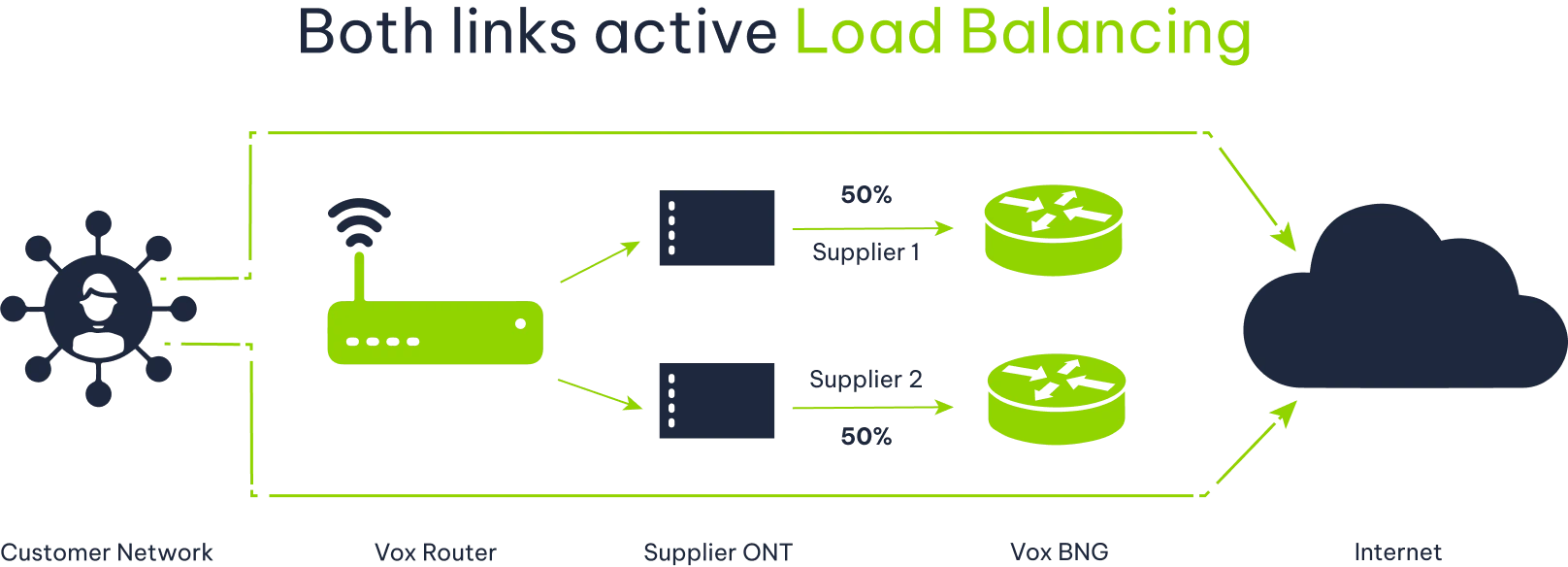
Traffic load-balances across both links - outbound sessions are split between Link A and Link B for maximum throughput and burstability.

Link B instantly absorbs all traffic - sessions stay alive, users see nothing. When Link A recovers, balance returns automatically.
Benefits
What you get with Vox Active-Active.

Business continuity, increased uptime
Two links on distinct networks drastically reduce downtime risk - a single fibre cut or fibre network issue can't take you offline

Bandwidth efficiencies & burstability
With both links active, you get more bandwidth at your disposal when both are up - not a backup that sits idle.
Cost efficiencies
No additional devices, no extra licences. The Active-Active failover runs on the included router - one bill, one supplier.
More value for your money
Both links carry traffic, so you don't pay for a service that sits unused. Every Rand of capacity is in production.

Peace of mind, seamless failover
If one link fails, the other continues carrying your traffic uninterrupted - provided you have enough capacity per link.

We do it all for you
Links, router, Active-Active setup and 24/7/365 support - all from Vox at one great price. No integration headaches.
Key features
What you get with Vox Active-Active.
Active-Active is purpose-built for broadband redundancy. Here's exactly where it shines, and where you'd reach for a different solution.

Outbound load-balancing
Traffic sessions originating from the customer side are balanced across both links for outbound throughput.
Dynamic DNS
Built-in Dynamic DNS keeps on-premises services reachable even when the public IP changes after a failover.
Use one link as a temporary line
If one link has a longer install time, the other is usable as soon as it's live - no waiting for both before going to production.
Broadband load-balancing
Supports broadband services from network operators using PPPoE - the standard FTTB connectivity model.

No Layer 7 application steering
The solution doesn't route per-application; it operates at lower layers of the OSI model.
No additional static public IPs
Best suited for cloud-based applications rather than on-premises hosting that requires fixed public addressing.
No customised traffic steering
Layer-3 rulesets based on 5-tuple forwarding aren't supported. For complex steering, look at SD-WAN.
Not suitable for site-to-site VPNs
Only client-initiated tunnels are supported, and tunnel traffic uses a single ISP link at a time.
Our fibre partners
We mix and match across SA's leading networks to give you two truly distinct links.
Active-Active works because we choose two operators that don't share infrastructure where it matters. Available combinations depend on coverage at your premises.















“Our partnership with Vox dates back over 10 years and we continue to deploy Vox solutions nationally. From inception Enyuka has found that Vox’s support has far exceeded our expectations. Faults or qu...
“Our partnership with Vox dates back over 10 years and we continue to deploy Vox solutions nationally. From inception Enyuka has found that Vox’s support has far exceeded our expectations. Faults or queries logged are dealt with professionally and timeously. We will remain a partner with Vox for many years to come.”

Frequently asked
Your questions, answered.
The questions our account managers field most often about Active-Active failover. Still stuck? Our SA-based business support team is one call away, 24/7/365.
Vox owns the end-to-end service — links, router, Active-Active configuration and 24/7/365 SA-based support. One supplier, one bill, one number to call.
Active-Active is best suited for cloud-based applications. The included Dynamic DNS keeps simple on-prem services reachable across a failover, but the solution doesn't include additional static public IPs.
Yes. If one of the links has a longer installation period, the other can be used as soon as it's installed — you won't be waiting for both to go live before going to production.
Only client-initiated tunnels are supported, and tunnel traffic uses a single ISP link at a time. For full site-to-site VPN with link diversity, we'd recommend our SD-WAN.
In most cases, no. The switchover happens at the router and is effectively instantaneous — existing sessions continue uninterrupted. Some long-lived single-session protocols may briefly pause, but typical web, email, voice and SaaS traffic is unaffected.
No — and that's intentional. We deliberately pick two distinct networks (or fibre + LTE / wireless) so a single FNO outage or fibre cut can't take both links down. Available combinations depend on which operators reach your premises.
No. The Active-Active failover runs on the single Vox-supplied router included in the service. There are no additional devices, no extra licences and no SD-WAN subscription required.
Active-Passive uses one link at a time — the second link sits idle and only takes over when the first fails. Active-Active uses both links simultaneously, balancing traffic for better throughput and burstability. If one fails, the other absorbs all traffic seamlessly.


