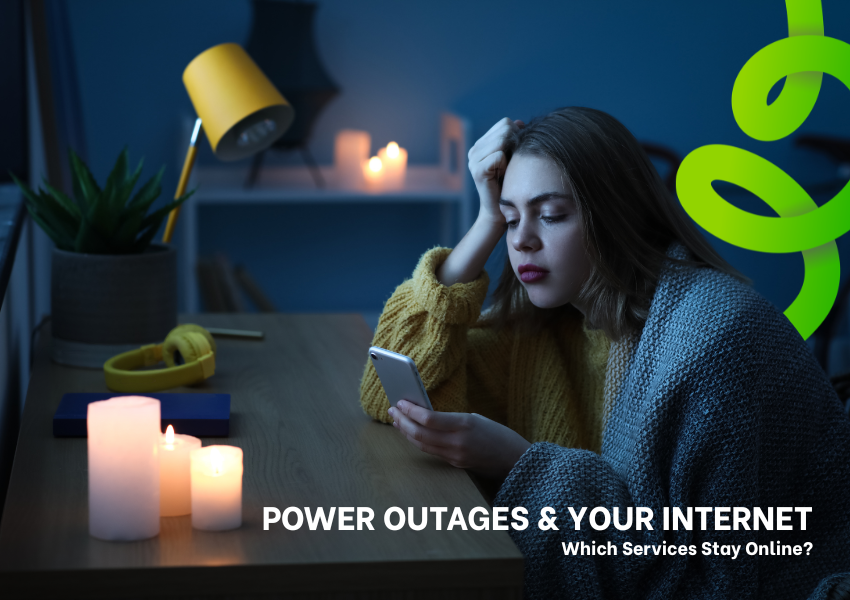
South Africans have developed a unique set of survival skills.
We can braai in hurricane-force winds. We can identify a taxi by sound alone. And thanks to years of load shedding, we can predict a power outage with greater accuracy than most weather forecasts.
The lights flicker. The kettle dies. Someone in the house immediately shouts, “Is the Wi-Fi working?”
Because let’s be honest. The power going out is annoying. The internet going out is a national emergency.
The problem is that not all ISP’s handle power outages the same way. Some keep going. Some fall over instantly. Some spend the next two hours pretending they’re connected while refusing to load a single WhatsApp image.
Let’s look at what actually happens…
Fibre Internet During a Power Outage
Fibre is often treated like the King of Kings. Fast. Reliable. Stable. But, when the power goes out, things get a little more complicated.
The good news is that the Fibre cable itself doesn’t need electricity running through it. The bad news is that just about everything connected to it does. Your ONT needs power. Your router needs power.
The equipment serving your area needs power. If any of those stop working, your internet is going nowhere. This is why some people proudly announce that their Fibre still works during power outages, while their neighbour across the road is staring into the void wondering why Netflix has abandoned them.
If you’ve got a UPS or inverter keeping your equipment alive, there’s a good chance your Fibre will stay online. Assuming the network infrastructure in your area is also running on backup power.
It’s a bit like owning a Ferrari. It’s fantastic, provided somebody remembered to put fuel in it.
LTE and 5G During a Power Outage
On paper, LTE and 5G seem like the obvious winners. No cables, no Fibre infrastructure, no problem. Except there’s one small issue.
The second the power goes out, every person within a five-kilometre radius has exactly the same idea. “Let me hotspot quickly.” Suddenly, the local tower is carrying the hopes, dreams, Netflix streams and TikTok addictions of an entire suburb.
Even if the tower stays online thanks to batteries and generators, congestion can become a problem.
You’ve probably experienced it before? Five bars of signal and speeds slower than a pension queue.
Your phone insists you’re connected, yet somehow a two-line WhatsApp message takes longer to send than a mail by pigeon.

Fixed Wireless and Vox Kiwi
This is where Vox Kiwi enters the chat.
Kiwi is a Fixed Wireless service that delivers a Fibre-like experience without requiring trenches, digging, construction teams or a six-week waiting period while someone promises to call you back “next week”. Instead, a small receiver is installed at your home and connects to Vox’s wireless network. Like Fibre, you’ll still need power for the equipment inside your home. A UPS or inverter can keep everything running during an outage.
The difference is that you’re not dependent on Fibre infrastructure reaching your street. No digging,
no trenching, and no wondering why the road outside your house has been under construction since the previous government.
Just fast, uncapped internet with rapid installation and no Fair Use Policy limits.
Satellite Internet

Then, there’s Satellite – the overachiever of the internet world.
Rather than relying on local infrastructure, it communicates with satellites orbiting hundreds of kilometres above the Earth (which is admittedly quite impressive; your internet is literally coming from space). The downside is that you’ll still need power for your equipment at home. A Satellite dish without electricity is basically just a very expensive garden ornament.
Satellite can be a fantastic solution in remote areas, but for most urban households, it’s usually not the first option people consider.
So, Which Internet Service Wins?
Unfortunately, there isn’t a magical internet technology that laughs in the face of power outages.
Every service relies on equipment that needs electricity somewhere along the chain.
The real secret isn’t choosing an internet service that never experiences outages. It’s making sure you have backup power for the equipment inside your home.
A decent UPS or inverter can often make the difference between continuing your Teams meeting and suddenly becoming “that guy” who mysteriously disappeared halfway through a presentation.
So if you’re serious about staying connected during power outages:
- Keep your router on backup power.
- Keep your ONT powered if you use Fibre.
- Have a mobile backup option available.
- Choose a provider with resilient infrastructure.
And if Fibre isn’t available in your area, or you’re tired of waiting for it to arrive, Vox Kiwi offers a Fibre-like alternative that gets you online quickly, without the digging, delays and disruption. Because when the lights go out, your internet shouldn’t immediately decide to join them.
About Author