
Balancing Various Voice and Telephony Choices: Microsoft vs non-Microsoft voice solutions compared on cost, security and speed. Get Vox’s guide to choosing between Teams Phone, 3CX and OmniOne PBX
When a business plans to modernise its communication systems by upgrading to Cloud Voice solutions, decision-makers can find themselves choosing between Microsoft versus non-Microsoft solutions. Making your choice should be guided by such factors as your company’s current infrastructure, growth strategy and collaboration needs. Both sides of the coin serve different needs and business environments and are able to offer significant benefits.
For local businesses that are evaluating Cloud Voice upgrades, Microsoft Teams Phone solutions – through Operator Connect and Direct Routing – excel in integrated ecosystems, offering seamless security and productivity gains for Microsoft 365-heavy organisations. However, non-Microsoft alternatives like 3CX or OmniOne PBX may provide better value for standalone setups or budget-focused needs.
This article explores when each option shines, also considering real-world outcomes with pragmatic total cost of ownership (TCO) criteria.
Comparing Microsoft vs Non-Microsoft Options
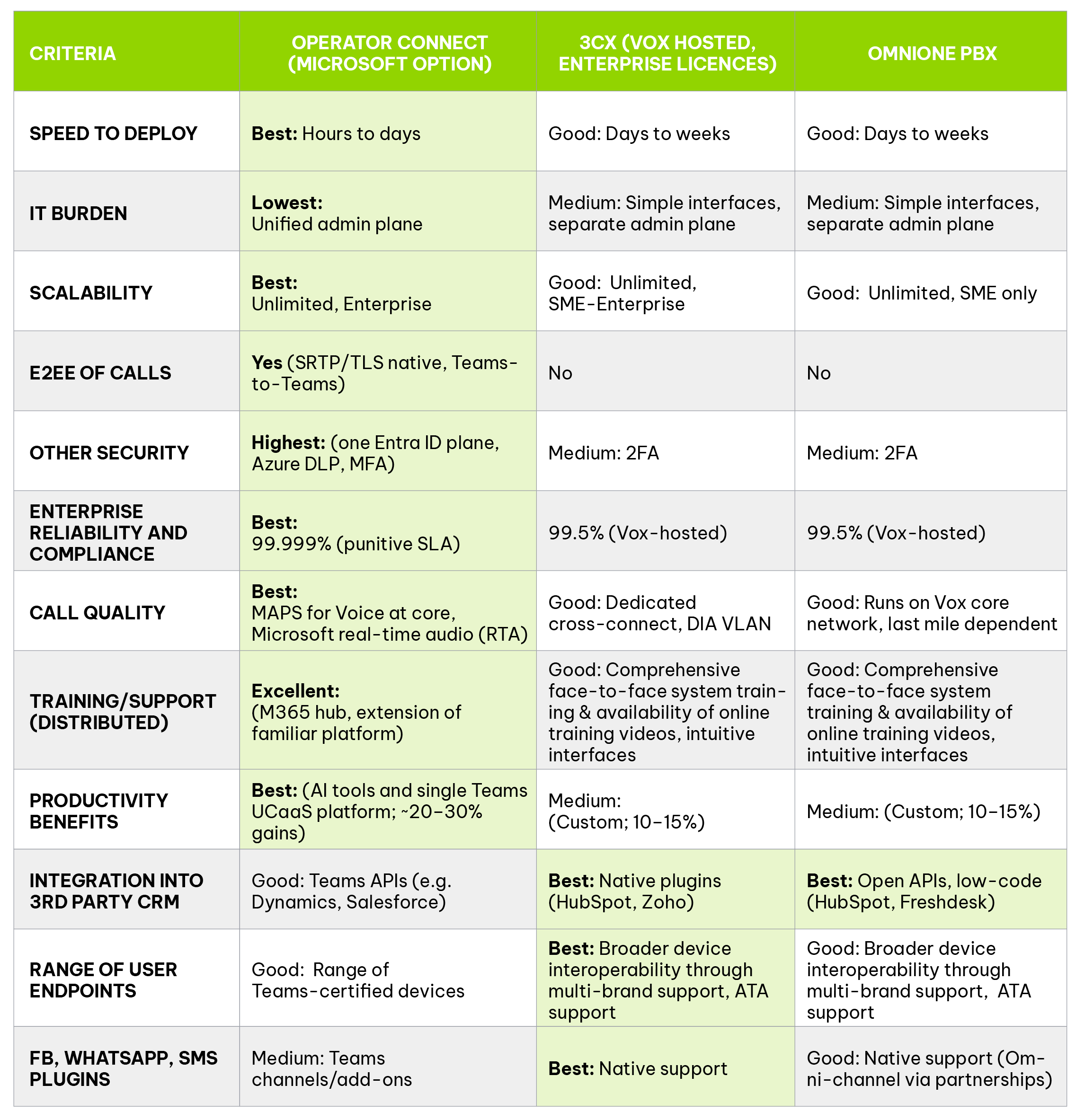
Licence costs alone don’t tell the story – it’s critical to focus on total cost of ownership (TCO), which also factors in other elements that are often ignored. To provide a balanced view, let’s compare core aspects across Microsoft Teams Phone – focusing on Operator Connect as the managed flagship – and two other Vox alternatives, namely 3CX and OmniOne PBX.
It’s important to note that, while Teams Phone licensing may seem premium, its TCO often undercuts alternatives by 20 to 40 percent through its accompanying reduced integration and admin costs – especially in regulated or distributed industries, and productivity gains from a natively integrated UCaaS platform.
When we look at specific business factors across the three alternative options, we find the following:
- Single User Access and Permissions: Microsoft uses Entra ID for granular, centralised control, such as Conditional Access and multi-factor authentication (MFA). This makes it seamless for M365 users but could otherwise be regarded as being ‘overkill’. In contrast, 3CX offers flexible and customisable role-based access control, but generally requires separate platform-level configuration, which can increase administrative efforts when environments scale.
- Ease of Training and Support in Distributed Environments: Microsoft’s intuitive Teams interface and 24/7 local support suit hybrid teams. 3CX and OmniOne PBX require bespoke training on a separate platform. And while Vox has invested in platform-specific training and enablement programmes to ensure consistent user adoption, these do operate outside the Microsoft interface, which may be less structured for distributed setups.
- Security Benefits: Operator Connect supports end-to-end encryption (E2EE) for 1-to-1 calls and integrates Microsoft Entra ID, DLP and Vox’s proactive fraud monitoring, which reduces breach risks in compliance-heavy sectors. 3CX and OmniOne PBX offer flexible security capabilities, but typically require additional configuration and governance effort to achieve comparable compliance outcomes, which can increase complexity and costs.
The consolidated table below sets out comparisons.
When a Microsoft Voice Solution is Preferable
Microsoft Teams Phone integrates PSTN/VoIP calling natively into the Teams platform, leveraging Entra ID for unified identity and governance. This makes it a strong fit when your organisation is already invested in Microsoft 365, as it prevents solution sprawl and operational overheads.
From Vox’s deployments and global patterns, here’s where Microsoft Teams Phone often out-performs non-Microsoft options:
- Integrated Ecosystems and Productivity: If Teams is your primary hub for collaboration, adding Voice keeps everything under one identity, policy set and analytics plane (Entra ID + Teams Admin Centre). This enables features like AI-powered call transcripts (via Copilot), bi-directional presence sync and seamless transitions from chat and video to calls – boosting efficiency by 20 to 30 percent in hybrid teams. Non-Microsoft PBXs (for example 3CX) can integrate with Microsoft Teams to enable calling and presence; however, some advanced capabilities – particularly Copilot-based insights, native policy management, and single-pane analytics – remain limited or external to the Microsoft ecosystem.
- Speed and Low-Risk Deployments: For businesses valuing fast rollouts over DIY control, Operator Connect eliminates Session Border Controllers (SBCs), with Vox handling interconnects via direct Azure peering. Time-to-service can be hours to days, which is ideal for 24/7 operations, new markets or seasonal staffing in SA’s dynamic economy. In contrast, standalone PBXs often require infrastructure provisioning, SBC configuration and number porting coordination, which can extend the deployment lead-times to days or weeks.
- Enterprise Reliability and Compliance: A 99.999 percent punitive SLA, proactive fraud monitoring and Vox’s 4.3 MOS-rated network provide the highest call quality experience available in South Africa. For Microsoft Teams Phone, shared escalation paths and accountability between Vox and Microsoft enhance support and operational resilience. Platforms like 3CX provide reliable enterprise telephony and are certified to interoperate with the Vox voice network, offering assurance of compatibility and performance. However, these solutions typically function under separate compliance and audit frameworks. This distinction is crucial where data residency and audit logs are non-negotiable, for example financial services firms report tighter compliance without add-ons.
Real outcomes from customers (anonymised from Vox case studies) reflect these Microsoft advantages, as follows:
- A Johannesburg financial institution reduced desk phone dependency by 90 percent, inheriting Entra ID’s MFA and retention policies for e-discovery.
- In the education sector, a distributed South African university achieved significant operational savings and fast multi-site rollouts with no downtime during cutover from its legacy system.
When looking at purchase decisions across different vertical sectors, the following industries tend to favour Microsoft solutions:
- Financial Services: Audited changes, business continuity and disaster recovery, and integrated channels (Voice/SMS/fax) align with compliance needs.
- Higher Education/Public Sector: Large populations benefit from budget-friendly scaling and unified admin.
- Retail/Hospitality/Franchises: High churn and thin IT resourcing favour no-SBC footprints and quick provisioning.
- Mobile/Field-Heavy Organisations (Utilities, Logistics, Healthcare): Collapses identities into one business number with Teams presence, suiting SA’s remote workforces.
Hybrid flexibility adds appeal: Mix Operator Connect for most users with Direct Routing for legacy sites, or Azure Communication Services for custom applications, to avoid all-or-nothing migrations.
When a Non-Microsoft Voice Solution Might Deliver Better Value
Not every scenario warrants Microsoft’s ecosystem. Standalone Cloud PBXs can be simpler and more cost-effective where the following conditions apply:
- Teams Isn’t Central: If your internal communications hub is Google, Zoom, Slack or another separate platform, integration costs may outweigh benefits. A more cost-efficient PBX like 3CX avoids Microsoft licensing entirely while also providing you with Unified Communication benefits.
- Deep Contact Centre Needs: Some outbound or customer experience Contact Centre as a Service (CCaaS) environments require more specialised call-flow control, agent performance and granular reporting, which come as a standard in PBXs like 3CX.
- Complex call routing requirements: For some organisations, the ability to design tailored call routing and sophisticated call flows – including conditional routing, skills-based distribution, time-of-day rules or multi-level queue logic – is a critical operational requirement rather than a nice-to-have.
- Heavy Analogue/DECT Integrations: Traditional PBXs often provide a better fit for complex estates, though Microsoft’s SIP Gateway handles the basics.
- Integration into CRM systems: When customer records and telephony are closely linked, seamless CRM and PBX integration become essential. Choosing a vendor with off-the-shelf integration capabilities for leading CRM platforms can deliver significant operational and customer experience benefits.
In these cases, non-Microsoft solutions shine for their flexibility and lower entry barriers, especially for smaller, non-Microsoft-centric firms.
Moving Forward
Microsoft Voice solutions aren’t always cheaper – they are safer and faster for M365-standardised organisations in multi-site, regulated or mobile workforce centric organisations, with TCO savings from lower operational costs and risks and productivity gains. If survivability, legacy equipment or non-Teams hubs dominate, hosted PBXs like 3CX and OmniOne PBX offer solid value.
One option could be to start with our low-cost 3CX or OmniOne PBX as your flexible entry (flat fees suit variable usage), then layer Microsoft Operator Connect integration for growth, without needing to rip-and-replace technology as your business scales.
As your advisor, Vox helps you to navigate your decision-making journey – book a TCO assessment at https://www.vox.co.za/microsoft-operator-connect.
About Author