
Your firewall has flagged something, while your email gateway and endpoint protection have each done the same. However, none of the protection systems are talking to each other. At the same time, your security team members don’t have enough available hours to piece the realisation of three separate alerts into one attack.
This is the reality for many South African businesses today: security tools that work brilliantly on their own, but not very well together. In response, this is the gap that Sophos Extended Detection and Response (XDR) was designed to close for clients that have their own security operations centre (SOC), because modern attacks don’t sit in one tool, but instead move quickly from email to endpoint, from cloud to identity. Siloed alerts miss the bigger picture, but in response, XDR connects the dots.
For example, a ransomware attack typically starts with a phished credential, moves laterally through a server, and only reveals itself as ransomware once it’s already deep inside the network.
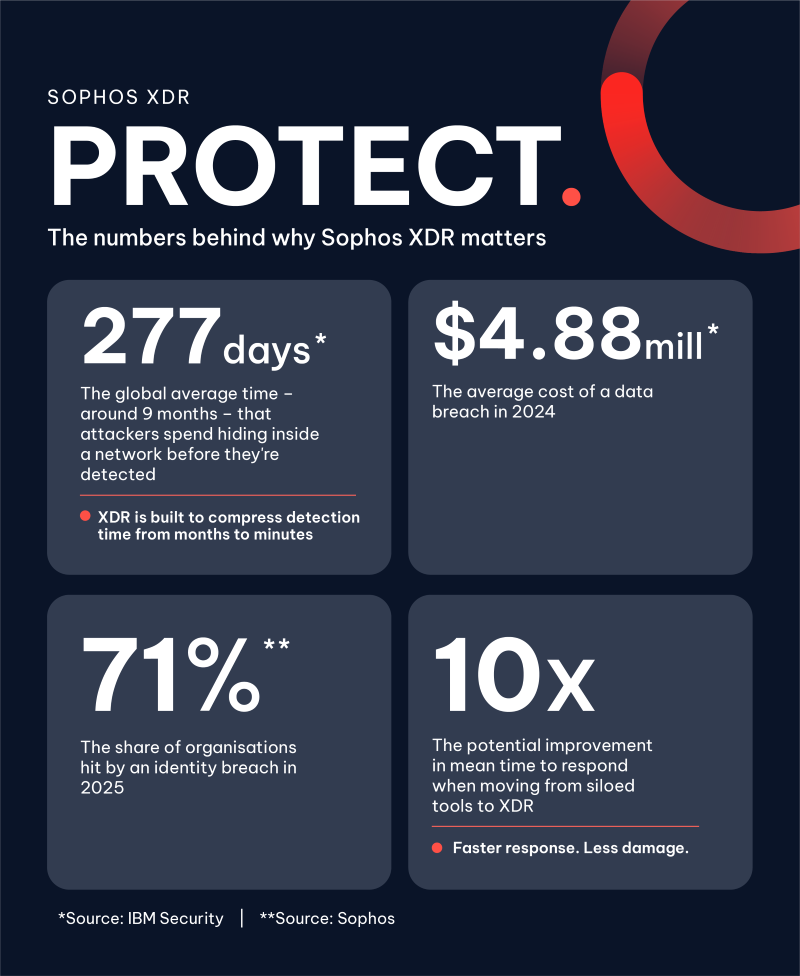
When we have security tools that only see their own slice of that journey – for example, the email gateway sees the phishing email, the server logs show the lateral movement and the endpoint sees the encryption – we find that each tool can potentially miss that they’re looking at the same attack.
XDR is built to see the whole path, not just the footprints left behind in any one tool.
What Does XDR Actually Mean?
Where traditional endpoint detection and response (EDR) keeps watch over individual devices, including laptops, servers and mobiles, XDR broadens the picture considerably.
It pulls telemetry from endpoint, firewall, email, cloud and identity systems into a single platform, correlates it automatically, and gives your security team one unified view of what’s actually happening across the business, instead of five separate consoles each showing a different slice of the picture.
In practice, that means a suspicious email, an unusual firewall event and an odd login attempt, which are three things that would normally sit in three different tools, triggering three different alerts, will get assigned together into a single incident, with the full attack path visible from the start.
How XDR Works

Sophos XDR goes beyond endpoint detection by integrating data from multiple sources to provide a broader and more accurate view of threats. Underpinning it is a five-stage process that runs continuously, day and night:
- Collect: Real-time telemetry is gathered from every protected surface, including endpoints, firewalls, email, cloud and servers.
- Correlate: Sophos Central automatically joins together related events into a single incident, rather than leaving your team to connect the dots manually.
- Analyse: Deep-learning AI, trained on hundreds of millions of malware samples, scores each incident by its likely impact.
- Investigate: Threat hunters can access the full incident timeline through the Sophos Threat Analysis Centre, with nothing left to reconstruct after the fact.
- Respond: Automated playbooks isolate hosts, terminate malicious processes and revoke compromised sessions, often before a human ever needs to step in.
Sophos XDR also uses synchronised security, so your tools actively work together rather than simply reporting to the same dashboard. For example, a firewall detecting a threat can automatically quarantine the matching endpoint.
Built-in CryptoGuard technology detects unauthorised file encryption in real time and can automatically roll it back, which is critically important in the event of a live ransomware attempt.
The Business Benefits of XDR
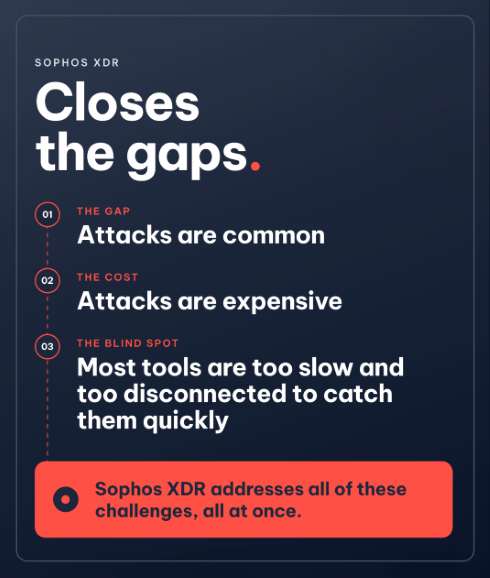
The business case for XDR is multi-faceted and includes the following scenarios, depending on your organisation’s particular situation:
- Your company has a security team: XDR acts as a force-multiplier, cutting the time your analysts spend triaging alerts so they can focus on genuine incidents instead of noise.
- Compliance issues are mandatory: XDR keeps 30 days of forensic retention plus full incident timelines, supporting POPIA, PCI-DSS and ISO 27001 reporting requirements.
In short, XDR turns technical visibility into a business outcome, with less time spent chasing alerts, faster containment when something does go wrong, and a much stronger position when a regulator, insurer or internal customer asks how a breach was handled.
See the whole attack, not just one alert
Sophos is a recognised leader in endpoint and network security and has been named a Leader in the 2026 Gartner Magic Quadrant for Endpoint Protection Platforms for the 17th consecutive year, as well as a 2026 Gartner Peer Insights Customers’ Choice.
Vox is an accredited Sophos Platinum Partner with over 200 certifications across the Sophos product stack. We offer local, South African-based deployment, tuning and support with business-focused service levels.
Talk to your Vox Business account manager for a tailored quote and a recommended rollout that matches your existing security stack.
Contact: (JHB) +27 (0) 87 805 0500, or email: info@voxtelecom.co.za
Frequently Asked Questions
What is Sophos XDR?
Sophos Extended Detection and Response (XDR) collects security data from your endpoints, firewalls, email, cloud and identity systems in one platform. It automatically links related events into a single incident, so your security team sees the whole attack path in one view instead of separate alerts across several consoles.
What is the difference between EDR and XDR?
Endpoint detection and response (EDR) monitors individual devices such as laptops, servers and mobiles. XDR adds firewall, email, cloud and identity data. A suspicious email, an unusual firewall event and an odd login attempt would normally trigger three separate alerts. XDR groups them into one incident.
How does Sophos XDR work?
It runs a continuous five-stage process:
- Collect: Gathers real-time telemetry from every protected surface.
- Correlate: Joins related events into one incident.
- Analyse: Deep-learning AI scores each incident by its likely impact.
- Investigate: Threat hunters get the full incident timeline.
- Respond: Automated playbooks isolate hosts, stop malicious processes and revoke compromised sessions, often before a person needs to step in.
How does Vox provide support for Sophos XDR in South Africa?
Vox is an accredited Sophos Platinum Partner with more than 200 certifications across the Sophos product stack. Vox provides deployment, tuning and support from within South Africa, with business-focused service levels. For a tailored quote and a rollout plan that fits your existing security stack, contact your Vox Business account manager on +27 (0) 87 805 0500 or at info@voxtelecom.co.za.
About Author