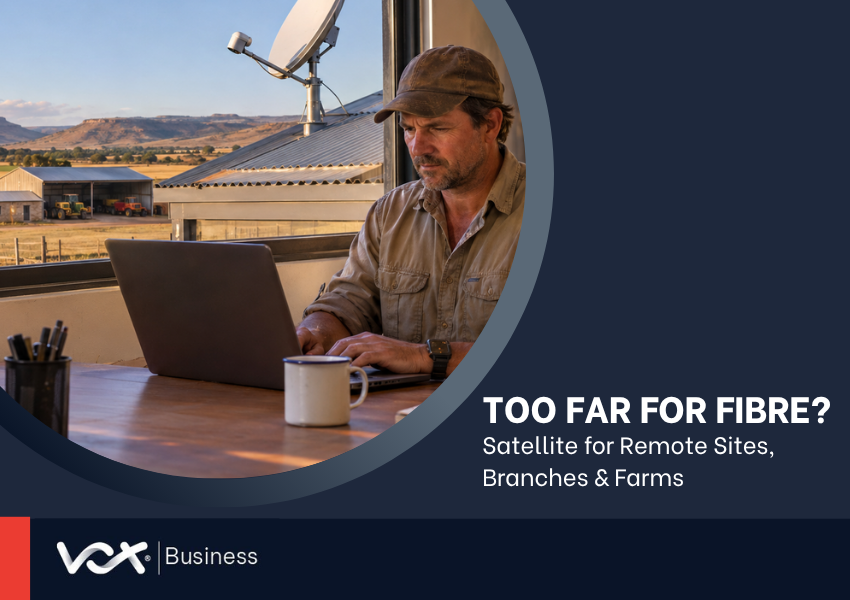
Your farm has irrigation controls, security cameras, cloud software and a card machine. Satellite? Hmm.
Your internet connection is one bar of signal next to the storeroom window. Fantastic.
At least someone gets to spend the day standing very still with a phone held above their head. But when the business depends on those systems, “try moving closer to the window” is not much of a connectivity plan.
The Question: What Happens When Fibre Can’t Reach You?
It’s called Satellite. And it services everything from the dorpie to the pandokkie.
Satellite internet can connect sites that are too far from Fibre and poorly served by mobile networks. Farms, lodges, mines, construction sites and remote branches can get online without waiting for a cable to arrive or a cell tower to remember they exist.
How does it work?
Your site sends data to a Satellite network, which passes it back to a ground station and on to the internet. The bit that matters is how far away those Satellites are.
Traditional geostationary satellites orbit a long way from Earth. Data has a long trip to make, which can mean noticeable delay. That’s not ideal when you’re on a video call and everyone is waiting for the sentence you finished saying six seconds ago.
Low Earth Orbit (LEO) satellites orbit closer to Earth, so the trip is shorter and the connection can feel more responsive. Vox’s managed LEO service uses the Eutelsat-OneWeb constellation through Q-KON. It offers latency under 70 milliseconds and speeds up to 100 Mbps per terminal, depending on the service and site.
That makes it a real option for day-to-day business use. Not just the internet equivalent of a flare gun for when everything else has failed.
What can my farm use it for?
A farm might use Satellite connectivity for irrigation, livestock monitoring, security and cloud-based systems. A lodge needs bookings, payments and guest Wi-Fi to work. A branch needs staff, phones and point-of-sale systems connected to the rest of the business.
Then there are temporary construction sites, renewable energy projects and operations spread across several locations. If people and systems need to report back to head office, they need a connection that does more than occasionally wave hello.
Does it work with the rest of your business network?
It can. Satellite does not have to become a lonely little internet island at the edge of the map.
A managed service can connect remote sites to a wider business network using technologies such as VPN and SD-WAN. That can help staff reach shared systems, keep voice services connected and give the business a more consistent way to manage its branches.
The point is to connect the site properly, not just get a signal and hope for the best. Because “the Wi-Fi works in the manager’s office” and “the branch is connected” are not always the same thing.
Is it right for every site?
No.
Definitively, emphatically no.
If Fibre is available and works for your site, that’s usually the first thing to look at. Satellite is useful when the geography is awkward, mobile coverage is unreliable or you need another way to keep a remote site connected.
There are practical details to sort out. The Satellite terminal needs a suitable place to be installed and it needs power. If the site is off-grid, or load shedding likes to make an appearance, you’ll need to plan for a UPS or solar supply. Weather can affect satellite services too, so the provider should assess the site and what you need the connection to do.
And think about what happens if the site goes offline. If payments stop, systems disappear and the nearest reliable signal is a drive away, it may be time to look at your options.
Get Connected wherever you are:
Satellite internet can bring farms, branches and operational sites online when fibre and mobile networks don’t reach. That means fewer staff members hunting for signal and more of them getting on with the actual job.
Vox can help assess Satellite connectivity for your remote sites and how it could fit into your wider business network. Your staff have enough to do without doubling as a mobile tower.
About Author