What Does “Internet Speed” Actually Mean?
Internet speed is typically measured in Megabits per second (Mbps) and it covers two directions: download speed (how fast the data comes to you) and upload speed (how fast you send data out).
Most home internet packages lead with their download speed, since that’s what handles streaming, browsing and gaming. Upload speed matters more for video calls, cloud backups and sending large files. When people ask “how many Mbps do I need?” they’re usually thinking about download speed — but keep upload in mind too.
When Faster Internet Speeds Make a Real Difference
Here are the situations where a higher Mbps genuinely improves your experience:
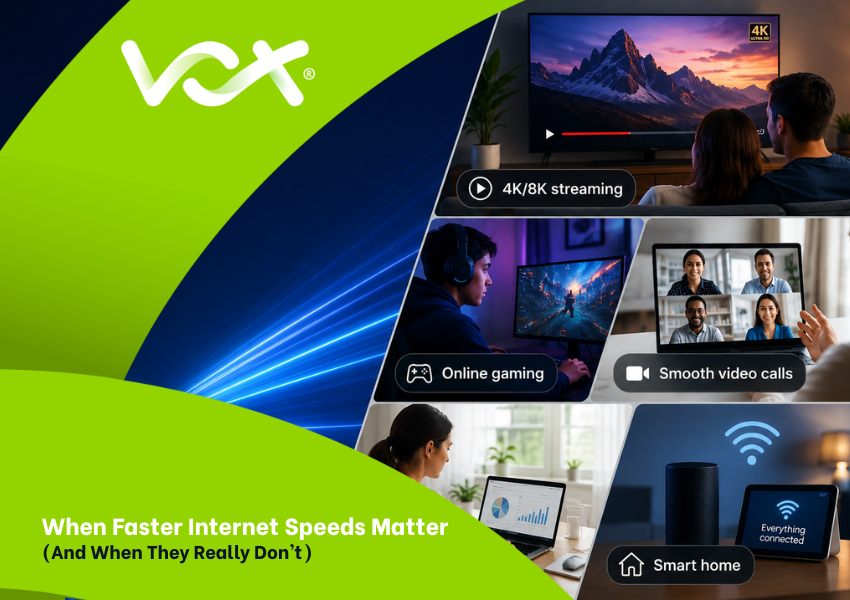
1. You Stream in 4K — or on Multiple Screens at Once
Streaming a single HD video uses roughly 5 Mbps. But 4K streaming on Netflix, Showmax or YouTube bumps that up to 15–25 Mbps per screen. If you’ve got two or three people all streaming simultaneously, your connection needs to handle all of that at once.
A household of four, all streaming in 4K at the same time, could need 60–100 Mbps just for video alone. This is a scenario where faster internet speeds make an obvious, immediate difference.
2. You’re an Online Gamer
Here’s a surprise: gaming itself doesn’t actually use much bandwidth — online multiplayer typically requires only 3–25 Mbps. What matters more for gaming is latency (also called ping), not raw speed.
That said, where internet speed does matter for gamers is when downloading large game files. A new release or update can easily be 50–100 GB. On a slow connection, that’s hours of waiting. On a fast Fibre line, you’re downloading in minutes.

3. You Work From Home
Remote work relies heavily on stable, fast internet, especially for video conferencing. A Zoom or Microsoft Teams call uses around 1.5–3 Mbps per direction, but the experience degrades noticeably on a congested connection.
If you’re regularly on video calls, collaborating on large documents in the cloud, or accessing company systems remotely, faster speeds (combined with good latency and a stable connection) will make your working day much smoother. Vox’s Fibre packages are built with symmetric upload and download speeds, which is exactly what home office users need.
4. Your Household Has Lots of Connected Devices
Every device connected to your Wi-Fi is drawing from your total bandwidth, including smartphones, laptops, smart TVs, tablets, smart speakers and security cameras. Even when you’re not actively using them, many devices run background updates and syncs.
A household with 8–10 connected devices can comfortably strain a 20 Mbps connection, even with moderate usage. This is the “multiple device” scenario where upgrading your internet speed makes a noticeable difference to everyone in the home.

5. You Regularly Upload Large Files
Photographers, videographers, content creators and anyone backing up to the cloud knows the pain of slow upload speeds. If you’re regularly uploading large files — raw photos, video footage, presentation decks — a plan with strong upload speeds will save you hours of waiting.
When Extra Speed Probably Won’t Change Much
Faster isn’t always better — and it’s certainly not always necessary. Here are the situations where your current speed is probably just fine:
1. You Mostly Browse and Scroll Social Media
Browsing websites, scrolling Instagram or TikTok, or reading the news uses very little bandwidth — typically less than 5 Mbps. Even on an older, slower connection, pages and feeds load near-instantly. Upgrading from 20 Mbps to 100 Mbps won’t change this experience at all.

2. You Only Stream on One Screen at a Time
If there’s one person in the house and one screen streaming Netflix in HD, 10–15 Mbps is all you need. Going faster won’t make the picture sharper or the experience better — you’ll simply be paying for unused capacity.
3. You’re Using One or Two Devices
A single person working on a laptop or a couple with two devices rarely puts significant strain on a connection. Unless those devices are doing data-intensive tasks simultaneously, a mid-range plan will serve you perfectly well.
4. You Send Emails and Use Messaging Apps
Email, WhatsApp, Slack and similar tools use an almost negligible amount of bandwidth. Even at 5 Mbps, messages and emails fly through instantly. Faster internet speeds deliver zero benefit here.
So, What Internet Speed Do You Actually Need?
Use this quick guide to find the right speed range for your household:
| Speed Tier | Best For | What You Can Do |
| 10–20 Mbps | Light users / single device | Browsing, email, SD streaming, messaging |
| 25–50 Mbps | Small households (1–2 people) | HD streaming, video calls, light gaming |
| 50–100 Mbps | Average family (3–4 people) | 4K streaming on 1–2 screens, remote work, gaming |
| 100–200 Mbps | Busy households / power users | Multiple 4K streams, gaming, large uploads, 5+ devices |
| 200 Mbps+ | Heavy users / home offices | Everything — future-proof for growing households |
Keep in mind: these are approximate benchmarks. If everyone in your household tends to be online at the same time, or you stream in 4K on multiple TVs, lean towards the higher end.
Find the Right Speed With Vox
Vox offers a range of Fibre and LTE packages designed for different household needs — from light users who just need reliable basics, to power households that demand the fastest speeds available.
The best internet speed isn’t the fastest one — it’s the one that matches how your household actually uses the internet. Vox’s team can help you figure out exactly which package fits your lifestyle, without paying for speed you’ll never use.
| 🔥 Ready to find your perfect plan? Browse Vox Fibre and home internet packages at vox.co.za and get connected with the speed you actually need. |
Frequently Asked Questions
Is 50 Mbps fast enough for a family of four?
Yes, in most cases. A 50 Mbps connection can comfortably handle HD streaming on two or three screens, video calls and normal browsing simultaneously. If your family regularly streams in 4K on multiple TVs and has many devices connected, consider upgrading to 100 Mbps or more.
Does internet speed affect video calls?
Yes, though the impact is mainly felt at lower speeds. Video calls on Zoom, Teams or Google Meet require around 1.5–3 Mbps per direction. More important than raw speed, however, is a stable connection with low latency. A Fibre line with consistent speeds will always outperform an unstable connection with higher headline speeds.
What’s the difference between download and upload speed?
Download speed is how fast data comes to your device — this affects streaming, browsing and gaming. Upload speed is how fast you send data out — this affects video calls, cloud backups and file uploads. Many home internet packages offer much higher download than upload speeds; Vox fibre packages include symmetrical speeds, giving you the same performance in both directions.
Will faster internet fix buffering?
Sometimes — but not always. Buffering can be caused by slow speeds, but it can also be caused by network congestion, poor Wi-Fi signal, or issues with the streaming platform itself. If you’re already on a 50 Mbps+ connection and still buffering, the problem is likely elsewhere. Check your Wi-Fi router placement and try a wired connection to diagnose the issue.
How do I know what speed I’m currently getting?
Run a free speed test at speedtest.net or fast.com. Test at different times of day (peak evening hours vs early morning) to get an accurate picture of your real-world performance. If your results are consistently well below your package speed, contact your ISP.
The Bottom Line
Faster internet speeds genuinely matter when you’re streaming in 4K, working from home, gaming, or juggling a house full of devices. But if your household is made up of light users — browsing, messaging and the occasional Netflix session — upgrading your speed may not change your experience at all.
The smart move is to understand your household’s actual usage, then match your plan to that reality. Vox makes it easy to find a Fibre or LTE package that fits — whether you need the basics done reliably or you want the fastest speeds South Africa’s fibre network can deliver.
| Explore Vox home internet packages Visit vox.co.za or call us to find the right speed for your home. No jargon, no overselling — just the connection you need. |
About Author