Meet our Experts: Spotlight on Kathleen Morris
At Vox, we value, support and actively engage people with the levels of expertise that we require to keep us moving forward as a company. In this edition of ‘Meet our Experts’, we find out more about Kathleen Morris, who works in the Wireless Department as the Vox Satellite Product Manager. She has a deep understanding of how Satellite internet has evolved from GEO to modern LEO services; what this means for rural South Africa; and why Satellite is back on the connectivity map.
Kathleen has been involved in steering Vox’s Satellite offerings for roughly a decade, and interestingly, she is one of just a few women locally in an otherwise largely male domain. “I don’t know of any other woman in South Africa who deals with Satellite from a technology perspective. People usually think I am the PA when they first encounter me!” she smiles.
Nothing could be further from the truth: Kathleen has a deep technical understanding of Satellite technology, and she is passionate about using it to connect people in a practical way. She explains: “As the person who makes sure that everyone understands ‘internet from space’, I try to ensure that people can connect even where cables can’t.”

It’s a simple way of describing a complicated business, but it’s the foundation of why Satellite matters, especially in a country as varied, geographically and infrastructurally, as South Africa. We find out more about Kathleen’s passion for Satellite technology and what she likes to do in her time away from work.
A Deep Understanding of the Ever-Changing Satellite Story
In the same way that clothing styles come and go, so Satellite technology has also been in and out of fashion in recent years. Kathleen recalls: “In the early 2010s, Satellite had an amazing uptake – when it first launched at scale in South Africa, people queued for it! In fact, when Satellite launched in 2011, we had over 15,000 customers.”
Then, however, Fibre connectivity came along, from around 2014 in South Africa, and this began to change the consumer experience because of its exceptional speeds and lower latency (the time that it takes for data to travel from a source to a destination). Satellite became more of a failover solution for locations that fixed infrastructure didn’t reach.
Kathleen clarifies: “This trend continued even more after we launched Wireless solutions, and certainly it’s true that Fibre connectivity generally provides the fastest connectivity speeds with the lowest latency. However, what is interesting is how quickly this situation is now shifting – advances in Satellite technology have accelerated in the past decade.
“We’ve moved from big Geostationary (GEO) Satellites orbiting the Earth 35,000 kilometres away to a new generation of Low‑Earth Orbit (LEO) constellations at much lower altitudes. With GEO Satellites, the data has to travel 70,000 kilometres during its round trip! With today’s LEO Satellites, the distance is significantly less, meaning the latency is significantly lower.”
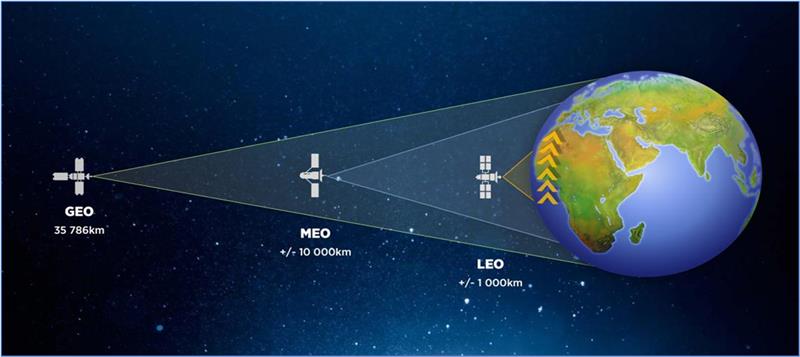
This change has brought a few significant consequences, specifically including lower latency, more competitive speeds and a product that can compete more directly with terrestrial broadband in certain scenarios.
“In a nutshell, Leo Satellites have changed the overall connectivity landscape once again, in a truly exciting way!” says Kathleen. “It’s basically gone from dial-up-type speed to Fibre-like speeds from space. At the same time, Satellite won’t replace Fibre options in large metro areas such as Cape Town, Durban and Joburg, but then it was never meant to. It fills the gaps that matter most.”
Kathleen states that rural and remote communities are potentially the first winners: “This includes remote farms and schools, medical clinics, police stations, and remote businesses and industry operations. We still have multiple remote schools without connectivity, and being able to change this will empower teachers and learners alike.
“Satellite brings these customers everyday usability, because the new generation of Satellite can handle video calls, streaming and remote work in a way the old technology simply couldn’t. It’s exciting because more competition will bring more choices, and new players entering the market will mean pricing pressure and better deals over time.”
Vox’s Satellite Pathway: from KA‑Band to Business LEO
Vox has been involved in Satellite for long enough to see those shifts first‑hand. Kathleen says: “Vox was on board early with KA‑Band services in South Africa – a technology generation that made Satellite far more usable for everyday internet tasks. Vox was, in fact, the first company to launch KA‑Band Satellite in South Africa, as well as the first to offer Voice solutions over KA Band Satellite.
“More recently, we have moved into newer Satellite products with the launch of Business LEO Satellites. This product is positioned for business customers and it showcases how Satellite can be adapted for different market needs.”

Kathleen is excited about future possibilities: “Satellite is going to become a focused product again, not relegated to the margins, and this is an important shift for me – seeing Satellite becoming increasingly part of the mainstream conversation about connectivity, and no longer simply the default option when nothing else is possible.
“It’s about thoughtful implementation, sensible pricing and a people‑centred approach to product development. The technology is moving fast enough so that the conversation is already different from ten years ago, and this change creates opportunities for providers – always including Vox, of course! – who are ready to adapt,” she says.
Part of what makes Vox’s Satellite offering resilient is the people behind it. “Satellite is my niche, and what I love doing – I am fortunate to work within a tight, close-knit team. I always enjoy Monday mornings when I start the day and a new week with a meeting with my colleagues, to catch up and continue moving forward. At Vox, we are not just colleagues. We are family.”
Combining Technology and History
Kathleen’s journey to Satellite product management has travelled a road with some interesting twists and turns. Today, she balances her fascination with both the future and the past, while continuing to manage her job and her family in the present.
Kathleen started at Vox in 2008 as a call operator, after she had popped into the Vox Service Centre early one evening to drop off supper for her two older brothers, who were both working there. Possibly struck by her pleasant ‘can-do attitude’ and bubbly personality, the then-manager of the service centre decided to offer her an interview, and Kathleen started at Vox two weeks later, where she found herself working for the same company as her brothers – something which they all appreciated.

She stayed for a couple of years and found herself going wherever she was needed, moving round regularly within different departments. “But it wasn’t chaos,” she laughs, “rather, it was an education. Every role taught me something new, and I absorbed it all!”
Fate then took a hand when family commitments found her moving to Botswana for a while. Here she studied for a period before going back into the IT arena, and then later back home to South Africa, around 2015.
“I found myself studying criminology and forensic science in Botswana purely to meet work permit requirements,” she smiles, “and I then moved back into IT while I was still there, before returning to South Africa. I was back at Vox within a year, this time reporting to Jacques Visser and then later Theo van Zyl, the line managers I credit with giving me both the independence and the trust to truly grow.”
In November 2016, Kathleen took on the role of Satellite Product Manager, a position she has now held for nearly a decade.
“In my downtime, I’m fascinated by history and war studies. I’m especially interested in World War Two,” she says, noting that an understanding of why societies change can help people to design systems that last.
And so by day she worries about constellation architectures, latency and product packaging. By night she reads about the past: “I’m reminded that technology sits within history. Every era has its cutting edge, and every new tool is part of a longer human story.”
Her mix of legal training, curiosity and a comfortableness with technical detail all works in her favour as she engages with Satellite product development at Vox.
Keeping Things Tidy and Juggling Family Moments

Kathleen also met her husband, Marcel, while working at Vox, and today they share three daughters, Gizelle, her eldest, and her twins Reece and Mackenzie. Raising twins, she says cheerfully, was generally easier than she had expected. ”

She’s also close to her two brothers, younger sister and their partners, as well as her parents, who have been married for over 45 years. Both at work and at home, Kathleen is organised to the point where it’s now part of her brand: “My processes at work are tidy, and at home I apply the same discipline. I am very, very, very, very, very organised – you have no idea!” she laughs.
Something else that has become part of her personal brand is the way that Kathleen rarely lets her hair loose and is famously always seen around the office with it tied back, a habit that began in childhood and stuck. Her colleagues at Vox have almost never seen it worn loose, which Kathleen attributes to her late grandmother’s legacy.
“My grandmother ran a tight ship when my siblings and I were small. She was a hairdresser, with a very firm view that hair should never fall in a child’s face, and she had the scissors to enforce it. At one stage my mom said, ‘This needs to stop!’” Kathleen recalls, laughing.
As an adult whose hair was finally allowed to grow, her hair has always been in an updo at the office: almost every single day, so that today it’s become another part of her personal brand.
[Editor’s Note: Perhaps her skilled and sometimes-intricate up-styles are a sign that Kathleen has inherited some of her grandmother’s hairdressing skills?]
When she thinks about what she’d still like to achieve, Kathleen points to the bigger picture, in which, she says, more than 3,000 schools in South Africa still lack reliable internet connectivity.
“In a country where satellite could be the most practical and affordable solution for remote and underserved communities, I see an opportunity for genuine upliftment that goes well beyond commercial targets. I would just like to get everyone connected,” she says.

“Connecting schools, supporting rural health facilities and making Satellite more affordable for everyday households are concrete, measurable goals. I would also like to emphasise the flexibility of all Vox’s connectivity options. Within this context, Satellite must be positioned as part of a broader connectivity mix, not an either/or choice. In short, we need to embrace Satellite to fit into South Africa’s evolving digital landscape,” she concludes.
About Author