Parental Controls vs Internet Policing: Finding the Balance That Works For You
Kids, meet the Internet.
What could possibly go wrong?
Who would’ve thought that allowing underaged minors without fully developed frontal lobes access to a world of strangers, dangers, and content would one day have repercussions? Back in the day, our dads worried about us reading the wrong magazine or watching anything above PG13. Now? Five minutes on Twitter is enough to make a sailor blush.
The saying goes: we used to warn our kids not to jump in a stranger’s car or trust the Internet. Now, we use the Internet to pay a stranger to drive us places.
Any parent post 2010 knows the struggle. One minute, the toddlers are watching their assessed, filtered, and approved favourite show. The next, Blippi is screaming like an ape, or YouTube has auto played yet another toy review/challenge/prank vid that makes you question reality.
So, yeah, parental controls kind of matter.
There’s a fine line, however. How do we differentiate between protecting our child online and turning the house into tech-Alcatraz? Do we try (and fail) to shield them from everything, or just let the chips fall where they may and regret it later?
Seems like a lose-lose. Which is why we’re here to speak about it.
Let’s Clear the Air: Parental Controls are NOT your Enemy
Far from it, in fact.
Maybe we’re hard-wired from our own parents cutting off our MXit supply, or their repeated warnings of Y2K. But some of us seem to believe that parental controls = Lucifer, when the reality is far from the truth.
Today’s systems are advanced. Not only can you manage WHAT your kids access, you can also impact WHEN they go online, HOW much time they spend on a screen, and WHERE they happen to visit.
This isn’t about control but taking the necessary precautions. Prevention, cure, you know the saying.
When used properly, you can block adult content, limit app usage, reduce screen-time arguments, and keep young ones away from things they’re just not ready for.
And no, you’re not being strict. You’re just being a parent.
That Being Said, You Are Not The Hawks
The problem starts when every click becomes a deep dive and investigation.
If your child, or any child for that matter, feels watched all the time, they may become sneakier rather than safer. Kids learn fast (sometimes too fast). Block something? They’ll ask a friend. Ban an app? They’ll move to another. Confiscate the phone? The house PC is suddenly really interesting to them.
The goal shouldn’t be controlling every second.
The goal should be teaching them how to use the Internet responsibly.
Let’s Strike a Balance:

We use a simple formula:
Rules + Trust + Conversations + Honesty
Set clear boundaries. Reinforce where needed. Keep communication open, transparent, and free of judgement.
Children are naturally curious. Let’s remove the shame and guilt and allow them to feel safe talking about the very real struggles they face (if not with you, they’ll look for it elsewhere). Bad parenting is brushing things under the rug or pretending they don’t exist. Good parenting? Having open conversations about topics like certain websites, games, and apps. Explain the danger. Unpack the reality. “Because I said so” didn’t work 20 years ago – it definitely won’t now.
Children need to understand situations, not fear punishment.
What Can You Control?
Start with the basics and keep them non-negotiable:
- Age restrict certain devices, apps, and websites
- Decide on your screen-time limits
- Block any harmful or adult content
- NO DEVICES AT NIGHT
- Assess all privacy settings on games and social apps
- Educate them about sharing too much information online.
The goal isn’t to periodically check their phone and chats. This can breach trust, and just lead to more sneaky behaviour. You can, however, keep a watchful eye from a distance. And don’t forget multi-player games with chat features – many risks aren’t in the actual device, but the strangers who have access to their username.
What Can’t You Control?
Simply put; you cannot control every device they touch.
They’ll just use a friend’s phone, watch something at their cousins’ house, overhear something at school or search out of curiosity.
Conversation matters more than setting.
Parental controls are useful, yes, but not a substitute for actual parenting.
The Internet Needs to be a Shared Space
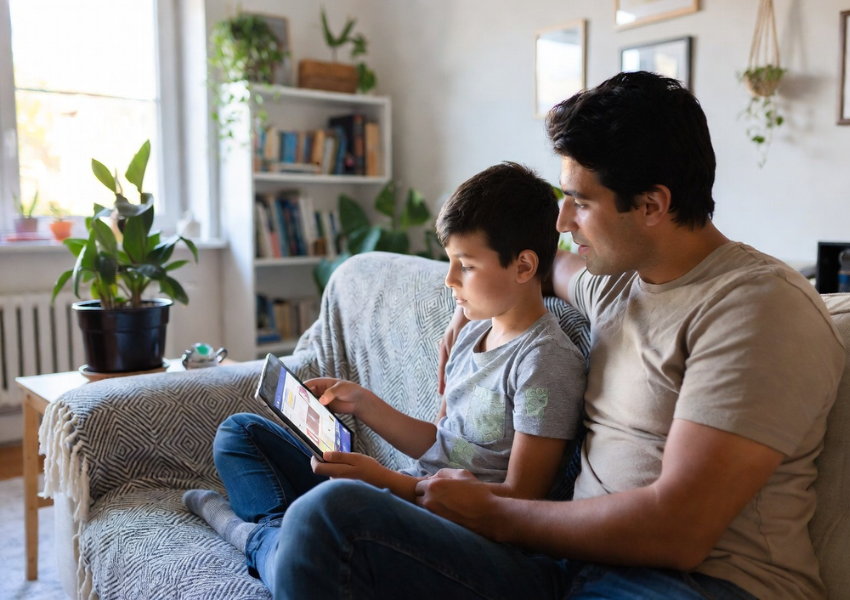
Particularly for younger kids.
Keep screens in common areas and watch them occasionally. Ask questions. Engage. Show genuine interest without making it an interrogation. Some parents game with their kids. Others enjoy their favourite show together (we’re personally quite partial to a good Bluey).
We’re not our parents’ generation anymore, ladies and gents. We listen, we treat our kids as humans, and we are actively present at all times.
As your kid gets older, they can earn more freedom when they prove they can handle it. And therein lies the balance – more responsibility = more trust.
It’s daunting, we know. But you don’t need to be the internet police – you need to be a guide, advisor, confidante and mentor.
Use controls to enforce safe boundaries, but don’t rely on them to do all the work for you. Smart settings, clear rules, regular conversation, and a sprinkle of trust is all it takes. Fact is, the Internet isn’t going away, so why try to hide it forever?
We prefer empowering them so that they can handle it properly.
But that’s just our two cents.
About Author