































Is your business connected in the right way?
E-commerce is well and truly established in South Africa, with the country’s online retail turnover expected to surpass R130 billion by the end of the 2025 financial year. Online retail shopping is also expected to make up almost 10 percent of the country’s total retail market.
This is according to a recent report by World Wide Worx, a leading local technology research and strategy organisation. It’s a long way from 2020, when World Wide Worx reported previously that local online retail was valued at around R30,200 billion – a significantly less amount than today (around R100,000 billion, to be exact).
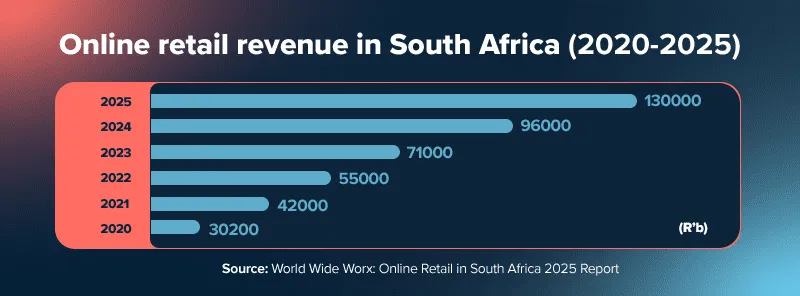
We know that that the Covid-19 pandemic played a significant role in boosting online revenue, and it’s strange to look back to a time when brick-and-mortar stores dominated sales. It’s only ten years ago that online revenue was hardly even reaching one percent of retail sales overall!
Today, in contrast, customers move quickly between physical and online channels. They search on a phone, compare options in store and complete payment online. But behind every smooth touchpoint lies the need for reliable connectivity.
It’s the network that keeps product information, payments, support and advertising in sync for online retailers – except when it doesn’t.
Connectivity Links the Entire Commerce Chain
Great connectivity is hugely important for the customer experience.
For online shopping, synced inventory and low latency mean that product pages load correctly and stock levels are accurate, which then works to reduce abandoned shopping scarts. Invoicing systems rely on always‑on links to send bills, apply credits and reconcile accounts quickly, enabling clearer records. Payments need reliable connectivity for authorisation, with fewer timeouts resulting in fewer declined transactions and higher e-commerce conversion.
In practice, a retailer running a weekend promotion must ensure that the advertising platforms, e‑commerce carts, payment gateways and fulfilment systems are all talking in real time – any lag erodes revenue and a business’s reputation.

Why Great Connectivity Isn’t Just About Speed
When systems talk to each other in real time, customers get relevant offers, accurate delivery ETAs and seamless checkouts. Conversely, when links break or lag, conversion drops, calls to support rise (together with customers’ tempers!) and trust in the business is eroded. The right connectivity strategy reduces these risks and turns operational capability into a competitive customer experience (CX) advantage.
Retail connectivity isn’t just about speed. It’s about consistent, always‑on data flows that enable personalisation, accurate inventory, stable payment authorisations and responsive customer support.
Let’s look at some aspects of online retail today, and how strong connectivity enables and improves the customer experience within that sector.
Fashion, Jewellery and Footwear
Shoppers in this sector expect bright, high-definition imagery, accurate size guidance and the ability to carry out quick exchanges.

Retail here is highly visual, and the overall online experience can make the difference between a completed sale or a shopping cart left abandoned. Connectivity enables high‑resolution product galleries, virtual reality (VR) try‑ons and live inventory displays, so online shoppers can see what’s actually in stock. Within the physical store, tablets and point of sale (POS) systems need reliable links to fetch customer profiles and loyalty rewards instantly.
- Connectivity sweet spot: South African fashion retailers running weekend launches or end‑of‑season sales can avoid missed sales by pairing a primary Fibre connection with Wireless or 5G/LTE failover solutions to keep storefronts and e‑commerce platforms responsive.
Supermarkets and Groceries

Behind the rise of the kamikaze motorbike riders in turquoise uniforms lies the realisation that fresh goods and punctual delivery are central to consumer trust here.
Real‑time stock synchronisation prevents orders for out‑of‑stock items; route optimisation improves delivery windows; and mobile tills cut queue times. Connectivity also powers substitution logic and notifications, so that customers know when an item has been replaced with a similar option if the original request wasn’t in the physical store. For online grocery services in South Africa, a stable connection reduces picking errors and late deliveries, which are both common causes of poor reviews.
- Connectivity sweet spot: Investing in resilient networks helps supermarkets scale their click‑and‑collect and same‑day delivery options, as well as in‑store digital checkouts, to maximise service quality.
Home, Décor and Furniture
Purchases are high‑consideration and sometimes big-ticket items, often involving delivery and installation scheduling.

Connectivity enables rich 3D visualisations, real-time stock checks and booking systems that show delivery slots and assembly options. Customers can track large orders and communicate with delivery teams, reducing anxiety and cancellations.
- Connectivity sweet spot: For retailers handling bulky items across South Africa, reliable networks cut failed delivery attempts and improve first‑time delivery rates, reducing logistics costs.
Electronics and Cell Phones
This sector is known for its fast product cycles, promotions and high customer support expectations.

During product launches, low latency and high throughput prevent cart abandonment on high‑traffic pages.
- Connectivity sweet spot: South African electronics retailers and mobile dealers benefit from robust connectivity to support inventory synchronisation, payment authorisations and instant support during peak demand.
Banks and Financial Services
Customers expect quick payment authorisations, reliable mobile banking and immediate fraud detection.

Trust and speed are critically important. Connectivity supports real‑time fraud support, multiple payment platforms and excellent authorisation success.
- Connectivity sweet spot: For South African financial services, resilient links and redundancy are vital for maintaining transaction flow and regulatory reporting during high‑volume events, while delivering the seamless digital experiences customers expect.
Making Sure that the X in CX Doesn’t stand for ‘Ex-Customer’
Great customer experience starts with a networked foundation. Make connectivity a strategic priority and your business will see better conversions, fewer errors and stronger customer loyalty.
One thing is certain – online retail sales in South Africa have been rising steadily over the past few years, and the lines on the graph will continue to rise. As more people continue turning to digital platforms to browse, compare and buy products and services, business owners should take note: today’s reality is a signal of how customers expect to interact with your brand.
Speak to a Vox specialist to assess your customer experience journeys and find the right mix of Fibre to the Business, Wireless and 5G/LTE for resilience and performance. Contact us today and take the first step towards maximising your online retail offering.
FAQs
What does ‘Customer experience starts with connectivity’ mean?
It means a reliable, fast network is the base layer that makes personalised offers, real‑time inventory, smooth checkout and responsive support possible, and all of these shape customer satisfaction.
How does connectivity improve online shopping for retailers?
Connectivity keeps product pages fast and accurate, synchronises stock across channels, enables live chat and reduces checkout failures, which together increase conversions and lower returns.
Why is connectivity important for supermarkets and grocery delivery?
It synchronises inventory, optimises delivery routes, supports mobile tills and ensures accurate substitutions — helping shoppers get fresh items on time.
Can better connectivity reduce payment failures?
Yes: stable, low‑latency links reduce payment timeouts and declines, enable tokenisation and support multiple payment rails for higher authorisation success.
What quick steps can a business take to improve CX through connectivity?
Map customer journeys, prioritise resilient primary links with wireless failover, test peak‑time scenarios and ensure payment/invoicing systems are integrated end‑to‑end.
Is 5G/LTE useful for customer experience or just mobile use?
5G/LTE provides low latency and high throughput that can power in‑store experiences, failover for fibre outages and fast remote branch connectivity — all improving CX reliability.
How do I measure the CX impact of better connectivity?
Track cart abandonment, conversion, payment decline rates, CSAT/NPS and delivery on‑time percentages before and after connectivity changes.
About Author