
Microsoft Family and Personal Licences Unlock the Power of Ai

The speed at which artificial intelligence (AI) has transformed from being a niche technology into a mainstream tool these past few years is astonishing. The key differentiator in the recent AI journey has arguably been the introduction of ‘generative AI’, meaning a type of AI that can create new content and ideas, including conversations, stories, images, videos and music.

Artificial intelligence is the broader concept of making machines more human-like. It includes everything from smart assistants like Alexa, chatbots and image generators to robotic vacuum cleaners and self-driving cars. Generative AI is a subset that generates new content meaningfully and intelligently.

Generative AI has been a major step-up from the relatively simple chatbots that we’ve been used to for a while now. For some people, it’s exhilarating and for others, a little intimidating.

In this article, we look at Microsoft Copilot – a generative AI chatbot developed by Microsoft – and how it can help people in their work and home lives with the Microsoft 365 Personal and Family plans.

But first, let’s take a quick glance at how we got to this point.

ai generated 8620394 1280 smaller | Vox | Microsoft Family and Personal Licences Unlock the Power of Ai


From ELIZA to LLMs

The history of generative AI dates back further than you might think, to the 1960s in fact. The first historical example of generative AI was called ELIZA, created in 1966 by Joseph Weizenbaum, a computer scientist and professor at the Massachusetts Institute of Technology (MIT). ELIZA was a talking computer program that would respond to a human, using a natural language and responses designed to sound empathic. We could say that ELIZA was the first chatbot!

weizenbaum at computer w eliza | Vox | Microsoft Family and Personal Licences Unlock the Power of Ai
Image courtesy https://www.cbc.ca/radio


The transition from basic chatbots to advanced platforms like Microsoft Copilot represents a shift from rule-based interactions to large language model (LLM)-powered conversational AI.

Microsoft explains that LLMs: ‘are advanced AI systems that understand and generate natural language, or human-like text, using the data they’ve been trained on through machine learning techniques.’

Traditional chatbots are limited by their predefined scripts, while today’s generative capabilities allow for context-aware and human-like responses, enabling more natural and flexible interactions.

Let’s fast-forward to the 21st century. In November 2022, OpenAI introduced ChatGPT, a generative AI combined with large language models. This was closely followed by Microsoft Copilot in 2023.

The combination of generative AI training with large language models has resulted in artificial intelligence that is able to think and reason. With today’s ‘smarter chatbots’, we’ve achieved a new level of artificial intelligence – they can perform research; support reasonably good writing; and generate realistic videos, audio and images.

So how can Microsoft Copilot help you and your family members?


Technology Working Smarter for the Whole Family
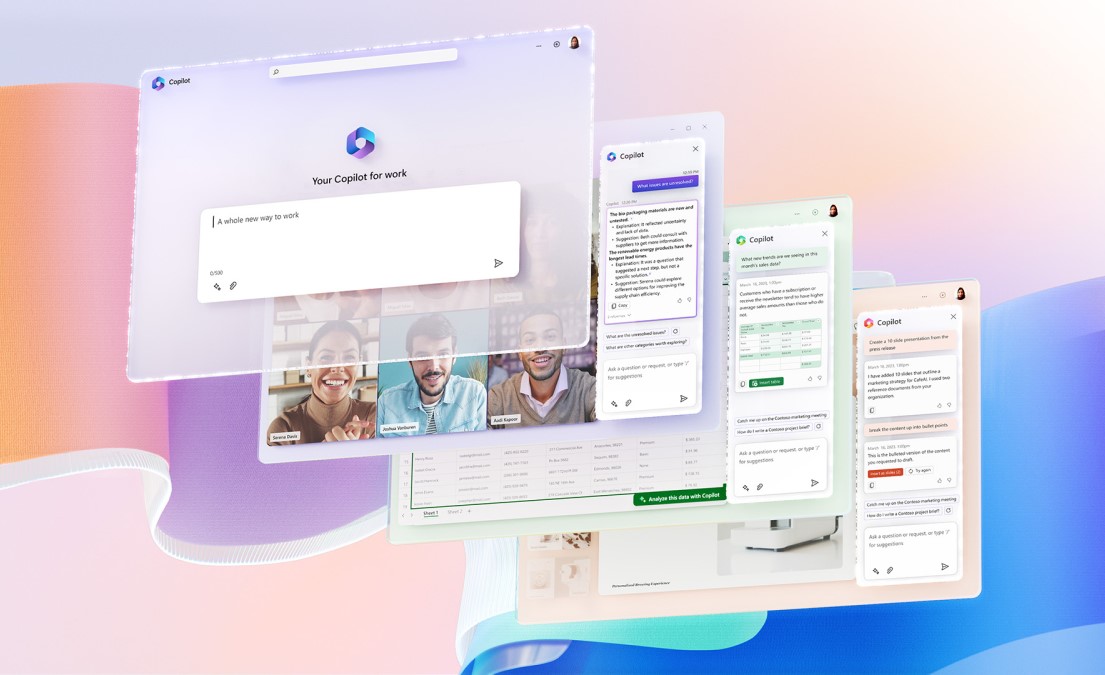
M365Copilot HeroBanner Apps BLOG FEATURE | Vox | Microsoft Family and Personal Licences Unlock the Power of Ai

Microsoft 365 Copilot is now available in Microsoft 365 Personal and Family plans.

It’s an AI-powered assistant built right into the Microsoft 365 ecosystem – a digital assistant designed to help you with a range of tasks and activities. It’s not just a chatbot bolted onto Office but instead can interact with your content, understand context, and execute complex tasks using your data securely.

You could think of it as a digital co-worker that understands your documents, spreadsheets and conversations, and then helps you work faster with automated ideas.

Microsoft Copilot can create drafts of content, recommend different ways to reword something you’ve written, suggest and insert images or banners, create PowerPoint presentations from your Word documents, and many other helpful things.

With your licence, enjoy intelligent features like:

  • Smart suggestions for faster document creation and editing;
  • AI-driven insights to help you stay organised and make informed decisions;
  • Enhanced security with AI-powered threat detection for peace of mind; and
  • Personalised experiences tailored to your preferences and usage patterns.


From seamless collaboration to smarter everyday tools, Microsoft’s AI integration ensures that you get the most out of your Personal and Family plans.

Bring the future to your fingertips with cutting-edge AI features included in our Family and Personal licences. Whether you’re managing household tasks, boosting productivity, or exploring creative projects, our AI-powered tools are designed to simplify your life and elevate your experience.

Choose a Family or Personal licence today and step into a world where technology works smarter for you – and the whole family!

The risks inherent in an unmanaged Microsoft 365 environment

Organisations need to rethink their security technology stack and how environments are managed and contained, says Gartner in an analysis of the threat vectors most prominent in 2022. The research firm highlighted how the ‘ever-expanding digital footprint’ of the modern business is increasing risks, opening up vulnerabilities and creating gaps that are wide enough for any hacker to step inside. Security has to be a priority for the business, particularly those using Microsoft 365 environments. Not because they are easy to hack, but because they are so popular. As Quintin van Zyl, Head of Managed Services at Qwerti, points out, it is one of the most powerful and well-known platforms in the world and so it has to remain as secure as possible to mitigate relentless attacks.

“One of the biggest challenges is ensuring that environments like Microsoft 365 remain secure,” he adds. “This solution has become incredibly popular and is in use by millions of organisations worldwide, which makes it a target.”

Microsoft Office, just one part of the 365 ecosystem, is currently used by more than one million companies worldwide and holds 46% of the global market, only two percent less than its closest competitor, Google’s G Suite. It is an impressive software solution that offers an equally impressive architecture to the modern organisation as it navigates the complex seas of hybrid working frameworks, global clientele and ongoing uncertainty. However, the risks that walk hand in credit card with the platform must remain top of mind.

st people sign up for the platform with their credit card or they use a vendor that can sign them up instead,” says van Zyl. “Then they set it up, and forget about it. They simply get on with the business of doing business. The problem is, they often neglect to set up the security features and functionality that have to be enabled to ensure that 365 remains a secure system. Microsoft has put a lot of research and development into developing this security, but it’s of little use if nobody enables it.”

The Microsoft 365 Defender Security Research Group is exactly that – a dedicated service using research, development and analysis to identify and protect against the cybersecurity onslaught. The team of more than 8,500 security engineers and researchers monitors more than 24 trillion daily security signals using artificial intelligence and automation, and has blocked more than nine billion endpoint threats and 32 billion email threats. It is a behemoth built to secure and protect. It also won’t do what it needs to do if the entire Microsoft 365 ecosystem isn’t using it properly.

“This situation is further complicated by staff turnover and poor security policies,” says van Zyl. “People may leave, others may not get training, and the result is that security best practice degrades over time. This means that gaps can appear in the security, people can use poor passwords, malicious emails and sites can get through the firewalls, and that the whole organisation is less a smooth unscalable wall and more a sieve.”

These are just some of the most common risks inherent within an unmanaged 365 environment, but there are multiple other elements that can influence how well the business is protected, if at all. To resolve this, companies have to focus on creating an environment that prioritises security throughout every part of the business ecosystem. This includes staff training, policy development, password management, reporting, and awareness. It also should include using a third-party service provider to take on the management of the entire Microsoft 365 ecosystem so that nobody turns off that notification because it’s annoying, or that zero-day exploit goes unnoticed because nobody is aware of it.

“If you don’t ensure that these boxes are ticked, it’s easy for hackers to get hold of someone’s password and use it to access the business, or for your global admin rights to be misused or stolen, opening you up for attack,” concludes van Zyl. “Then, your business is compromised, you lose money, you lose reputation, and you can come up against the regulatory and compliance firing line. It’s not worth it to compromise on security, not anymore.”

A managed Microsoft 365 environment will be honed to secure perfection, leveraging the skillsets and expertise of a trained security team alongside the security features enabled by Microsoft itself. It will ensure that users are managed and trained, that policies are robust, and that holes are found and patched before they become an expensive mistake.