From Sign to Surfing: How Vox Makes Your Home Internet Experience Hassle-Free

The internet is part of everyday life now and something that we access continually, whether it’s for online banking and shopping, working and studying, or gaming and entertainment options.

And the difference between having access to capped versus uncapped data can feel life-changing – not to mention that if you are constantly topping up your data, it can quickly become expensive. In comparison, Fibre to the Home (FTTH) provides lightning-fast, uncapped data – and the cost just might surprise you when you compare it to constantly having to buy data bundles.

Why not check out our Vox FTTH offerings and see how making the switch to uncapped data could change your life for the better?


What’s Your Story?

Almost everyone has had a bad experience with using uncapped data – so what’s yours?

Maybe you were working from home with an urgent deadline, but your Internet wasn’t up to the task and you missed the cut-off. (You also missed out on your next pay increase.)

Or perhaps your data ran out during a job interview? (Another potential salary increase that went whizzing by into the realm of ‘If Only’…)

What about that movie you were really looking forward to watching, but it stopped streaming halfway through? Or the times you were speaking to family members far away and the data-based call dropped, just when the catch-up was getting really enjoyable?

Maybe you were writing an online exam at home, but your data cut out and stopped you from submitting the paper. (You still passed, but that zero really brought down your grade average for the year.)

Kirill Makes Pics Pixabay despaired 2261021 1920 | Vox | From Sign to Surfing: How Vox Makes Your Home Internet Experience Hassle-Free

Running-out-of-data stories generally don’t end with a smile on the storyteller’s face – so maybe it’s time to ditch using a data package that needs constant topping up, and move over to the convenience and enjoyment of fast, uncapped data with Vox’s Fibre to the Home.


Problem, Solution: Enter Vox

If you’re still thinking: “Why Vox Fibre for your Home?” – well, Vox offers access to a home environment where super-fast Internet lets customers stream Netflix or YouTube without the annoying buffering. It allows you to connect multiple devices inside your home, simultaneously, on a single Fibre line. You can surf the Internet – for working, studying, gaming, shopping, socialising or simply being entertained – with no interruptions.

Long story short: Vox FTTH offerings bring you a home in which your Internet experience is reliable and fast (Eskom allowing, of course, and Vox has loadshedding solutions there too).

And not only does Vox FTTH bring you a fantastic Internet experience, it’s also pretty easy to sign up with us.


Easy Steps to Signing Up with Vox

Fibre Coverage?

The first step is checking that Fibre lines have been laid in the ground in your area. Go to the ‘Vox Shop’ to check out the useful coverage map. Simply put in your address – you can have a quick peak at the neighbours’ rooftops and surrounding vicinity if you enjoy cyber-sleuthing – to find out if Fibre to the Home is available in your area. The answer will come up very quickly.

Fibre Package

Next up is to choose a Fibre package option. Once you’ve matched the options to your needs, simply hit the ‘Send’ button and follow the instructions to input your details.

Quotation and RICA Time

Next, you will receive an emailed quote from one of our sales consultants. When you accept the quote, you’ll also need to send in your RICA documents.

  • A quick technical note: By law, you need to follow RICA procedures (the Regulation of Interception of Communications and Provision of Communication Related Information Act), which involves submitting certain documents, like your ID and proof of current address. RICA legislation was enacted to protect the security and privacy of South Africans.


Fibre Installation with the FNO

Once all your documents are processed, Vox will log a call with the relevant Fibre supplier associated with your chosen quotation package.

  • Another quick technical note: As an Internet Service Provider (ISP), Vox works with the Fibre Network Operators (FNOs) who own and operate the Fibre lines in the ground.


It’s a Date!

The relevant FNO will get in touch with you to bring a short Fibre line onto your property. Basically, the FNO’s job is to connect the Fibre outside in the street into your home, ultimately to be connected to your Vox Wi-Fi equipment.

The FNO will plan the route for the Fibre line and the location of the ONT inside your home, which you’ll be asked to accept and sign off.

  • Another quick technical note: The ONT is the Optical Network Terminal and is also commonly referred to as a ‘fibre box’. The ONT is what allows the fibre optic cable to be connected from inside your home, out through your property and to the fibre network at the street.


Once you have signed off the necessary paperwork for the Fibre line handover with the FNO company, it’s back to Vox.

Vox Wi-Fi Router

Vox will deliver your Wi-Fi router by courier. You’ll then set up the Wi-Fi router as per the self-installation instructions, which are simple and clear to understand. Welcome to an online experience that is easy, uncapped and FAST!


Come Home to Vox

Are you ready to make the life-changing move to uncapped data and super-fast internet?

With Vox, you will enjoy uncapped Wi-Fi, with unlimited surfing possibilities, an end to movies buffering, super-fast gaming and a working-from-home experience that, quite simply, works.

Just click here to find out more about signing up for FTTH with Vox.


Frequently Asked Questions

What is Vox Home Fibre and how does it differ from mobile data?

Vox Home Fibre is a fixed fibre connection to your house offering uncapped, high‑speed internet; unlike mobile data, Fibre provides consistent, symmetrical speeds and supports many devices simultaneously.

How do I check if Fibre is available at my home?

Use the Vox coverage map and enter your address. The tool will tell you immediately if Home Fibre is available in your area.

What documents do I need to sign up for Vox fibre?

You’ll need to submit RICA documents: a valid South African ID and proof of current address. RICA is a legal requirement for new internet connections.

What is an ONT and who installs it?

The ONT (Optical Network Terminal) is the fibre box installed by the Fibre Network Operator (FNO) to bring the fibre into your home. The FNO plans the route and hands over the ONT once installed.

Will Vox install my Wi‑Fi router?

Vox delivers your router by courier and provides simple self‑install instructions. Support is available if you prefer guided setup.

How long does installation take after I accept the quote?

Installation lead times vary by area and FNO schedules. After you accept the quote and submit RICA documents, Vox and the FNO will confirm an installation date.


 

How Internet Access is Changing Life for South Africans

Working together to build inclusive internet access can improve people’s lives.


Connectivity through the internet brings many benefits, but while internet access is something that many of us take for granted, accessing its benefits is still a challenge for many South Africans.

Greater connectivity allows people to learn new skills and advance their abilities. It also allows employers and businesses to create opportunities that will unlock future jobs and drive our economy forward.

The internet, you could say, opens up the highway to the future, providing tools, skills, benefits and opportunities. Like access to regular and efficient electricity and water supplies, reliable internet access should be part of modern life for everyone.


A New Basic Necessity

According to the World Bank[1], high-speed internet access is not a luxury, but a basic necessity for economic and human development in both developed and developing countries.

The World Bank clarifies: “(The internet) is a powerful tool for the delivery of essential services such as education and healthcare, offers increased opportunities for women’s empowerment and environmental sustainability, and contributes to enhanced government transparency and accountability. It also helps foster the social development of communities, including within the broader global context.”

The World Bank adds that the challenge is to expand broadband access to all, noting that: “Only about 35 percent of the population in developing countries has access to the Internet (versus about 80 percent in advanced economies).”

So where does that leave South Africa?


Spotlight on SA

The Independent Communications Authority of South Africa (ICASA) says: “As of October 2022, some 78% of South African households had access to or had used the Internet in some form or another. This includes access at home, at work, at their place of study, via an Internet café, or at a public hot spot. This represents a dramatic increase from the national average of a mere 28% from ten years ago.”

At almost 80% access, this is a surprisingly hopeful statistic. We could argue that, even if not everyone in the home is internet-savvy, having just one person in the household who is able to access the Internet is beneficial in some form or another.

However, ICASA also goes on to add the following warning: “Worrying though, Internet access at home (largely by means of a device such as a laptop computer or tablet) continues to languish at around a mere 10% of households.”

In other words, those in South Africa who actually have access to the internet at home through a laptop or tablet computer – and not only via a smart phone – number only about one in 10 households.

As ICASA points out: “…substantial and active steps remain necessary to address South Africa’s digital divide, a divide that separates urban and rural, rich and poor, men and women, and that prevents far too many of our people from exercising their fundamental human rights. Indeed, access to the Internet is now widely accepted as a fundamental human right in its very self.”

Internet access has the capacity to change and improve the lives of our citizens, from those in rural areas and small towns to metropolitan hubs. No matter where in the country we are, the internet brings new possibilities – provided, of course, that our citizens have access to it.


Benefits of Internet Access

The benefits of internet connectivity include the following: access to information; communication possibilities over various online platforms; educational opportunities; remote working possibilities; entertainment via online streaming, gaming, YouTube, TikTok and more; online shopping; banking and investment applications; and security through CCTV access – to name just a few.

Let’s unpack a few of the ways in which internet access has changed – or is changing – people’s lives in South Africa.

  • Information Access: The Internet democratises information access and makes it possible to communicate with people all over the country, in real time. Email, instant messaging, and social media platforms like Facebook, Twitter and Instagram have made it possible to share news, views and opinions, and join in conversations – without needing to wait for the ‘official’ news to break the story.
  • Lower Communication Costs: Using an internet-enabled app on your smartphone is generally cheaper than a landline or normal mobile call (check out Vox’s Vobi app for smartphones here).
  • Online Banking and eWallets: Mobile banking allows users to access and manage their bank accounts and financial information without needing to physically go to the bank all the time. In addition, eWallets are instant, easy and secure, and are offered by all the big banks, as well as some other services, bringing consumers an instant, easy and affordable money transfer service that allows anyone to send money to anyone else.
  • ICT-Related Jobs: The rolling out of internet infrastructure, such as fibre or wireless technology, brings employment opportunities to people across communities, including fibre installation, route surveying, network design and service provisioning. Here at Vox, our journey first began in 1998 with around 20 employees. Today, we employee almost 2,000 employees and interact with several business partners, while our numbers continue growing every month – we are proud to play our role in facilitating employment growth in South Africa. If you’re interested, view our job opportunities here.


On the flip side, the rise of internet connectivity has also enabled e-hailing – giving rise to fleets of drivers for apps like Uber, Bolt and others – while online shopping for groceries and takeaways has brought a new dynamic to our city roads in the form of death-defying motorbike riders bringing groceries and foods to households as fast as is humanly possible.

  • Satellite Connectivity in Remote Areas: Satellite Internet has become a game-changer for those living in rural or outlying areas, where Fibre and Wireless Internet options aren’t available. Check out our Vox Satellite options – we offer high-speed Internet, independent of conventional cabling, across the country. And unlike some others, we’re here to stay – we’ll never pull out of SA Inc.
  • Access to Weather Updates: Just for fun but still important: Vox Weather brings you the weather details through the internet. It’s a fantastic service for anyone whose job requires knowing whether thunderstorms or snow are on the horizon, as well as for the rest of us who just want to know how to dress for the day.


ICASA Assists in Democratising Broadband Access

The digital divide in South Africa is multi-faceted, encompassing not only the availability of technology but also access.

According to ICASA, the successful 2023 auction – after years of waiting for finality – of broadband radio frequencies that enable the implementation of 4G and 5G radio waves, will bring the country a significant step closer to achieving universal access and service.

ICASA gave six companies licences to acquire a large amount of additional spectrum that is suitable for providing voice and data services in both urban and rural areas. Consumers can expect greater levels of access and enhanced quality of service, giving them faster download speeds, lower latency, more capacity and connectivity for millions of connected devices. This in turn will pave the way for far better access to online information and content.

In addition, which is probably less universally realised and a Really Good Thing, ICASA has imposed a number of service obligations on the companies that bought spectrum in the auction. These obligations are aimed at increasing the pace of network rollout in previously under-served areas, and include providing connectivity to public institutions.

The licence-holders are required to connect over 18,000 government schools, over 3 900 government clinics, more than 1 700 government hospitals, over 550 police stations, and 8 200 traditional authorities (tribal offices), as well as providing zero-rated access to a range of public benefit websites, including .gov.za websites.

At Vox, we look forward to hearing positive news of this ICASA rollout, as it will move the country closer to having all its citizens able to enjoy their human rights through connectivity.


The Final Word

Between laptops, tablets and mobile phones, internet access is now enabled on the move in today’s world. Even if a smartphone is the only electronic communication device that an individual has, it is capable of giving full and widespread access to the internet in a way that was unheard of just 15 years ago.

There are other ways in which the future is already here. Smartphones today can also understand complex spoken commands; make reservations for entertainment or eating out options; control a smart home; be used to play a sophisticated video game; and stream 4K video.

But that’s a different story – a sequel maybe? Watch this space.

john mark arnold soMvIOHmdgM unsplash | Vox | How Internet Access is Changing Life for South Africans


[1] The World Bank is an international development organisation owned by 187 countries. It provides loans and grants to the governments of low- and middle-income countries to help them pursue project to improve their economies and also improve the standard of living of their citizens.

Fibre to the Home: How Fast is Fast Enough?

Slow internet isn’t just annoying; it also costs time and productivity. Whether you’re joining an important Teams call, uploading large work files, streaming 4K video or gaming online, insufficient speed creates delays, buffering and poor call quality. Choosing the right Fibre to the Home plan reduces interruptions and keeps your household or small business running smoothly.


Nobody wants to look like a zombie in a bad freeze-frame moment.

So there you are: working from home, and one minute away from joining the most important conference call of the week.

Your outfit, hair and outward demeanour are all on point. You have great input to share when it’s your five minutes in the spotlight.

And then your Internet speed lets you down.

You are hit with the dreaded freeze-frame scenario in which your eyes are closed – but only halfway – giving you the dreaded Undead-Look-of-the-Day.

Never mind the hair and outfit: perhaps it’s time to upgrade your Internet speed.


When Good Internet Goes Bad

Slow internet can have clearly negative effects on people’s lives, including detrimental results on efficiency, communication, and access to information and opportunities. For example, slow internet can:

  • Reduce productivity: Slowing down work processes and making it harder to access and share information.
  • Have a negative effect on communication: Causing delays and disruptions in online conversations and video calls.
  • Limit access to online resources and opportunities: Certain websites and services may not load or function properly.
  • Affect your leisure time: Slowing down your streaming and gaming down-time.


From faster file downloads to interruption-free video and music streaming, you don’t have to be an IT expert to appreciate the benefits of high-speed internet service.

internet speed for gaming

How Fast is Fast Enough?

Your internet speed sets the framework for what you can do online, so it needs to be able to support your daily internet usage.

Ranging from less than 1 Mbps (very slow) to 5,000 Mbps (really fast), you can choose an internet plan to suit your needs. We recommend that a good download speed is at least 100 Mbps, while a good upload speed is at least 10 Mbps.

Let’s take a look at understanding the parameters of your internet speed in relation to your devices and usage.

  • Number of devices: If you have multiple devices (for example computers, smartphones, smart TVs, gaming consoles, etc.), you’ll want a higher speed to accommodate simultaneous usage without slowdowns.
  • Consider your specific needs: For basic web browsing, email and social media, a moderate speed should be fine. However, if you work from home and need to be online on platforms such as Teams, or else you enjoy streaming high-definition videos or participating in online gaming, you’ll benefit from faster speeds.
  • Upload versus download speed: Internet speeds are often quoted in terms of both download and upload speeds. The first number is the download speed and the second is the upload speed. If you frequently upload large files (such as videos or photos), prioritise a good upload speed.
  • Future proofing: As technology evolves and your own needs change, having a faster connection can prevent the need for upgrades later – so it’s wise to choose a speed that allows for future growth.


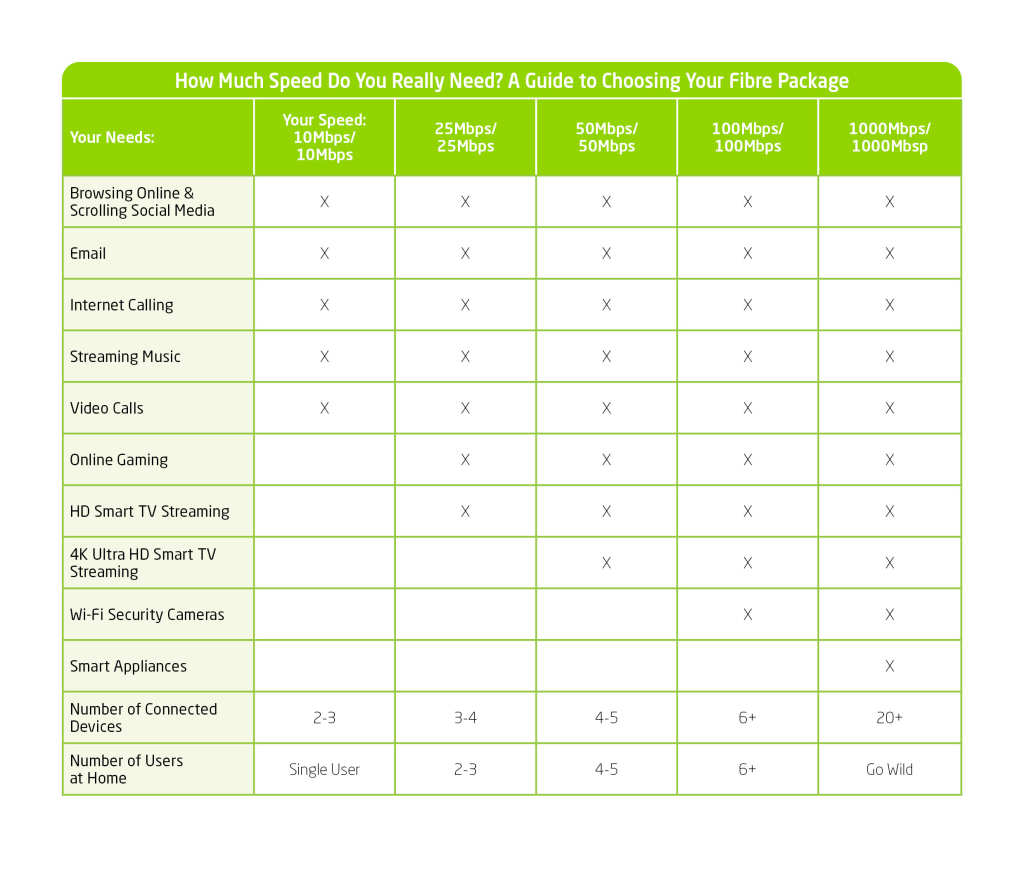
The table below shows how you can match your needs to your speeds, and you can check out some of our current offerings here.


What internet speed do I need

How About a Speed Test?

Higher internet speeds results in faster downloads and uploads – so you could notice that your internet searches are bringing up results faster, while your movie and audio downloads take just seconds.

On the flip side, if there are too many devices or users trying to use the internet connection at the same time, you’ll notice a lag, which is known as latency.

To conduct a speed test, you can:


For a more accurate speed test:

  • Connect a LAN cable directly from the router to your computer or laptop.
  • Perform the broadband test from the ONT/CPE to your device.


The bottom line: Why live with a situation in which slow internet causes tasks that should be quick and easy to become time-consuming and difficult?

At Vox, we have multiple solutions for your every speed requirement. We like to call it ‘The Vox Factor’.


FAQs

Q: What internet speed do I need for remote work and video calls?
For reliable remote work and multi‑participant video calls, aim for at least 100–200Mbps download with 10+ Mbps upload. If multiple people work from home simultaneously, choose higher tiers or symmetrical options.

Q Is 100Mbps enough for a typical family?
Yes, 100Mbps is a strong baseline for a family streaming HD video on several devices, browsing and video calling. Heavy 4K streaming or multiple simultaneous uploads may need higher speeds.

Q:What is symmetrical fibre and do I need it?
Symmetrical fibre provides the same upload and download speeds. It’s useful for content creators, frequent file uploaders, and businesses that require reliable two‑way performance.

Q How can I get the most accurate speed test results?
Use a wired connection from your ONT/CPE to a computer, close other apps and test at different times (peak and off‑peak). Use reliable tools like Speedtest.net or Nperf.

Q: What if fibre isn’t available at my address?
If Fibre to the Home isn’t yet available, Vox offers LTE and 5G, Wireless and Satellite options and works with FNO partners to expand coverage. Use the availability tool to see current options and timelines.

Q: Does a higher Mbps plan reduce latency?
Higher Mbps improves throughput but doesn’t always lower latency. Latency depends on network routing and congestion; however, better plans and lower contention ratios typically give a more responsive experience.

Q: How many devices can a 200Mbps plan support?
A 200Mbps plan comfortably supports multiple simultaneous 4K streams, several online gamers and multiple work‑from‑home users. Exact performance depends on device usage patterns.

Q: Are there cost‑effective ways to future‑proof my connection?
Choose slightly higher tiers than your current need, opt for symmetrical plans if you upload often, and check for bundle or contract options that include upgraded equipment and support.

Is Fast Fibre to the Home Still Relevant?

You’re back in the office: the daily commute is real again and working from home has mostly gone. So: is Fibre to the home still relevant in a non‑WFH world? The short answer is yes. Fast home fibre remains a smart household investment in South Africa, for security, entertainment, study, gaming and futureproofing, even when most people spend weekdays at the office.


So there you are, heading back to work in the morning traffic.

Life (perhaps via a Company Policy, or otherwise loadshedding?) has made the decision for you – working from home is over, and it’s now back to the office, like it or not.

Which is making you wonder whether you really need that fast Fibre to the Home (FTTH) now, after all.

As you dodge those special drivers who mistakenly believe that they own the road, your thoughts turn back to those pleasant days of WFH for almost everyone, when the main part of the daily commute to your desk involved just a short walk, and perhaps a change out of your night clothes (optional for some).

Then, of course, fast Fibre was as necessary for our collective well-being in the home as access to water and electricity. It was also – when boosted by an uninterruptible power supply (UPS) – arguably more reliable.

So this begs the question: if you’re back in the office for most or all of the working week, do you still need that amazing Fibre to the Home? Is fast FTTH still relevant in a non-WFH world?

After wading through the acronyms, the answer should surely be an emphatic ‘Yes, it is!’

Fibre to the Home


Why Fibre Comes First

As a company, Vox supports the upliftment of South Africans at both the Macro-Economic level as well as for individuals.

Economic growth depends on reliable and high-speed digital infrastructure – as a country, we need to work towards a digital future for everyone. Fibre lines use light, not electricity, to transfer data, offering significantly higher bandwidth speeds and capacity – the amount of information that your internet connection can handle at a given time – when compared to other internet solutions. (Short science lesson: this is because nothing yet discovered is as fast as the speed of light, which is quite literally what your data is being carried on.)

Currently, too many South Africans still have to rely on mobile data for their home internet communications, or even on copper-based ADSL lines. Neither of these internet options is steadily reliable, and they don’t offer the same high-speed connection as Fibre.

ADSL’s copper wires are unfortunately stolen regularly and, even when left undisturbed, have both a limited capacity and lifespan – not to mention that they are also susceptible to lightning strikes. Not unsurprisingly, and following in other global footsteps, ADSL is being phased out in South Africa and replaced with more modern technology wherever the opportunity arises.

Mobile data also does not offer South Africans the digital future we all deserve. With regular power outages and load-shedding, network towers can’t provide a stable connection. Fibre towers, on the other hand, often operate on solar energy, and users can back up their Fibre routers with UPS systems.

Despite all these advantages presented by Fibre, some people might feel that, if they are no longer working from home, they could downgrade their Fibre line speed to save some money. Below, we’ll unpack why you might want to think twice about this option.


Taking It Personally

Let’s look at how fast Fibre to the Home benefits you and your family members – even when you’re at work.
FTTH on your property is able to do the following:

  • Improve security: Beyond enabling a more digital-friendly lifestyle, Fibre contributes to good security such as channelling CCTV feeds through always-on internet access. Fibre-optic networks also offer improved security compared to traditional copper cable networks – they are difficult to tap into or intercept, making them a secure choice for transmitting sensitive data. (In comparison, copper cables are vulnerable to physical tampering, as they can be easily accessed and spliced into, leaving them open to data interception and manipulation.)
  • Provide entertainment: In the old days we would channel-hop. Today, the streaming options just keep on coming for those who like their entertainment in passive format. Stream shows and download movies faster, and enjoy your current-favourite shows with less buffering, or better yet none at all.
  • Gamers unite: Download and play games faster – gamers need the highest speed internet with minimal lag. Fibre has lower latency – the millisecond delay when data travels from your device to the game hosting server – and it should be low to prevent in-game lagging.
  • Facilitate studies: You might be at work in the afternoons again, but the chances are that your children will be at home (at least the older ones). Being able to use the internet for their homework and to research projects is critical. Give them the benefit of proper Fibre speeds and enable them to finish their projects faster and better, whether they’re at school or tertiary level. It’s all about enabling their future.
  • Futureproofing your home: And speaking of the future – connecting your home to high-speed Fibre will ensure your household’s digital activities can continue at future speeds without replacing the cabling in a few years’ time, because a Fibre network, once installed, does not require an imminent future change. Because the fibre-optic cabling infrastructure has unlimited bandwidth and can cover long distances, it will be able to handle future technological inventions. (Some of them, actually, like smart fridges, smart sensors and other appliances connected to the Internet of Things (IoT) are already here – but that’s a different story.)


home fibre for gamers


Why downgrading can cost you more

If you’re considering a cheaper, slower package because you no longer work from home, consider the hidden costs: slower downloads, more buffering, weaker CCTV feeds, and less headroom for multiple devices.

A small upgrade in monthly spend can deliver a markedly better experience and protect the value of smart devices and services you use at home.


Going Home

Fibre to the Home

So, there you are. The working day is over and you’re back in traffic, now on the evening run and driving home.

You have the satisfaction of knowing that your house – and most importantly, your family – is secured by a good security system channelled by CCTV feeds.

Your older kids are busy with their educational projects before putting away their homework and enjoying some well-deserved YouTube or gaming moments.

And for the adults, there is the latest streaming programme to look forward to as you prepare to wind down the day.

Before that, you might do a spot of quick banking, messaging or online shopping using your phone apps – with the emphasis being on quick, because it’s all enabled by super-fast Fibre to the Home.

And it makes your home just that bit more comfortable – and secure – all round than if you’d decided to downgrade to a slower Fibre package.

So yes. In a non-WFH world, super-fast FTTH is definitely still relevant.

Learn more about Vox Fibre to the Home options and find the right package for your household. Explore Vox Fibre packages at vox.co.za or Call 087 805 5050 to speak to an advisor.


Frequently Asked Questions

Do I still need fast Home Fibre if I don’t work from home?
Yes. Fast Home Fibre supports home security, streaming, gaming and multiple devices, which are benefits that remain even if you’re primarily office‑based.

How does Fibre compare to ADSL or mobile data?
Fibre offers higher speeds, lower latency and better stability than ADSL or mobile data. ADSL is being phased out and mobile can be affected by load‑shedding and tower congestion.

Will Fibre keep working during load‑shedding?
Fibre itself is resilient; many users back up their home router with a UPS. This keeps internet and home security systems running during power outages.

Is Fibre worth it for gamers?
Definitely. Fast Home Fibre lowers latency and provides consistent speeds needed for online gaming and quick downloads.

Can Fibre improve home security?
Yes. Constant high‑speed connectivity makes CCTV feeds and smart‑home alerts more reliable and secure compared with copper or mobile solutions.

If I downgrade my Fibre package, what could I lose?
You may experience slower downloads, more buffering, longer game update times and reduced performance when multiple devices are online simultaneously.

How do I sign up for Vox Fibre?
Visit vox.co.za to view available Home Fibre packages or Call 087 805 5050 to speak to a Vox advisor.

Does fibre futureproof my home?
Yes. Fibre cabling supports high capacities and new technologies, so it’s a long‑term solution for growing household connectivity needs.