Uncapped, unshaped data with no fair use policies, Kiwi Wireless is about to change the face of connectivity in South Africa
Vox, a specialist provider of top-class internet and voice solutions for homes and business, has announced the launch of Vox Kiwi Home Wireless, a new consumer broadband service that delivers a fibre-like experience without the need for trenching or cabling. Powered by Tarana’s next-generation technology, Kiwi offers speeds of 50 Mbps, 100 Mbps, and up to 200 Mbps, on an uncapped, unshaped and unthrottled line.
Fibre-like Speeds where Fibre Can’t Reach
Designed for South African households that don’t have access to fibre and where installation is prohibitively slow or expensive, Kiwi Wireless offers customers a simpler wireless alternative. One that delivers exceptional connectivity without the need for extensive infrastructure or disruption.
“Consumers have told us that they want fibre-quality internet without the hassle and with no fair-use policies or unpredictable throttling,” said Nikita Appelman, Product Manager for Wireless at Vox.
“Vox Kiwi Home Wireless is a smooth and simple alternative to disruptive trenching or fibre installation delays, offering consistent, high-quality connectivity people can rely on. Installation is also painless – a small, flat panel antenna is mounted on the roof connected to a router inside the home.”
The result is consistent connectivity for streaming, remote work, online learning and smart home devices, without the disruption of trenching or digging.
Affordable Costing
Vox Kiwi Home Wireless is also launching at an affordable price point, making it an accessible choice for consumers. It costs R849 per month for the 50 Mbps service with installation priced at just R999 as a once-off fee.
This upfront cost is competitive, lowering the barrier to entry for households wanting a trusted connectivity solution that doesn’t leave their wallet gasping. The 100 Mbps service is available for R1,039 a month and it is possible to upgrade to the 200 Mbps option if the home fits specific conditions, such as proximity to high sites.
Vox has a proven track record. The Service spans more than five million homes across South Africa, spanning both major metros and smaller towns.
“Vox Kiwi Home Wireless is giving South Africans more choice,” says Appelman. “If you can’t get fibre or you don’t want the wait and disruption that comes with installing fibre, then you can use Kiwi to get connected almost immediately. The service is fast and consistent and is designed to deliver high-quality connectivity.”
Vox Kiwi Home Wireless with the Vox backing, brings unmatched quality and reliability and a fresh and innovative new product offering to the South African consumer.
Available to order from 19 November 2025, with installations handled directly by Vox’s national support and service teams, Kiwi Wireless is the perfect fit for consumers who want access to the digital lifestyle without having to hurry up and wait for fibre.
Kiwi Wireless offers choice – a way to access a modern, connected lifestyle even when fibre isn’t feasible. With transparent pricing and uncapped data, it’s a practical, future‑ready option for many South African homes.
Ready to stop waiting for fibre? Discover Kiwi Wireless and order here:
FAQs
What is Vox Kiwi Home Wireless? Vox Kiwi Home Wireless is a fixed wireless consumer broadband service using Tarana technology that delivers fibre-like speeds (50/100/200 Mbps) without trenching or cabling.
Is the data capped or throttled? No. Kiwi is uncapped, unshaped and unthrottled, and it does not have a fair‑use policy.
How is Kiwi installed? A small flat panel antenna is mounted on the roof and connected to a router inside the home. Installation is managed by Vox certified teams.
Who is Kiwi best suited for? Households without access to fibre, properties where trenching is expensive or disruptive, renters, and anyone needing a quick, reliable broadband solution.
Does Vox provide support and maintenance? Yes. Vox handles installation and ongoing support through its national service teams.
How do I check availability at my address? Visit the Vox Kiwi product page and enter your address to check coverage and order options: https://www.vox.co.za/wireless-to-the-home/
At Vox, we value, support and actively engage people with the levels of expertise that we require to keep us moving forward as a company. In this edition of ‘Meet our Experts’, we find out more about Peter Motaung, who works in the Fibre to the Business Department as a Service Manager. Peter is known amongst his colleagues as being a calm, positive leader who is simultaneously kind and caring, while still promoting accountability and responsibility among his team members.
“There are no traffic jams along the extra mile.” – Roger Staubach, American Professional Football Player
Having been with Vox for 17 years already, Peter has progressed through various technical and operational roles during his time with the company so far, which has helped him to understand Vox’s business holistically and comprehensively.
In short, he’s someone who’s always prepared to ‘go the extra mile’, and his colleagues can always count on him to assist and solve any challenges – one of the reasons he was the first ever winner of the ‘Voscars Awards’, Vox’s internal achievement acknowledgements!
We find out more about this humble and well-liked Vox all-rounder.
A Customer-Centric Focus
Peter explains: “I’m the service manager for Fibre to the Business, with a dedicated focus on fibre network operator (FNO) partner Frogfoot. My role centres on managing relationships and communication between internal project managers, suppliers and customers. Our aim is to ensure that we deliver quality service within timelines and meet the business’s financial expectations.”
A critical part of Peter’s day-to-day responsibilities involves keeping a firm focus on the client. He explains the core challenge succinctly: “Everyone has got a process. Everyone has a timeline, but I think that at the end of the day, our customers are at the centre of everything, and communication is key. Failure to communicate properly with your customers is like putting yourself into the ‘blackout’ situation of load shedding!”
He believes Vox is differentiated in the market by its customer experience: “Our customer experience is the defining factor for us. I firmly believe that we are reliable and transparent with our customers.”
Understanding the Business Holistically
Peter joined Vox as a Level One call-centre agent and quickly progressed through various technical and operational roles, including in the monitoring team and later in the ‘Fishbone’ department.
He explains: “This was an ADSL aggregation solution designed to combine multiple ADSL lines for higher throughput. ADSL is, of course, being phased out today, but when I worked in the Fishbone department, we aggregated multiple broadband lines and thereby allowed businesses to experience far higher connectivity speeds than were previously available. It was an innovative and extremely effective solution before Fibre became widely available.”
Peter also spent time in message and collaboration (email setup) and later joined the advanced team handling firewalls and virtual private networks (VPNs). He recalls those moves as formative and says: “The variety of departments gave me many different types of experiences of connectivity, which came together to help me understand the business end-to-end.”
Peter attributes much of his development to the people he has worked with and the leadership experiences he was exposed to during his journey, including interacting with long-serving seniors along the way. But the learning journey is nowhere near over, he says: “Despite my relatively long tenure at Vox to date, I think I still have a lot to learn, and I’m very much looking forward to it!”
Lifelong Learning
Peter first prepared for his journey within the Vox family through his early studies after school, when he completed his entry-level IT qualifications, namely A+ and networking (N+) courses, over two years.
The A+ certification is the industry standard for starting an IT career, preparing individuals for roles like becoming a help desk technician, field service technician and IT support specialist. In turn, the Network+ certification builds on the A+ certification and is suitable for people who want to specialise in network administration and support roles.
Peter followed a pragmatic approach to his learning by first studying to get his initial qualifications completed, and then growing his qualifications further while working. He first worked for a printing company after completing his tertiary education and then got a position at Vox after about two years.
He explains: “I was very fortunate in that Vox supported my further training, and I was able to complete an NQF Level 5 project management course through the relevant SETA (Sector Education and Training Authority). Vox gave me a great opportunity to start ‘unpacking’ what I had previously studied, and then take it further.
“I found studying while working to be both challenging and exciting, and the practical relevance of the courses made it easier. This was because even though I was studying, it didn’t really feel onerous because I could at any time bring an understanding of what I was studying into the day-to-day operations of my work, which I appreciated and enjoyed.”
Peter makes it plain that he regards himself as being a lifelong learner: “Staying relevant requires ongoing learning, and it’s my intention to continue studying in various ways,” he says enthusiastically. “I also enjoy mentoring interns and passing on practical knowledge.”
For those looking to learn from his own example, Peter says: “Be eager to learn, resilient, and passionate about leadership. Vox offers a vast array of products and divisions to explore.”
Giving Back to the Community
“A person is a person because of other people.” – South African proverb highlighting the importance of community
Away from work, Peter is involved in mentoring in a different way: he helps to run a football club for children in his hometown. He explains: “I grew up in the small Free State town of Arlington, and I cherish its closeness and the feelings of safety and community that I experience there whenever I go back for a visit. I take great pride in giving back to the town that raised me by trying to help and empower young boys through soccer.
“Together with my cousin, I co-founded an under-13 soccer team in Arlington, which I continue to support, both financially as well as with my time and energy, today. The club has about 25 boys aged roughly nine to 14 and is known as the ‘Young Masters’ – the boys themselves came up with the name, and it expresses their desire to excel and move forward with the sport. The club operates with a focus on discipline and keeping the kids engaged in healthy sports, and away from other, potentially negative influences.”
He adds that the club follows a practical approach by keeping the parents involved and ensuring that limited training days mean that schoolwork isn’t neglected.
“The club is guided by a regular coach who is helped by a number of volunteers. Everyone involved is motivated to work together to keep the youngsters off the street and out of trouble, and help them to become future leaders. I hope that one day my own young son, who is still under five, will want to join the Young Masters!”
Creating Order from Complex Situations
Both at work and away from it, as well as on and off the soccer field, Peter’s message is consistent and positive – his colleagues say, with great affection, that he carries out his work with a boundless energy and a commitment to doing things the right way.
His long tenure at Vox has given him broad technical and operational insight, and he frames his work with a genuine customer-first philosophy. He combines his professional focus with genuine community engagement through the Young Masters football club, which embodies his ongoing interest in learning and mentorship. You could say that Peter has truly ‘mastered’ the art of moving forward with positivity and grace.
“Having to deal with a complex situation, bringing disparate stakeholders together and coming up with a solution to exceed customers’ expectations, is something that I find both challenging and exciting – it’s what I enjoy most in life! And above all else, communication is always key,” he concludes.
We’re living in turbulent times, and many of us are getting hammered (financially) on all fronts. And so Vox is proud to be the first local ISP to offer our customers, both new and existing, a brand-new…
*drum roll*
*it-really-doesn’t-get-much-better than this*
… loyalty programme, named Vox Rewards, which is guaranteed to help you stretch those Rands, and put a bit of sense back into your monthly budget!
Our favourite local blogger, The Good Things Guy, has also commented on how cash-strapped many South Africans are right now – does any of this sound familiar?
Picking which bill will go unpaid this month;
Choosing cheaper options in the grocery store;
Cutting back on data; and
Skipping meals (when you’re not on a diet)?
If none of the above apply to you right now, then they could surely mean something to someone you know?
Perhaps these scenarios are also familiar:
Persuading your carnivorous teenagers that ‘meat-free Mondays’ should be done for the household grocery budget as well as the planet;
Scouring online ads for specials (coffee!); and
Not being offended when you get offered the pensioner discount at the till, when you’re still some years off retirement age.
The struggle is real.
And so Vox is thrilled to announce the launch of Vox Rewards, which is being offered to both our new and existing Home Fibre clients. Designed in tiers – you can work your way up the levels – Vox Rewards will offer our customers access to thousands of Rands in monthly savings, discounts, vouchers and coupons from some of South Africa’s favourite brands!
The Rewards available will vary depending on the tier that you’re on, but include the following from some of our favourite local brands:
Enjoy up to R1,250 monthly in grocery savings (tier dependent);
Tickle your tastebuds with discounts on takeout;
Enjoy deals on travel, tech and gadgets, and online stationery;
Empower yourself with savings on online learning;
Get access to free legal or medical advice; and
Put your best fashion-foot forward with fashion retailers.
At Vox, we’re working together to help you navigate the challenges of the economy, and put real savings back into your pocket.
Now you can once again make ‘meat-free Mondays’ a personal choice, and not a financial survival strategy.
Watch this space – and our social media platforms – for more information coming soon!
Live Life in the Rewards Lane with Vox Fibre. Call us on 087 805 0003 for more information.
FAQs
What is Vox Rewards?
Vox Rewards is Vox’s new tiered loyalty programme offering discounts, vouchers and savings to both new and existing customers.
When does Vox Rewards launch?
Vox Rewards launched on 17 November 2025. Watch our social channels and your Vox account for full details.
Who is eligible for Vox Rewards?
Qualifying Vox customers, both new and existing, are eligible. Benefits depend on the tier you reach.
How do I join Vox Rewards?
Qualifying customers will receive launch and sign-up instructions from Vox. You can also visit our sign-up page: https://vox.co.za/sign-up
Are the rewards available nationwide?
Most partner offers are available across South Africa. Specific offers and participating retailers will be listed when the programme launches.
Can I move up tiers?
Yes. Vox Rewards is tiered so increased engagement and activity can unlock higher-level rewards.
Where can I get help or more information?
Call us on 087 805 0003 for more information.
The use of Teams Phone, a cloud-based phone system, transforms Microsoft Teams into a full Unified Communications as a Service (UCaaS) platform, blending Voice, video, chat and collaboration. To enable external calling, organisations can select from a variety of solutions, each balancing simplicity, control and customisation.
The right choice for your business depends on your IT maturity, existing infrastructure and business needs.
In this article we discuss the various options of navigating Microsoft Teams Voice Connectivity from Vox. Collectively, our customers report deployments that are 20 to 50 percent faster, with lower operational costs, and resilience tailored to SA’s infrastructure challenges.
Microsoft Teams Voice: Three Excellent Options to Consider
Microsoft Teams offers two primary pathways for enabling public switched telephone network (PSTN) or PSTN-replacement (VoIP) calling from within the Teams application, namely:
Operator Connect for managed simplicity, and
Direct Routing for flexible control.
We also discuss:
Azure Communication Services (ACS), a developer-centric Platform as a Service (PaaS), for building custom communication apps that extend Teams Phone into other IT assets.
The choice for your organisation hinges on factors such as infrastructure, scale and workforce distribution.
In addition, the options aren’t mutually exclusive. For example, you may want or need to use Operator Connect for core users and Azure Communication Services for developer-built bots, or Direct Routing with a Survival Branch Appliance (SBA) for branch offices or sites that can never be without telephony services (for example underground mining).
In short, though, it’s useful to think of your options as follows:
Operator Connect suits low-overhead rollouts in regulated sectors such as finance, legal and advisory;
Direct Routing fits legacy-heavy environments such as manufacturing; and
Azure Communication Services (ACS) is suitable if you’re building custom experiences, for example, Voice in CRM apps, or need extensibility beyond your standard PBX.
Operator Connect (OC)
Operator Connect (OC) is a fully managed service where the Vox Voice network enables calling to and from any destination while being integrated directly into Teams. No on-premises hardware is required – Vox peers with Microsoft’s Azure network for seamless integration.
Key features include the following: Number provisioning via Teams Admin Centre, built-in emergency calling, fraud monitoring, and 99.999% SLA from Vox and Microsoft. OC supports hybrid models (for example: mix with Direct Routing for sites that require offline survivability).
OC is best for organisations prioritising speed and a low IT burden. A deployment can take hours to days, instead of days to weeks, making OC ideal for environments requiring optimal security, fast scaling and low IT burden.
Choose Operator Connect if you are Microsoft 365-centric, want zero hardware (no Session Border Controller appliances – SBCs – or desk phones), and you value the provisioning of managed services with joint Vox-Microsoft support. It’s ideal for cloud-first migrations or when time-to-service in a week or less matters.
Typical industry use-cases include financial services (security, fraud monitoring); higher education or public sector (budget scrutiny, multi-site rollouts); retail and hospitality (high staff churn, thin IT capability across franchises).
Integrations: You could add ACS for AI call summaries and bot-to-human call hand-off.
Vox example: A Kwa-Zulu Natal university provisioned 2,400 users in days, inheriting Entra ID policies for seamless multi-factor authentication.
Direct Routing (DR)
Direct Routing allows the connection of your existing SIP trunks or PBX to Teams via a Session Border Controller (SBC) appliance. This SBC can be hosted on your premises or in your private cloud, or you can take advantage of Vox’s multi-tenanted SBCs.
With Direct Routing and your own SBC, you retain control over routing and carrier relationships, and with Vox’s shared SBCs we manage routing on your behalf.
Key Features include the following: Advanced call routing (for example failover paths), support for Survivable Branch Appliance (SBA) for local calling during internet outages, and compatibility with legacy endpoints like analogue phones or Digital Enhanced Cordless Telecommunications (DECT.
Direct Routing is best for businesses with complex, on-premises setups needing customisation. DR setup involves more planning, as well as more IT and scripting skills, and deployment is likely to take weeks to months.
Choose Direct Routing if you need on-prem survivability (for example, SBA for internet outages). DR is well suited for complex routing or when full control over media paths is required, due to its granular control over your calling environment.
Typical industry use-cases include manufacturing and utilities organisations (often incorporating legacy DECT/analogue integrations), or logistics and healthcare, which are typically device-dependent, and where offline survivability is critical).
Integrations: You could add an SBA for offline survivability or integrate ACS for custom analytics.
Vox example: A Cape Town logistics firm retained SIP trunks while routing 80% calls via Teams, using SBAs for depots.
Azure Communication Services (ACS)
Azure Communication Services (ACS) is a developer-centric PaaS for building custom communication apps that extend Teams Phone into other IT assets. It’s not a standalone PBX but integrates for scenarios such as embedded calling in apps or AI-driven interactions.
Key Features include the following: APIs for call recording, transcription, video at 720p+, and interoperability with Teams (for example, joining Teams meetings from custom applications or support platforms).
Azure Communication Services is best for innovators embedding Voice into workflows, such as custom contact centres or mobile apps. ACS pairs well with OC/DR for enhanced features without replacing core telephony services or needs.
Choose Azure Communication Services if you’re building custom experiences (for example, Voice in CRM apps) or need extensibility beyond your standard PBX. ACS’s low-code APIs make it accessible for developers, with pay-as-you-go pricing.
Typical industry use cases include tech or consulting (embedded communications in third party applications); contact centres (CCaaS integrations); finance and healthcare (where secure, compliant bots guide incoming calls, and hand off calls to humans where complexity cannot be handled by a bot).
Integrations: Add Teams Phone for hybrid calls and Copilot for AI transcription.
Choosing the right solution for your organisation does not need to be a one-size-fits-all decision. For example, you could start with Operator Connect for 80 percent coverage, layer in Direct Routing for edge cases, and at a later stage add Azure Communication Services for innovation and automation, thus reducing rip-and-replace risks and costs.
Partner with Vox for your Business Voice Requirements
Teams Voice options empower South African businesses to future-proof their communications without necessarily overhauling existing ecosystems. Your organisation could deploy Operator Connect for effortless deployment and scale, Direct Routing for control, and ACS for innovation.
Microsoft-centric organisations in regulated or distributed verticals often see 30 to 50 percent efficiency gains from hybrid deployments, while legacy-heavy setups thrive on Direct Routing.
As your local certified partner, Vox demystifies the realities of Business Voice to match your reality. Vox will engage with you in an initial consultation that covers the following points within this practical evaluation checklist:
Infrastructure Audit to ensure highest return on current investments;
Scale and speed requirements;
Compliance and resilience needs;
Customisation requirements;
Integration path needs; and
A total cost of ownership review that factors in hidden costs.
Explore a no-obligation assessment at https://www.vox.co.za/microsoft-operator-connect/.
Frequently Asked Questions
What is the difference between Operator Connect and Direct Routing?
Operator Connect is a managed service where Vox provisions calling directly into Teams with no SBC required by you. Direct Routing connects your SIP trunks or PBX to Teams via an SBC that you host, giving you more control and customisation.
Can I mix Operator Connect and Direct Routing?
Yes. Many organisations use Operator Connect for core users and Direct Routing for specific sites or legacy integrations where survivability or specialised routing is required.
Do I need on‑premises hardware for Teams Phone?
Not if you choose Operator Connect. The SBCs are hosted by Vox and each user can use either their laptop or mobile device as an endpoint.
What is Azure Communication Services (ACS) used for?
ACS is for developers building bespoke voice/video features or embedding calling into apps and CRM systems. It is not in itself a Teams calling solution, but complements OC/DR rather than replaces them.
How does survivability work if the internet fails?
Direct Routing can be paired with a Survivable Branch Appliance (SBA) to provide local onsite calling if internet connectivity is lost. Operator Connect relies on cloud availability and can be paired with hybrid designs for resilience.
How long does deployment take?
Deployments vary: Operator Connect implementations can be hours to days for typical rollouts; Direct Routing projects often take weeks to months depending on complexity.
Will Vox support compliance and fraud monitoring?
Yes. Vox provides fraud monitoring and supports emergency calling compliance. We’ll include these requirements in the assessment.
Vox partnered with the South African Heritage Resources Agency (SAHRA) to deliver an integrated programme of connectivity, voice and network security, demonstrating how SAHRA connectivity and SD‑WAN for heritage sites can safeguard archives, improve communication and reduce costs. SAHRA requires a modern, secure and resilient IT environment to protect national heritage records and support remote working.
Planning SAHRA’s Connectivity and SD-WAN for SA’s Heritage Sites
The South African Heritage Resources Agency (SAHRA) is an agency of the Department of Sport, Arts and Culture – formerly known until 2000 as the National Monuments Council – which is tasked with an overall legislative mandate to identify, assess, manage, protect and promote heritage resources in South Africa, and to protect them for future generations.
National heritage sites need to be protected and safeguarded from damage or alteration, and it’s important to prevent development that could endanger their existence. As a national agency with additional provincial authorities, SAHRA works with local communities to identify heritage resources and record their oral and living histories, as well as increase public involvement in the preservation of heritage resources.
“South Africa has a very rich heritage,” says Stephen Muller, SAHRA ICT Manager, “and SAHRA works across a number of business units – including Heritage Properties, Burial Grounds and Graves, the Built Environment and Heritage Protection – to identify and protect heritage resources in South Africa.
“We have a very valuable registry in the form of our internal archives, encompassing a vast amount of heritage documents including old papers, plans, maps, information about graves…. information from the past that it’s important to protect and preserve.
“Overall, our outlook for the future is to become significantly more digitalised, including with our registry and archives, and also as an organisation overall. The work done by SAHRA is valuable and it’s important that it’s assisted in the digital realm, to protect South Africa’s Heritage Sites in the physical realm.”
South Africa has eight World Heritage Sites, as follows: Robben Island (Western Cape), iSimangaliso Wetland Park (formerly known as the Greater St Lucia Wetland Park in Kwa-Zulu/Natal); the Cradle of Humankind (Gauteng), Maloti Drakensberg Park (Kwa-Zulu/Natal), Mapungubwe Heritage Site (in Limpopo province, located at the border of South Africa, Zimbabwe and Botswana), the Cape Floral Kingdom (Western Cape), the Richtersveld Cultural and Botanical Landscape (in the Northern Cape, along the Orange River border with Namibia) and the Vredefort Dome (Free State).
In addition, there are also several heritage sites declared by SAHRA, which include the Castle of Good Hope, the Bushmanskloof Rock Painting Landscape, the Daljosafat Cultural Landscape, the SS Mendi Memorial, the South African Astronomical Observatory, Liliesleaf Farm and the West Coast Fossil Park, among others.
SS Mendi Memorial
The Business Challenge
“It’s our intention to have a proper electronic document records management system in place so that we can get all our information, including our records and administrative systems, more digital,” explains Muller.
“We are moving forward in this regard; for example we have a YouTube channel and we use it to broadcast on pertinent issues, including a webinar in September – which is Heritage Month in South Africa – which is geared towards allowing the public to share in the conversation. I like to say that even though we’re a heritage organisation, it doesn’t mean that our technology or infrastructure needs to be heritage as well!”
In the quest to keep SAHRA’s digital processes and communications systems modern and not ‘vintage’, the organisation has carried out a significant number of implementations or upgrades in the past 10 years or so. These include such important technology elements as:
Business Fibre connectivity;
Voice and Telephony solutions;
Backup of data;
Foundational network security; and
The implementation of an SD-WAN solution.
Some of these implementations have been carried out at SAHRA’s head office in the Western Cape, and others have been at regional offices. SAHRA operates across four sites around the country. Muller clarifies that there have been some challenges previously with getting all the sites connected with fast connectivity, including the use of a slow ADSL line at one of the regional offices.
“Our concerns were around data security and service continuity, as well as site integrations that were required to interlink all our colleagues and allow them to interact and integrate with our existing systems and offices. Vox was able to address these requirements through well detailed bids,” he explains.
The Business Solution
As a government entity, SAHRA is required to follow strict bidding / tender procedures each time a new project or upgrade over a particular Rand value is required. Muller explains: “Being a government entity, we have to follow a formal public procurement process and that’s always done by a means of competitive bidding. SAHRA’s relationship with Vox began when we had to shift our existing voice solution, and then we also added in the Internet connectivity as well. Later on, we found the need to include managed firewall services and most recently we have had a requirement for an SD-WAN solution.
“On each of these occasions, Vox has submitted separate tender documentation in response to the advertised tenders. In summary, Vox has helped SAHRA to improve on our operational efficiency, including the enhancement of our remote working capabilities. Additionally, Vox has helped us to strengthen our cybersecurity posture, while also reducing infrastructure costs over time.”
Vox was the successful winner of a number of tender processes for SAHRA in recent years, as follows:
2018/2019: Hosted Digital Communication System
Fibre connectivity
Verto Hosted PBX and Yealink handsets
Uncapped Voice
Communications Manager (TMS)
Network Cabling
Chrome Air (Voice over LTE)
Number porting
2020: Poly Studio VC Solution
2021: Veeam Backup & Replication Enterprise Plus
2022: Connectivity and Voice and Network security
Primary and failover connectivity at five sites
Consists of fibre, wireless and LTE
Moved from Verto Supreme to 3CX Cloud for PBX, Unified Communication and mobility services
Uncapped Voice
Fortigate Firewall at five sites
2024: Connectivity and Voice and Network security / SD-WAN
Provision of two stand-alone internet links at four sites
Consists of fibre, wireless and LTE
Moved from Verto Supreme to 3CX Cloud for PBX, Unified Communication and mobility services
Uncapped Voice
Fortigate Firewall at five sites with SD-WAN for WAN resiliency
René Minnie, Key Account Manager at Vox, clarifies that the most recent 2024 upgrades are of particular interest and significance for SAHRA, involving upgrades to the entity’s connectivity, voice and network security. She says: “When we look at the migration from Verto Supreme to 3CX Cloud, we see that Vox is providing SAHRA with a solution that is future-proof and rich in functionality, and which allows more control. With regards to the implementation of an SD-WAN solution, it is important to note that Vox has provisioned for the ability to use both links at each site.
“As for the benefits of SD-WAN, it’s a modern networking solution that simplifies the management and operation of a wide area network (WAN) by decoupling the network hardware from its control mechanism, with key benefits including improved network performance, cost efficiency, enhanced security, simplified management, and scalability and flexibility.”
More details on the benefits of SD-WAN are as follows:
Improved Performance: SD-WAN intelligently routes traffic across the most efficient paths, reducing latency and improving application performance, especially for cloud-based services.
Cost Efficiency: SD-WAN allows businesses to use lower-cost internet connections (like broadband) alongside or instead of expensive MPLS links, significantly reducing WAN costs.
Enhanced Security: Built-in encryption, firewall capabilities and centralised security policies help protect data across all network endpoints.
Simplified Management: Centralised control makes it easier to configure, monitor and manage the network, reducing the need for manual intervention and on-site IT support.
Scalability and Flexibility: SD-WAN supports rapid deployment across multiple locations and adapts easily to changing business needs, making it ideal for growing organisations.
A Strategic Partner Towards the SAHRA IT Unit
Muller says he has been very happy with both the service and the products received from Vox overall, and enjoys an extremely positive relationship with Vox. He clarifies: “The service levels have always been consistently high, and in fact have always exceeded what we at SAHRA have requested. We also very much appreciate the scalability of the available offerings.
“You could say that Vox has essentially become a strategic partner towards the SAHRA IT unit, and as a company, its employees and divisions are very good at communicating the available offerings, both for a present requirement as well as for future possibilities and planning – I find Vox to be well-structured and transparent.”
Muller also praises the quality of Vox’s tender documents, which, he says, are unfailingly of a high quality and provide all the information – and sometimes more – than actually required.
“Usually, we look to see that the potential service providers are able to meet or even exceed our minimum requirements,” he explains. “Then we look at proven reliability and uptime, scalability, security and compliance. Cost-effectiveness plays a vital role as well, and we also look at strong support and after-sales service.
“Vox scores consistently highly across all these categories, including with excellent service and competitive pricing across all its products. The type of bid received from Vox overall is always excellent. No matter big or small, there’s always enough information. If it’s a specific brand or model mentioned, there will be a specification sheet that paints a clear picture.”
Minnie adds that the interactions with Muller and the rest of his team at SAHRA have always been most pleasant: “As a company, people across a number of divisions at Vox appreciate SAHRA’s business relationship, which is based on mutual politeness and respect. Our two companies work extremely well together, and we look forward to continuing to be of assistance to SAHRA for many years into the future,” she says.
“I believe that in Vox, SAHRA has found an excellent partner and over the years, we have met regularly and enjoyed smooth operations overall. And so if I could sum it up, Vox’s offerings are a clear commitment to a partnership with long-term value overall, because of the scalability and expansions that are offered by Vox,” concludes Muller.
What is SD‑WAN and why is it important for heritage institutions? SD‑WAN is a modern WAN architecture that intelligently routes traffic across multiple links. It improves performance, resilience and security, which is critical for institutions needing reliable access to cloud archives and remote collaboration.
Which Vox products were implemented at SAHRA? Vox implemented Business Fibre, voice platforms (Verto Hosted PBX historically and migration to 3CX Cloud), Yealink handsets, Fortigate firewalls, Veeam backup and Poly Studio VC, plus wireless/LTE failover.
How does SD‑WAN improve security? SD‑WAN supports centralised security policies, encryption of WAN links and integration with managed firewalls, reducing exposure for distributed sites and sensitive data.
Can SD‑WAN reduce costs for government agencies? Yes. By enabling the use of lower‑cost broadband and LTE alongside fibre, SD‑WAN can lower WAN expenses while maintaining performance and resilience.
How did Vox ensure compliance with SAHRA’s procurement rules? All implementations were awarded through formal competitive tenders, with Vox submitting detailed, compliant bid documents for each procurement phase.
Will SD‑WAN help with disaster recovery and backups? SD‑WAN improves connectivity resilience which supports replication and backup workflows. Combined with solutions like Veeam, it strengthens overall data protection and recovery capabilities.
Is 3CX Cloud suitable for public sector organisations? 3CX Cloud provides unified communications, mobility and scalability, making it suitable for public sector needs when paired with secure network infrastructure and managed services.
How can heritage organisations begin modernising their IT? Start with a connectivity assessment, define continuity and security requirements, and procure resilient links, firewall protection and a future‑proof voice platform. Consider a phased tendered approach similar to SAHRA’s.
People of Vox: Spotlight on Thandeka Ayanda Nkumbi
At Vox, we believe our employees are the beating heart of our company, with merit and value built into all our available positions. In this edition of People of Vox, we meet Thandeka Nkumbi, who works in the Marketing Department as a Marketing Assistant and Content Creator. Having initially studied Journalism after school, she is now carving out a niche for herself one story and social media post at a time.
When you see Thandeka in the Vox Joburg office, a few things are likely to jump out at you – for example, how she always looks stylish, attractive and well-groomed; her beautiful smile; and how very busy and active she is!
What a beautiful smile… and so stylish
Her colleagues will confirm that our well-known and much-loved Marketing Assistant never seems to stop moving (10,000 steps a day is nothing!). But use a slightly different filter on the camera of your mind’s eye, and a different picture emerges.
Our ultra-feminine office powerhouse says that at home, she’s an ardent football fan who never misses an Orlando Pirates game. And astonishingly, there was a period, just a couple of years ago, when she was in hospital for almost a month with a freak injury, and had to learn how to walk again.
Today, she’s grateful for the opportunity to swap out her famous fashion at work for her soccer shirts at home, as well as the fact that the scar on her leg today means she can still walk those 10,000 steps with ease – but more on this later.
With her finger always on the beating pulse of Vox, Thandeka is at the centre of multiple activities at any given moment. She always knows who’s who in the corporate zoo, and quite frequently where they are as well – just saying….
We get to know more about one of Vox’s bubbliest and most energetic daughters – including news on how her role at work is starting to change. Her story is one of persistence, creativity and resilience, interspersed with many tongue-in-cheek comments and laughs along the way.
A Day in the Working Life…
Born and raised in Soweto (originally from Diepkloof), Thandeka joined Vox as an intern in September 2022 and was taken on permanently by December that same year. Well, at Vox we know how to spot our gems!
As a Marketing Assistant in the vibrant, colourful Vox Marketing department, she supports the team – and, in fact, the rest of the company – with a wide range of practical and logistical tasks on a daily basis. Thandeka’s work includes ordering and managing marketing collateral, onboarding suppliers, raising purchase orders, coordinating print production for flyers and brochures, and ensuring that materials arrive on time for sales activations and giveaways.
“When I arrive at the office, I first check my emails while having a cup of coffee,” she clarifies, “because a girl needs all the energy before zikhala (getting busy)! I load new POs and check on submitted ones, and establish if I have orders that I need to pack and send for shipment. Stock inventory is very important, and so we make sure we keep track of what we have, and if we’re out of stock, we get quotes and order more.”
Thandeka’s day‑to‑day work requires close collaboration with designers and external vendors and quite a lot of logistical coordination – in short, the kind of hands‑on activity that keeps Vox events and field marketing running smoothly. It also includes a lot of walking…
“I am a people’s person,” she says with a smile, “so I need to chill and talk to my colleagues – from Block A to C, I’m there during the course of my duties! And of course, there’s no way I am not spending time with Paul… my Work Husband.”
(Editor’s note: We hope Paul is reading this.)
Her days are never the same but being hands-on is always a part of it.
“Sometimes I need to organise a collection with the courier company and then I just know in advance that they’re going to send that driver who always argues with me! And then ooh, guess what, other times I have a date… at the storeroom featuring boxes, scissors, and marketing collateral!
“How much time I spend in the storeroom depends on the amount of stock I have, and what’s going on in the company. Some days I spend most of my time there; at others it’s just a short ‘date’ but regardless, I enjoy it. Back to my machine… oh, a supplier is looking for the PO; time for me to chase for approval… time to move. And suddenly it’s home time – ishayile, we try again tomorrow!”
She speaks lightheartedly but the fact is that at any given moment, Thandeka has a lot of irons in a lot of fires, and she always knows what’s cooking (marshmallows, anyone?), and where!
How Thandeka’s Vox Journey Began
A proud graduation day!
Thandeka studied journalism at Rosebank College for four years, graduating in 2019 with the hope of pursuing sports communication and commentary. Fate, however – or to be specific, a global pandemic – had other plans when the COVID‑19 disruption of 2020 put those early goals on hold.
She says: “2020 was one of the toughest years for me, both personally and professionally, because we also had a death in our family during this time – the pain went very deep for all of us, and still does, to this day. Professionally, the pandemic stalled the early momentum from my journalism qualification and made job hunting very difficult – like many other people, COVID meant that my dreams were put on pause.”
However, she didn’t lose hope and was eventually able to start steadily rebuilding her path through part‑time teaching work from early 2021, with two different educational institutions: one for primary school children, and another for young adults trying to complete their matric certifications. Eventually, she was presented with an internship offer from Vox, which led to her permanent marketing assistant role at Vox in late 2022.
“I love being part of the Vox marketing team and appreciate the team’s fun and friendly nature – this group doesn’t have a filter! I like the way that we can tease one another while still being supportive. I especially value the sense of unity and family that Vox offers: despite cultural and personality variations, my colleagues always stick together and look out for each other, and this makes me proud to work for Vox.”
Thandeka with some of her Marketing Team colleagues
A Freak Accident
Despite settling in beautifully to her new job, the COVID pandemic was not the only challenge Thandeka would face in her early career – and there was a time in her life when she was definitely not walking on sunshine. In March 2023, she suffered an unexpected setback in the form of a sudden and severe injury to her leg when, on her way to see a family member after work one day, she slipped unexpectedly in heavy rain.
She was rushed to hospital and quickly transferred into the operating theatre as an emergency upon arrival, because her leg was found to be badly injured and a large skin‑graft procedure was required. She then spent almost a month – 29 days – in hospital, and endured weeks of follow‑up treatment and rehabilitation, needing time and patience to regain her confidence and mobility.
“It was something that was very hard to deal with, because one day I was really fine, and the next day I was lying in a hospital bed with VAC machines (Editor’s note: Vacuum Assisted Closure, which uses suction to help a wound heal) because the wound needed to close before the doctors could start with the process of the skin graft.
“I still experience pain and sensitivity at times, especially in cold weather or after long walks, but I’m grateful that I could recover without losing my mobility and independence,” she adds, “and get back on track with my job.”
And as of the first of September this year, Thandeka’s career path is morphing and changing once again!
Evolving into the Next Phase
Thandeka is thrilled to have been recently promoted to the role of Junior Content and Digital Creator, a role that shifts her focus toward social media, content creation and community engagement, for both Vox and sister company Hypa Fibre. Her journalism training obviously makes the content pathway feel like a natural fit.
She’s excited that her new role will be more of a return to what she studied originally, with her writing, storytelling and journalistic instincts applied to social channels, blogs and creative campaigns. And she’s enthusiastic about the creative and investigative aspects of content work: writing posts, producing blogs, and keeping the social presence active and responsive.
“In my new role, I plan to be highly present on social media, intentionally curious, and open‑minded. I want to learn, test new formats and help to improve Vox’s social offering,” she says enthusiastically. “Over the longer term, I expect my goals and daily tasks to evolve with experience.”
Thandeka expects to spend much more time monitoring social media platforms, studying competitor activity, tracking trends and producing regular content. While she’s super-excited about the promotion, she’s currently balancing both roles until a replacement Marketing Assistant is found.
Embracing Her Tomboy Side
Outside work, soccer plays a big part of Thandeka’s life and she rarely misses an Orlando Pirates game: “I’m obsessed, obsessed, obsessed with Orlando Pirates!” she laughs. But her love of the sport extends beyond fandom: she wants to give back by founding a football club aimed at children.
Team spirit!
“For me, sport is a community tool to keep young people engaged, build discipline and provide alternatives to drugs and destructive pastimes in townships,” she says. “I dream of one day running a soccer team to support youth development.”
Thandeka also loves music and enjoys car culture, especially BMW 325 drag racing. She describes herself as a tomboy in some respects, being comfortable in spaces traditionally dominated by men, and with many male friends. Travel is on her bucket list, with Namibia being her top destination.
Thandeka’s story to date – she’s young and it’s still very much unfolding! – is a portrait of a young professional who has navigated interrupted plans, family pain, and physical injury and recovery, while never giving up on working towards an opportunity that’s aligned with both her training and her passions.
She’s ready to tell stories – and so much more. Thandeka Ayanda Nkumbi is all set to help with shaping meaningful, community‑centred journeys that are grounded in reality – and sometimes soccer! – and guided by optimism and empathy.
She knows how to walk on sunshine! And she plans, both personally and professionally, to help others do the same.
Editor’s Update, December 2025:
Thandeka’s writing career is now in full swing! Please click here and here for the first samples of her wit and humour – and watch this space for more!
By Audrey Vadival, Head of Division: Security and Value-added Services
Vox is pleased to announce the launch of its new cybersecurity division in partnership with global cybersecurity leader, Sophos.
The Vox-Sophos cybersecurity partnership expands Vox’s long-standing position as a trusted ISP into a full-service digital guardian, offering South African companies an integrated portfolio of connectivity, communication and protection solutions.
Key highlights:
Comprehensive protection: Firewalls, endpoint security, MDR, XDR and Phish Threat solutions all integrated within Vox’s managed security offering.
AI-powered defence: Proactive threat hunting, deep learning analysis, and automated response capabilities.
Integrated simplicity: Unified Sophos Central dashboard consolidates all alerts and data across third-party tools with the XDR and MDR offerings.
Security awareness training: Automated phishing simulations and targeted education to turn employees into first-line defenders.
Accessible pricing: Vox pricing and fibre/firewall bundles for South African customers
The move is a response to a growing need in the market. Cyberattacks are growing more sophisticated and frequent in South Africa, with the country remaining one of Africa’s most targeted for cybercrime.
According to the BDO Global Risk Landscape Report 2025 and Allianz Risk Barometer, companies have faced an average of 2,114 cyberattacks per company per week in 2025 – a year-on-year increase of 14%. The Sophos State of Ransomware in South Africa 2025 report put a price tag on the threat – the median ransomware demand rose from R2.8 million in 2024 to R18 million in 2025 while the median payment nearly tripled to R8.3 million.
Vox’s partnership with Sophos brings enterprise-grade cybersecurity within reach for local companies of all sizes. Small to medium enterprises (SMEs) through to corporates can benefit from a portfolio of solutions designed to combine proactive threat hunting with round-the-clock monitoring and simplified management.
We’re connecting and protecting companies. Our partnership with Sophos gives us the ability to create world-class security solutions which leverage next-generation protection capabilities like AI within a local, managed services model that makes high-end protection both accessible and affordable.
Vox’s new cybersecurity arm forms part of our broader strategy to evolve from a pure connectivity and communications provider into a holistic managed service and security partner. The focus is simple – secure the connection, secure the data, protect customers – and it builds on the foundation of trust Vox has already built with our growing customer base.
Our customers already trust us with their communications and connectivity, and it makes sense to extend that trust into cybersecurity. Sophos has a robust and relevant solution portfolio that ensures we can deliver a synchronised security stack that protects every part of the digital journey, from the connection to the user.
The value proposition within the partnership rests in Vox’s ability to combine advanced technology with real-world simplicity. One dashboard, one licence and one provider, with multiple solutions integrated smoothly through Sophos Central. Companies can monitor and respond to threats rapidly with a single, unified view.
Vox will be offering a suite of five Sophos products which are designed to work together to prevent, detect and respond to modern threats.
The Sophos XGS Series firewall, launched earlier this year, offers AI-powered threat prevention and zero-day defence, while Sophos Intercept X combines deep learning AI and anti-ransomware for rapid threat detection and defence.
Sophos MDR delivers 24/7 expert-led security as a service with proactive threat hunting and rapid incident response. Sophos XDR provides visibility across all critical attack surfaces, including third party tools, while Sophos Phish Threat helps you stay ahead and prevent expensive mistakes by proactively educating your workforce
According to Pieter Nel, Sales Director SADC at Sophos South Africa: “The threat landscape in South Africa continues to intensify, and organisations are looking for a partner that can simplify cybersecurity while still delivering enterprise-grade protection.
“Our partnership with Vox brings the full strength of Sophos’ MDR, XDR and AI-driven technologies directly into a locally managed service model, making advanced cyber defence accessible to businesses of all sizes. Together, we are ensuring South African organisations can detect and stop ransomware and other cyberattacks before they cause disruption or financial damage.”
Vox, a Gold Partner for Sophos, offers highly competitive pricing and flexible security bundles which combine fibre and firewall protection in one accessible package. Starting from October 2025 with the ‘Securing Your Connectivity’ promotion, Vox is making enterprise-level security affordable to South African companies while providing local support and expertise.
Businesses are dealing with complicated threats and sophisticated attacks and are at constant risk, so our mission is making their lives easier. You don’t need a large team or multiple IT vendors, just one partner with the right security tools, and that’s us.
To learn how the Vox Sophos cybersecurity partnership can protect your business, contact Vox for a tailored security assessment and a quote for managed security services and fibre/firewall bundles.
Recommended next steps for businesses
Assess current exposure: Identify critical assets and where detection blind spots exist.
Consider a managed approach: If you lack in-house security resource, managed XDR/MDR can significantly reduce risk.
Combine connectivity and security: Explore Vox’s firewall and fibre bundles for simplified billing and integrated support.
Train staff: Add security awareness training to reduce phishing and social engineering risk.
FAQs
What is the Vox Sophos cybersecurity partnership? The Vox Sophos cybersecurity partnership is a local managed security service combining Vox connectivity with Sophos enterprise-grade tools (XGS firewall, Intercept X, MDR, XDR and Phish Threat) to protect South African businesses.
What cybersecurity solutions are included in Vox’s offering? Vox offers Sophos XGS firewalls, Intercept X endpoint protection, Sophos MDR (24/7 monitoring & response), Sophos XDR (cross-surface visibility) and Phish Threat security awareness training, all managed via the Sophos Central dashboard.
Who should consider Vox managed security services? SMEs through to large corporates that want simplified, enterprise-grade protection—organisations without large in‑house security teams, or those seeking 24/7 threat hunting, AI-driven detection and consolidated management.
How do I get started or request a quote? Contact Vox’s security team for a tailored security assessment and pricing. Vox offers competitive fibre and firewall bundles (including the “Securing Your Connectivity” promotion from October 2025) with local support and implementation.
It seems like every other week that some big company announces they’ve been hacked (seriously, hospitals – heard of a firewall?). Entire databases of private, confidential information are sent into the digital wild more frequently than Trump changes his mind. And, the sad part is, the individuals who’ve been compromised often suffer as much as the entities who let it happen.
A good PR campaign and said company can get back on their feet. Know who can’t? The affected parties who now must recover financially, emotionally, and socially.
Financial Impact: Immediate and Hidden Costs
When people think about breaches, the first implication they consider is financial – rightfully so, as the immediate effect is usually on your pocket.
Fraud, loans and damaged credit:
Criminals don’t even need actual money to run wild – just your card details are enough of a launching pad. How so? Here are some ways:
They may start fraudulently purchasing gift items, electronics, or crypto before you’re even aware of it.
Many criminals take out excessive loans linked to another account using stolen identities. The victim only finds out once collection is due.
On a smaller scale, quick cash-outs via e-wallet, ride sharing, and even food delivery accounts are also small ways victims have been hit.
Think it’s not relevant? Let’s look at the history:
An Equifax breach exposed the personal information of 147 MILLION people in 2017. Most of these victims later reported fake loan approvals and fraudulent credit card applications within a matter of days. And, even if the matter is eventually resolved, you can’t put a price on the stress, hours lost waiting on hold, or any residual damage to your credit score.
Identity theft — a long‑term risk:
Unlike a wallet, you can’t just “get a new” digital identity. Once your data is compromised, criminals can use it for decades. Think credit fraud, tax fraud, or even medical identity theft for prescription drugs.
The knock-on effect of these breaches is immense. They can impact on your ability to rent, apply for loans, and in some cases even find jobs.
The human cost — stress, relationships and reputation:
Everyone talks about Data breaches numerically, but what the victims go through is often overlooked. Many victims have to live with the daunting reality of:
Mounting anxiety as they log in and out of their banking app. Repeatedly.
The uncertainty of not knowing whether your info has been stolen.
The pain of repeatedly explaining your situation to strangers.
Think sleepless nights, relationship stress, and a never-ending daunting feeling. Cybercrime steals more than data – it takes away peace of mind.
Privacy harms that money can’t fix:
Many breaches expose extremely sensitive information. Think dating apps, health records, or your browser history (shudder).
And, unlike credit cards, your bank can’t (eventually) undo this one.
Ever heard of Ashley Madison? They were Tinder before Tinder. Until, one day, users were blackmailed with threats to expose their private activity. You can imagine how this went down.
Or spare a second to think about health-related breaches – and how stigmatised patients can feel when their conditions become public.
Some impacts transcend monetary value – they can damage reputations, careers, respect and relationships.
The problem with a breach is often the delayed effect. Cybercrime has a long tail, and slow burning effect. Once your Data is sold on the dark web, it stays there. In fact, it can even be resold, and repeat issues emerge for multiple years.
What to do right now if your data’s been breached
But enough fearmongering, what can we do if we find ourselves compromised? Here’s an easy guide:
Change your passwords. Immediately. ALL of them.
Enable your multifactor authentication (MFA).
Verify whether your email has also been leaked (use sites like “have I been pwnd” – you can even do it now).
Monitor your bank accounts (and notify your bank).
Temporarily freeze your credit file.
Double-check any calls, emails, or texts asking for information.
You can’t simply measure the true cost of a Data breach via a spreadsheet. The price you pay is intangible, and how do you quantify a lifetime of looking over your shoulder?
Act now – protect your data
Companies can move on – but victims carry the burden even once the headlines fade. This is why taking your cybersecurity seriously is no longer optional. It’s necessary. Because, in today’s digital world, your bank account isn’t your most valuable asset – your data is.
You can’t undo every breach, but you can limit the damage. Change passwords, enable MFA, keep an eye on your accounts and use reputable security tools. Treat data protection as essential because your information is often more valuable than the cash in your account.
What immediate steps should I take after a breach?
Change passwords, enable MFA, check Have I Been Pwned, notify your bank, and consider freezing your credit.
How long can identity theft affect me?
It can last years. Stolen data can be resold and reused, so ongoing monitoring is essential.
Will my bank always refund fraud losses?
Not always. Many banks will help, but you still face time spent on disputes and potential credit impacts. Report fraud immediately.
Can consumer security software really help?
Yes. Reputable suites (like Norton 360 offered through Vox) reduce your risk of phishing, smishing and device compromise and include privacy tools and 24/7 support.
I know an elderly lady who is dignified and respectable, with grown-up children and grandchildren. She is, as they say, a ‘pillar of her community’. She also, rather startlingly, has some, shall we say, unfortunate images on her phone at the moment, involving various anatomical closeups of naked people.
But this is not an article about a seemingly-sweet old lady who is at the helm of a mafia-style criminal empire – no, that’s not it at all, because she actually has NO IDEA that these images are currently on her phone (and her family members haven’t yet had the courage to tell her).
Vox has teamed up with global cybersecurity expert company Norton™ to offer comprehensive protection for your devices and online privacy, for the whole family, all in one solution. Traditionally, people have worried about their own online safety as well as their children’s, but there is no reason why your older parents can’t benefit also.
In this article, we look at how so many older people today have absolutely no idea of the perils that lurk online. We discuss how to protect people of an older generation who didn’t grow up with technology at their fingertips.
And we look at how acquiring the right software can take away the stress of having to keep saying: “NO, Mom – DON’T click on that link!”
Why Older People Are Especially Vulnerable Online
Criminals have always seen older people as being a soft target, and today’s digital world simply presents long-existing criminal tendencies in a brand-new wrapping. When the goal is to scam older people out of their hard-earned savings, the Internet, online banking and social media all just make it easier for cyber criminals, because many older people are just not that comfortable with today’s technology.
This is largely because, in contrast to younger generations, older citizens had to learn to use information technology when they were already adults. It’s something that was initially entirely new to them.
And so the relationship that today’s senior citizens have with technology can be an uneasy or uncomfortable one, as shown in this clip from the popular and acclaimed Netflix sitcom, ‘Grace and Frankie’.
In the video clip, we see clearly just how some of the older generation think about technology – Frankie is deeply afraid of it at first. (Grace, as a retired former CEO, does at least know how to boot up a new laptop.)
The video clip raises another point: if so many of today’s older generation are uncomfortable simply with acquiring new technology, you can imagine that they’re even more vulnerable once they’re finally online.
Senior citizens can be particularly vulnerable to cybercriminals who use social engineering – deception intended to manipulate people into sharing confidential or personal information – to lure their victims into handing over valuable personal details.
Why The Older Generation Is Vulnerable Online
Online criminals prey on qualities shared by many older users, including a fear of technology that they don’t fully understand, loneliness as their children grow up and leave home, an ingrained respect for authority and institutions, and an increasing need to feel financially secure as they get older.
If this is all sounding just a bit too familiar and close to the bone, the good news is that there are ways in which you can help protect your older parent or relative against would-be online scammers.
Keep It Simple — Three Rules to Teach Your Parent
Firstly, share the following information with your older parent to try to help them recognise when a criminal is trying to steal their bank account information, passwords or credit card numbers, or otherwise trying to separate them from their money.
Trust no one: never click links or open attachments from unexpected senders.
Ask first: establish a rule — “Call or text me before you act.”
Don’t share security details: never send PINs, passwords or banking details by message or phone.
These short, repeatable rules are easier to remember than long lectures. Think of them as being the digital equivalent of “Don’t open the door to strangers.”
In summary: ‘Don’t click on every link that looks like fun or promises you a great bargain.’ It’s the Internet version of ‘If it looks too good to be true, it probably is.’
How Norton from Vox helps — Straightforward, Family-Wide Protection
You can try to teach all the rules in the world, but intuitive software makes prevention easier. Stop the malware from getting in by blocking those seductive ‘Click here’ messages before they even reach your parent’s phone, tablet or laptop with their exotic and interesting click-bait messaging.
Norton’s software safeguards your entire family’s PCs, Macs®, tablets and smartphones from viruses, ransomware, phishing and other cyber threats while you bank, shop and browse online.
Norton 360 family protection provides multiple layers of defence against viruses, malware, ransomware and phishing, which are the common tools criminals use to target seniors. Key benefits for elderly parents:
Blocks malicious links and phishing attempts before they land.
Protects PCs, Macs, Android and iOS devices with one app.
Simplifies security for non‑tech users — automatic updates and background protection.
Centralised family protection so you can check that your parent’s devices are safe.
Buying Norton via Vox gives you a local, reliable channel to purchase and manage the licence, which is one less thing to worry about.
Practical steps for immediate protection
Install Norton on every device your parent uses and enable automatic updates.
Turn on email and web protection to block suspicious links.
Set up one shared contact (you) who your parent must call before sharing money or details.
Back up important files so ransomware can’t hold photos or documents hostage.
Norton from Vox offers robust, all-in-one protection against viruses, malware, ransomware and online threats – for the whole family, including your elderly parents. It’s Internet safety for the elderly – like the virtual equivalent of a home security guard, refusing to allow the criminal over the threshold while your mom or dad are blissfully unaware and watching their favourite show or match on TV.
And if your elderly family members aren’t downloading dodgy links, you don’t have to spend precious time cleaning up their phones at a later stage.
Frequently Asked Questions
How do I start a sensitive conversation with my ageing parent?
Choose a calm moment, be honest but respectful, ask open questions and listen to their priorities
How can I suggest home-safety changes without upsetting them?
Frame changes as ways to keep them independent, offer choices and involve them in decision-making.
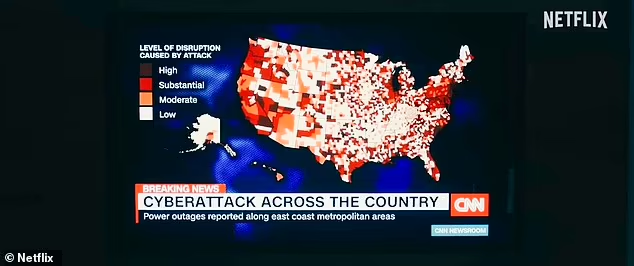
There are very real cyberthreats lurking today, including critical infrastructure cyber attacks, and all organisations need to protect themselves. We tune into the movies and TV shows for entertainment – sometimes because we need a serious dose of escaping reality to forget about our challenges for a while.
And if we’re watching a thriller, when the film is over, we breathe a sigh of relief that what happened in it was much too far-fetched to have any actual connection to reality.
Perhaps viewers a couple of years ago were comfortable, while watching the 2023 American apocalyptic thriller ‘Leave the World Behind’, to think that they would be returning safely to reality when the credits finally rolled, because….
[Editor’s note: If you haven’t seen the movie, here comes a spoiler alert!]
…because a war was NOT actually being started outside the cinema by sinister forces who began by first destroying communication networks and critical infrastructure through a highly targeted cyber attack.
(If you haven’t seen the movie and want to know more, here’s a quick sneak peek at the trailer. The movie stars Julia Roberts, Mahershala Ali, Ethan Hawke and Kevin Bacon.)
Except that… attacks on infrastructure ARE becoming more commonplace in the real world, as Information Technology (IT) and Operational Technology (OT) systems become increasingly intertwined.
Let’s look at some real-life examples.
Why It’s real: IT and OT Convergence
One of the largest oil pipelines in the United States, the Colonial Pipeline in the eastern USA, went down in May 2021 for a few days because of a massive cyber-attack. It caused fuel shortages, panic buying and a temporary spike in gasoline prices.
The attack, from a Ransomware-as-a-Service (RaaS) operation named DarkSide, caused a four-day shutdown of the pipeline, after DarkSide’s operators had accessed the company’s IT network, stolen 100 gigabytes of data and encrypted several critical systems. A significant section of the eastern part of the country was affected, and Colonial Pipeline paid the hackers nearly $5 million as a ransom to finally regain control of their systems.
So perhaps the moral of this particular story is this: Taking down critical infrastructure is not so far-fetched after all!
As for communications networks, cyber-attacks on telecommunications companies (telcos) can have far-reaching consequences. The nature of the information held on customers can put their personal safety at risk if it’s breached.
Data breaches and service failures undermine customer trust and have a negative impact on reputations. The result is companies being hit with recovery expenses as well as a potential loss of future customer revenue.
Closer to Home: South African Incidents
South Africa has not gone unscathed as far as significant cyber attacks are concerned.
Transnet Attack: In July 2021, South Africa’s state-owned logistics firm, Transet, suffered a major ransomware attack that disrupted operations at ports and significantly affected the supply chain, demonstrating how ransomware can affect national economic activities. You could perhaps regard this as being SA’s own version of the Colonial Pipeline major critical infrastructure attack, because the results were also severe and far-reaching – in fact, Transnet declared a ‘Force Majeure’, meaning an event that cannot be reasonably anticipated or controlled.
Experian South Africa: In August 2020, this renowned consumer, business and credit information services agency experienced a data breach where a fraudster gained unauthorised access to the personal information of approximately 24 million South Africans and almost 800,000 (793,749) businesses. The exposed data included contact information and employment details.
National Health Laboratory Service (NHLS): When the IT systems of the NHLS were targeted by ransomware in 2024, all files on the affected computers and servers became inaccessible, leading to a halt in NHLS operations. In addition, 1.2 terabytes of data was stolen during the attack, including the sensitive medical information of millions of patients.
South African Weather Service (SAWS): In January 2025, the SAWS disclosed that its ICT-base systems were disrupted by an attack led by ransomware-as-a-service group RansomHub.
These are just a few examples of local cyber breaches in South Africa. Knowing the cause, impact and response to past data breaches can help businesses protect their own data – and bottom-line – by ensuring that they avoid the same pitfalls and mistakes.
Practical, Non-technical Actions Organisations Can Take
You don’t need to be a security expert to take sensible steps that reduce risk. Recommended actions include:
Develop and exercise an incident response plan and communications strategy so you can act fast when an event occurs.
Classify and prioritise critical assets and data to focus protection and recovery efforts where they matter most.
Conduct regular tabletop exercises with leadership, legal and communications teams to test decision-making under pressure.
Strengthen supplier and vendor oversight — downstream vendors can introduce supply-chain risk.
Train staff to recognise phishing and social engineering, the most common initial vectors for ransomware attack.
Consider cyber insurance and ensure coverage aligns with your operational risk profile.
It’s important to understand that kidnapping today is no longer only the domain of Somali pirates operating off the coast of Northeast Africa, using speedboats and machine guns to take over lucrative international cargo ships. Cybercriminals – like the Colonial Oil attackers – now ‘kidnap’ data, holding systems and companies to ransom until significant sums of money are paid.
No organisation wants to be in the media spotlight for the wrong reasons. Being aware of cyber attacks suffered by other companies can help your business to learn from these pitfalls and stay safe moving forward. Let’s go back to the movies to ponder that one a bit more closely:
“In my line of work, you have to understand the patterns that govern the world. It can help you see your future. And I knew something was coming.” – George H Scott, ‘Leave the World Behind’
Any business can be a victim of cybercrime. If you need help with cyber protection for your organisation, please contact Vox to see how we can be of assistance.
FAQs
What are critical infrastructure cyberattacks?
Critical infrastructure cyberattacks target systems that support essential services — such as energy, transport, health and communications — and can disrupt services, harm the economy and endanger the public.
How can I tell if my organisation is being targeted?
Common signs include unexplained system slowdowns, unusual login patterns, unexpected file encryption, or ransom notes. Prompt investigation and containment are vital.
What’s the difference between a ransomware attack and a data breach?
A ransomware attack encrypts and locks systems to demand payment; a data breach involves unauthorised access and exfiltration of sensitive information. Both can occur together.
How can smaller businesses protect themselves against these threats?
Smaller businesses should focus on basics: backups, an incident response plan, staff training, and assessing third-party risks — these steps significantly reduce exposure.
Does cyber insurance replace preparedness?
No. Cyber insurance can help with financial recovery, but it does not replace proactive measures like planning, training and asset prioritisation.