Microsoft Azure lands in South Africa – Q&A with Craig Freer, Head of Cloud at Vox

Microsoft Azure is an open and flexible cloud platform that helps give businesses the freedom to quickly build, deploy and manage applications and services using your favourite Microsoft tools. Azure comes with many associated services, including those for compute, storage, data, networking and apps. Vox is one of Microsoft’s preferred partners and one of few Microsoft Azure migration partners.

We chatted to Craig Freer, Head of Cloud at Vox, about his thoughts on the arrival of Microsoft Azure in South Africa.

What is the significance of Microsoft Azure landing in SA?

There are two significant points about Azure landing in South Africa.

The first is the infrastructure it brings to our country. Having a local cloud data centre means local storage and local processing and therefore, better performance of cloud technology.

The next significant point is Microsoft’s positive sentiment toward South Africa. Their investment shows that Microsoft sees our region as a sustainable market for positive growth in the cloud industry.

What does mean for the current SA market?

As mentioned above, Microsoft a global company, sees our region as a sustainable market for cloud technology. This will stimulate demand and create top-of-mind awareness for cloud services and products.


Their investment shows that Microsoft sees our region as a sustainable market for positive growth


How does this impact Vox?

Vox is a Microsoft partner and also one of few Azure migration partners. This puts us at the forefront of cloud technology with the company’s arrival and ultimately aids us in revenue growth.

What is Vox’s vision for cloud computing?

Over 60% of companies in South Africa have a cloud strategy. We distribute and manage IT infrastructure for many companies. Our vision is to be a leading and agnostic cloud provider that is able to deliver services according to the needs of any company’s cloud setup.

How is security affected in the cloud?

We are at the stage where all cloud vendors have in-built security and advanced security requirements. Security is a key consideration; cloud technology is not any less secure than an on-site IT environment.


Vox ramps up Microsoft offerings as SA businesses turn to cloud

A growing number of South African businesses are looking to move their operations to the cloud, and integrated ICT and infrastructure provider Vox is looking to take advantage of the opportunity by helping them make the shift by using a variety of Microsoft applications and technologies.

The Cloud Africa 2018 Report, by World Wide Worx, shows that the use of cloud among medium and large organisations has more than doubled in the last five years, with the majority of respondents stating that spending on cloud had increased over the year in review, and would continue to grow in 2019. 

“We are seeing a shift as companies migrate from on-site Exchange toward Microsoft’s 365 cloud-based products, and have done thousands of migrations across a range of industries. This trend is likely to accelerate as Azure data centres have now been launched locally,” says Craig Freer, Executive Head: Cloud and Managed Services at Vox.

Having started with the Office 365 productivity suite, Vox has since expanded its Microsoft offerings to include cloud-based applications for enterprise resource planning, business intelligence, customer relationship management, and employee communication and collaboration, to tap into this growing market.

Vox further caters for business customers who have their own data centres, or are making the shift to the cloud using a hybrid model. Through its Braintree subsidiary, created through the acquisition of three companies, additional Microsoft skills and competencies have been brought into the company. This includes consultancy, custom development and on-premise implementations, giving the company the ability to comprehensively guide its customers’ digital transformation journeys in totality, and not just in the cloud.

“Vox is one of the few companies that are certified by Microsoft to carry out data centre migrations, and has Microsoft Gold competency across multiple divisions in the company. The company has actively beefed up its consulting capabilities over the past few years, and adheres to Microsoft’s methodology and best practice around data centre migrations and Azure cloud deployments,” says Freer. 

“In addition, as part of Vox’s network infrastructure is located within Terraco – host to one of Microsoft’s local Azure data centres – customers stand to gain additional benefits in the form of improved performance and reduced interconnection costs.”

Vox unlimited email archiving protects data when disaster strikes

Vox has launched an unlimited email archiving solution to provide organisations with a cost-effective and user-friendly way to protect their email data in the event of a disaster.

“It has become far too commonplace for companies to lose email – it is estimated that one in ten new laptops will suffer a hard drive failure resulting in data loss or corruption. Given the regulatory environment we are operating in, the impact of being unable to access key information could be significant both from a financial as well as reputational perspective,” says Craig Freer, executive head of cloud and managed services at Vox.

Freer says that part of this challenge is that email platforms have a limited amount of storage available to users. This results in users having to delete old emails on a regular basis to stay within their space allocation. Even if the offering is cloud-based, once an email gets deleted it is gone.

“Through our Unlimited Archiving solution, we are offering companies of all sizes irrespective of industry sector an affordable plug-and-play solution that enables them to retain 10 years’ email irrespective of how much data that is,” he says.

The Vox offering integrates into any email platform empowering businesses, especially SMEs, with archiving features that are typically quite expensive.

Concludes Freer, “In the digital world, it is easy to have data corrupted, getting a laptop stolen, or suffering another disaster typically associated with being always connected. With our solution, users get the peace of mind that their email data is safeguarded. And because it is plug-and-play, once it is installed, the user does not have to do any administration or even think about the archiving process.”

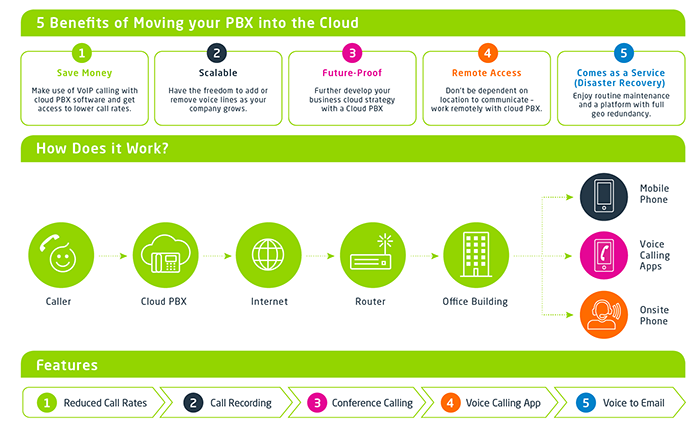
Why you should consider a Cloud PBX

Your PBX is going on early retirement and it’s time to trade the old model for a newer, more tech-savvy one. Like fish, there are loads of PBXs in the sea – well not literally – you know what I mean. So which one should you buy?


What to look out for when buying a PBX in 2019.


Many PBXs come with different features which are either included in the price or are added extras. Look out for what is included in your package when purchasing the right PBX.


  • Reduced call rates – Get a package that comes bundled with lower call rates. Just pay less, it’s that simple.
  • Call recording – Keep a record of all your calls. Just in case the customer is not the king.
  • Conference calling – Conduct meetings with colleagues and clients nationwide and around the world – and in your underpants, without them ever knowing!
  • Softphone – Turn into a virtual office when the power goes down by having voice calling apps installed on your employees’ mobile phones. It will be business as usual when load shedding strikes!
  • Telephone Management System (TMS) – Get reporting insights to understand your usage (I mean don’t you want to know who’s been making dodgy phone calls to the other side of the world?) and get the right insights to cut your call costs. Information is power.
  • Voicemail to email – Get your voicemail sent to your mailbox for a quicker response. You don’t want to miss a message from the big boss!
  • Digital receptionist and auto menu system – Give your clients a top-quality on hold service with navigational voice prompts. Leaving them hanging would be ever so awkward – if you know what I mean.

2192 Business Voice with Cloud PBX Infographic V6 20190318 FARGB 1 | Vox | Why you should consider a Cloud PBX


Advantages of a Cloud PBX
In an ever-evolving technological landscape, on-premise PBXs reach end of life in an average of 3-5 years or the day after your warranty expires – good ‘ole Murphy. Onsite PBXs are also reliant on location. Today your PBX can sit in the cloud. This makes for some epic benefits:

  • It comes as a service, so it has an ongoing maintenance plan (I wish my car sat in the cloud).
  • It is not dependent on location – think of how many times you’ve moved office and needed to reinstall a PBX system.
  • It is not reliant on electricity. Coupled with voice calling apps, your business will not be interrupted by power cuts.
  • It allows you to have a virtual office. When employees are travelling or working remotely, they can still be linked to your PBX system and receive calls wherever they are.


At Vox we offer a variety of options to meet the demands of any business size. Our call rates are as low as 0.25c excl. VAT, while traditional telecommunications companies are charging an average of 0.45c excl. VAT for call rates. We sell cloud or on-premise PBXs with tons of great features, TMS, voice calling apps, and so much more. Visit vox.co.za to learn more.

GSM vs VoIP calling

Global System for Mobile (GSM) was not only the first mobile telecommunications system in the world, but also the most popular one. GSM is like the old man that was once the popular jock at high school. His looks have faded, the knees have given in a bit, and the six pack has turned into a serious dad bod – but his kids still think he is cool, well they’re teenagers now, so… The reality is GSM is fast becoming outdated with the rise of a younger, fitter, more visionary Voice Over Internet Protocol (VoIP) technology.

Why VoIP is becoming more relevant than GSM

Compatibility with modern technology:
While GSM is the OG (Original Gangsta) of mobile telecommunications and is still used today, it simply is not as compatible with modern technology as VoIP is. More and more businesses are moving their technologies to the cloud. Having a GSM account as opposed to a VoIP account will limit your business capabilities.

Hardware needed:
VoIP requires less hardware as new telephony integrates seamlessly with VoIP providers. VoIP can connect directly to your PBX, whereas the old school GSM will need additional hardware to do the same thing. Less hardware – less costs.

Number porting:
With VoIP you can keep your fixed-line number (011, 010, 021) when moving over to VoIP services. You can’t port a fixed-line number to a mobile GSM service. Imagine the headache and cost of new business contact details.

Connectivity:
GSM will only work when there is mobile network coverage in the area, whereas VoIP does not rely on mobile coverage. Instead, it works with any internet connection or with a dedicated line to a VoIP provider – there is no need for internet at all in this case.

Call rates:
Since VoIP call rates are goverened by ICASAs interconnect call termination rates, they can be substantially reduced in comparison to GSM call rates. GSM call rates are governed by the fees charged from a variety of mobile network providers it has to connect with in order to make your call. Seriously, who wants to pay a higher phone bill?

Quality:
The quality of a VoIP call exceeds that of a GSM call. This is based on the Mean Opinion Score (MOS – measures subjective call quality) for VoIP calls, which is 3.5 – 4.2 out of 5. GSM calls are scored 2.9 to 4.1 out of 5.

Scalability:
An entire enterprise can have all their inbound and outbound calls routed from a single SIP trunk. One GSM sim card can only support one call. VoIP allows you to utilise less equipment and produce a higher level of productivity.

Vox Voice Calling App – VOBI
VOBI is Vox’s voice calling application. It gives you a SIP account on your mobile phone, allowing you to call to and from anywhere in the world at reduced call rates. There is no need for roaming as VOBI runs over any internet connection – not just mobile data. VOBI can connect to your company’s cloud hosted PBX when the power goes out, when you travel for work, or when you work from home, allowing calls to be accessed remotely and business to continue as usual.

Visit https://www.vox.co.za/voice/vobi/ to find out how you can level up your life and your business today with Vox’s VoIP application, VOBI.

Vox offers countrywide emergency response at the click of a button

Vox is introducing Vox 911, a mobile app-based panic button that helps family members to easily request for roadside assistance or emergency services, as well as notify friends and family instantly.

Apart from being able to send an emergency SMS to a select contact list – be it family, friends or even neighbours – the app gives users access to additional connected services such as roadside assistance, emergency medical services, and armed response or police.

“In an emergency, a Vox 911 user presses a panic button on their cell phone, which contacts the Vox 911 call centre. An operator then calls the user back, within 30 seconds on average, to find out what the emergency is. If unable to get through to the user, the call centre uses caller ID and location tracking to identify who the member is, where they are, and ensures there is an emergency response,” says Rudi Potgieter, senior product manager at Vox.

To provide peace of mind, the user is sent an SMS notification to confirm that their panic alert has been received. Similar SMS notifications can also be sent to a list of family and friends to be contacted in case of an emergency.

Vox has a partnership with a national response network, ensuring that users are able to get countrywide coverage; whether medical, roadside assistance or physical security.

“You need just one subscription for a family of four. There is no call out fee for using any of the services, though there is a fair usage policy to prevent abuse. The app further allows the user to make voice recordings, with the message being forwarded to selected family and friends,” says Potgieter.

While the panic button service is currently based on a smartphone app, Vox is working on an Internet of Things wearable that is not dependent on being linked to a phone, giving users a way of contacting the call centre even if their device happens to be stolen.

“While there are some similar services in the market, they are not as comprehensive as Vox 911. They either only operate in select major cities, do not connect to an emergency control centre, or do not integrate with private security, roadside assistance, or emergency services,” adds Potgieter.

The panic button is a further addition to Vox’s Guardian Eye stable of products, which focuses on using technology to improve and simplify security for both home and business users. The subscription costs R99.87 per month on a 24 month contract, or R109.95 per month, on a month to month basis – for a family of four users.

The Vox 911 app can be downloaded from the Google Play Store or the Apple App Store.

Vox introduces competitively priced, high-speed satellite Internet plans

While a lot is being said about the spread of fixed and wireless network coverage around the country, there is still a vital role for satellite-based internet connectivity in both urban and rural areas of the South African market.

To keep pace with evolving customer requirements, integrated ICT and infrastructure provider Vox, which offers broadband satellite internet through YahClick, has announced new service plans to give customers better speeds and more data options.

“Apart from offering new users competitively priced products, this is of huge benefit to our existing customers. There has been a significant improvement in speed from between 1 and 7Mbps to 16Mbps, a broader range of service plans are now available, and users get to retain their voice channels,” says Jacques Visser, Head of Wireless at Vox.

Adds Visser, “This is the first phase to improve the throughput speeds of our YahClick satellite services. The second phase will offer throughput speeds of up to 25Mbps.”

YahClick, which launched in 2012 in partnership with YahSat, uses Ka-band satellites to provide a wide range of users across the country with reliable, high-speed internet connectivity. Using multi-spot beams as opposed to broadcasting over the continent allows for far more efficient use of available bandwidth and lower cost than traditional satellite technology.

While Vox will be progressively contacting customers to inform them of the new options available, and assisting them with making the switch, customers can also go online to the Vox website to compare and subscribe to satellite connectivity plans.

“The migration is a remote, online process and there is no charge to customers, who will not be required to make any changes to their on-premise equipment either. In general, most existing users will find that migrating to the new service plans will not result in a price increase, unless they upgrade their data allocation.”

The monthly service plans come with data allocations ranging from 5GB to 400GB, and for the first time introduces an uncapped option, which is subject to YahClick’s fair access policy that can be accessed on the website.

According to Visser, urban customers – especially businesses – use satellite services primarily for its high reliability, including as a backup to other types of connectivity. Other users include those in built up areas that have expanded rapidly in recent years, and have yet to be serviced by other forms of connectivity. In this case, satellite connectivity is used as a temporary service until fixed or wireless coverage is extended into the area.

Visser adds that satellite services have really come to the fore in South Africa’s underserved rural areas, where it is often the only reliable form of data and voice connectivity available. This includes some users of fixed-wireless services that were terminated as a result of changes to spectrum availability.

“When combined with the continued decline in the cost of on-premise equipment – which users can choose to either rent over the contract period or purchase outright – these new service plans offer individual and business customers across South Africa with access to competitively priced, reliable broadband satellite internet access,” concludes Visser.


Vox partners with Netstream, SADV to expand Fibre footprint

Vox has announced its partnership with Netstream and SA Digital Villages as it works on broadening the reach and availability of its fibre-to-the-home (FTTH) offerings.

In addition to using its own fibre infrastructure, through its Frogfoot subsidiary, partnering with other fibre network operators helps Vox to both speed up the pace at which it can get customers connected to reliable broadband internet, and to be able to expand network coverage beyond core urban areas such as Pietermaritzburg or Knysna.

“We want to position ourselves as the internet service provider of choice for FTTH and the best way to do this is by extending our reach in the consumer market. Coupled with a 24/7/365 support desk, and having a presence in all major metropolitan areas enables us to service our customers more efficiently, aiding our expansion goals,” says Claire Williamson, senior product manager FTTH at Vox.

Fibre connectivity through SA Digital Villages is available in selected areas in Gauteng, Western Cape, KwaZulu-Natal, Free State and the North West, while Netstream provides services in Gauteng and the Western Cape. Combined, they will provide access to 50 000 additional ‘live’ homes, with around another 40 000 to go live over the course of 2019.

According to Williamson, having a footprint in new developments and areas, as well as an aggressive national rollout strategy were some of the considerations when it came to choosing a fibre network operator as a partner.

“What is also important – due to the high demand for FTTH services – is that they have some level of automation, such as an online ordering portal or interface that will help us to effectively manage and deliver the service to our customers. These are some of the things that both these players were able to provide us with,” adds Williamson.

There are several new plans for customers who will use infrastructure from Netstream or SA Digital Villages, with speeds ranging from 4Mbps to 100Mbps. All plans are uncapped and come with a free to use WiFi enabled router.

The plans available are as follows:

NETSTREAM
Line Speed Data allocation price including VAT
4/4 Mbps Uncapped 489.00
10/10 Mbps Uncapped 629.00
20/20 Mbps Uncapped 799.00
50/50 Mbps Uncapped 949.00
100/100 Mbps Uncapped 1099.00

SADV
Line Speed Data allocation price including VAT
10/10 Mbps Uncapped 549.00
20/20 Mbps Uncapped 699.00
50/50 Mbps Uncapped 899.00
100/100 Mbps Uncapped 1099.00

There is an installation fee: for Netstream, it is R1 725 including VAT, and for SA Digital Villages it is either R999 or R1 725 depending on the user’s dwelling type.

Customers wanting to sign up can do a network coverage check on the Vox website, as well as place their order directly from there. Alternatively they can contact the Vox call centre on 087 805 0003.

Vox is having a Green Week clearance sale

Vox is kicking off Green Week with clearance sale style offers home users and businesses alike and will run from Monday, 19 to Monday, 26 November.

The Green Week clearance sale includes limited specials ranging from Vox LTE mobile data to FTTB, voice and telephony packages, as well as Kaspersky anti-virus software. The discounted deals are available for one week only until midnight on Monday, 26 November.

“Our Green Week sale has something for everyone this year, whether you’re a consumer looking to save up to fifty percent on mobile data or a business that wants to take advantage of our 40Mbps for the price of 20Mbps FTTB offer. We did our homework and put together packages that will make a difference to people’s pockets and add real value” says Vera Romano, executive head: Marketing at Vox.

To find out more visit https://www.vox.co.za/blackfridayspecials/