Work from home simply, with managed desktop services

Proactive monitoring, maintenance and support for your desktop environment.

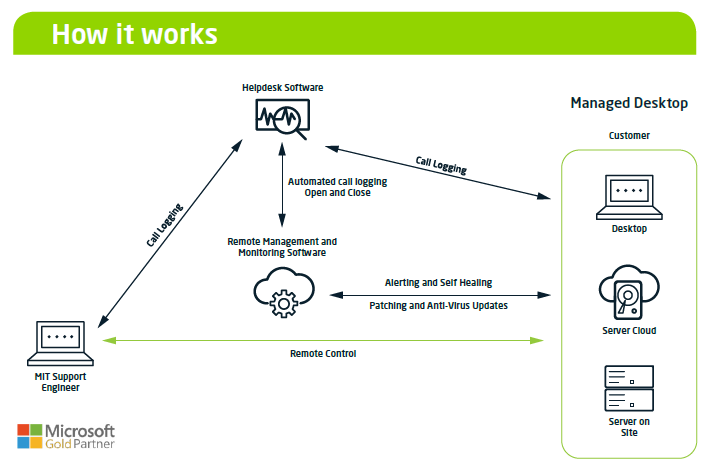
Vox Managed Desktop is a proactive and on demand support service. Access to support is as easy as clicking a Vox support icon. Our industry leading Remote Management and Monitoring (RMM) software allows us to remotely correct issues before they become problems.

Key features of the service  

  • Proactive Monitoring and Reporting
    • Proactive monitoring alerts our team of engineers of any issues within your IT environment so that we can resolve them when they are molehills rather than mountains. This keeps your IT environment healthy.
  • Desktop Support
    • Remote support is only an icon click, email or call away.
  • Patch Management
    • Keeping software current is crucial for businesses today, but in many disciplines, updating features may cause more problems than it solves. This is why our RMM software has full support for Microsoft’s new Monthly Security-Only updates, enabling us to keep your desktop secure while reducing the risk of incompatibilities with your software.
  • Anti-virus
    • Every managed desktop includes the award-winning Bitdefender anti-virus engine.
  • Third party vendor management
    • Vox provides end to end IT management which includes managing relationships with third party vendors.
  • IT asset management
    • Comprehensive IT asset register can be used for warranty, insurance, tracking and tax purposes.

For our onsite customers, we provide a weekly engineer visit to interact with your employees so that small user issues can be resolved quickly and easily.

Our Managed Desktop service can be used by small businesses with five users and more. For larger companies, we offer a dedicated IT resource service, which means you can get an outsourced skilled engineer, backed by a team of engineers.

Jurgen | Vox | Work from home simply, with managed desktop services

Do you need help supporting your staff working from home now? For more information on our current remote desktop support offers, contact your Account Manager.

Online safety: sexual predators in the digital age

The Digital Law Company explains what parents need to know to protect their children from sexual predators online.

Sexual predators have always hung out in spaces providing easy access to children. This has become worse in the digital age. Instagram, gaming chat rooms, Tik Tok – and whatever tomorrow’s next social media craze will be – are the modern-day playground for teens and tweens. They are therefore, also a very popular hangout for sexual predators.

We have seen a dramatic increase of cases where young boys and girls are groomed into sending sexually suggestive photos or videos to strangers. The person poses as a teenager on social media, but they are in actual fact an adult (usually male). These paedophiles prey on multiple victims.

The sexual predator in the digital age is slick and knows exactly how to get the attention of a victim. They set up a profile that a victim would be interested in. The predator then follows and/or likes accounts liked by the victim so that it appears that they have a number of mutual friends. The number of followers and likes on social media is one huge popularity contest: the more followers, the better you are.

Predators rely on fake accounts

We had one particular case at the Digital Law Company where the victim was a 12-year-old girl. Like any girl her age, she wanted affirmation. When a seemingly good-looking 14-year-old boy from another Johannesburg school started messaging her on Instagram – she was really flattered. She happened to be dyslexic and experienced difficulty with text-messaging. She would send the ’14-year-old’ voice notes. The real clincher was when he told her that he too, was dyslexic. It made her feel safe. Comfortable enough to send photographs of herself in her underwear to him. He was actually a 49-year-old (non-dyslexic) man.

In another case – an Instagram page pretended to be an official Miss Teen South Africa account. The account lured hundreds of young girls with the promise of an international modelling contract and R500, 000 in prizes. They were asked to send a WhatsApp to the number of an international modelling scout for the “international model verification process”. Soon enough the “verification process” required that the young girls send photographs of themselves naked. This was not Miss Teen South Africa – it was a sexual predator living in South Johannesburg.

Precaution makes all the difference

What parents have to understand is that the frontal lobe – the impulse control and decision-making part of the brain – is not fully developed until the age of 25. Teens and tweens do not understand the concept of permanent consequences for their actions. They live for instant gratification. Without overseeing what your kids are doing on social media, checking in frequently and having multiple conversations around their online activity; your kids are bound to make the kind of mistakes that have serious and long-term psychological, reputational, and even legal consequences.

So, what can you do to keep your teens and tweens safe from sexual predators?

  1. Ensure your child has a private account.
  2. Have conversations with your child about:
    • Stranger danger and not talking to people they don’t know in real life.
    • Being discerning about who they allow to follow them on Instagram. Explain to your children that being popular on Instagram is like being rich in Monopoly!
    • Blocking anyone who makes them feel even in the slightest bit uncomfortable.
    • Confiding in you whenever they feel upset/uncomfortable or threatened.
  3. Consider setting up a smartphone contract between you and your child to encourage good digital citizenship. You can download a smartphone contract from the Digital Law Company website.
  4. Limit time spent online. There are a number of apps and tools which allow you to limit the time your children spend online or on specific apps. Apple’s Screen Time app and Google Family Link are two free and relatively easy to use options.
  5. Disable location services on the app so that your child’s location is not accessible to others.

The ways in which people engage online changes all the time, and teens and tweens are always the first to jump onto the latest trend. But whatever new technology or app get used, you can be sure that your child is safer when they adopt good cyber-safety practices.

How we at Vox are helping our customers

During these trying times, staying connected is crucial in order to work from home, ensure the children can continue learning, and keep streaming your favourite content.

We are here to help!

Vox, in collaboration with our Fibre Network Operator (FNO) partners, will automatically be implementing the following initiatives. This is to assist our business customers so that they can continue operations while their teams work remotely:

  1. Vox and various FNOs will automatically be upgrading Fibre to the home line speeds, at no additional cost.
    • Frogfoot – current and new customers will benefit from the upgrade up to a maximum of 1 GBs from 1 April 2020 until 30 June 2020. Services will revert to the original speed after this period.*
    • Vumatel – current and new customers will benefit from the upgrade up to a maximum of 1 GBs in April 2020 until 31 May 2020. Services will revert to the original speed after this period.
    • South African Digital Villages (SADV) – current and new customers will benefit from the upgrade up to a maximum of 500 MBps from 1 April 2020 until 31 May 2020. Services will revert to the original speed after this period.
    • Waterfall Access Networks (WAN) – current and new customers will benefit from the upgrade up to a maximum of 100 MBps from 1 April 2020 until 16 April 2020. Services will revert to the original speed after this period.
    • MetroFibre Networx (MFN) – current and new customers will benefit from a 10 MBps top up on all line speeds, up to a maximum 210 Mbps, from 1 April 2020 until 27 May 2020. Services will revert to the original speed after this period.
    • Evotel – current and new customers will benefit from the upgrade up to a maximum of 200 MBps from 1 April 2020 until 31 May 2020. Services will revert to the original speed after this period.
  2. New Vox and Vumatel customers located in areas where Vumatel is already connected, who place orders from now until 30 April 2020 will receive 45 days free subscription from the date of activation.
  3. Capped Vox Fibre to the home customers will automatically receive triple the data bundle usage from 1 April until 31 May 2020 – at no additional cost.
  4. Vox is also offering FREE standard installation and activation on all new sales (T&Cs apply).
  5. Vox ADSL customers will receive triple the data bundle usage  from 1 April 2020 until 31 May 2020, at no additional cost.
    • The upgrade is automatic: current Vox customers don’t need to do anything to enjoy the additional benefits.
    • New Vox customers who subscribe for capped ADSL services during this period will also benefit from the upgrade.

Staying connected is crucial.

Key considerations for an effective Cloud strategy

A Cloud strategy can deliver significant benefits when done right.

For most companies, the cost of running onsite ICT infrastructure has become prohibitively expensive. Critical skill shortages, Eskom price increases and the decline in the rand against the dollar, has resulted in costs escalating by over 300% in the last few years.

However, the recent decline in the currency has also resulted in dollar denominated Cloud platform costs increasing by over twenty-percent.

Now is the best time to evaluate your Cloud strategy – whether your infrastructure is onsite, or already hosted on a Cloud platform.

Implemented properly; a Cloud strategy will deliver reduced costs, reduced HR overhead, new technologies, enhanced efficiencies, and most importantly – better redundancy and uptime.

Where do I begin to look?

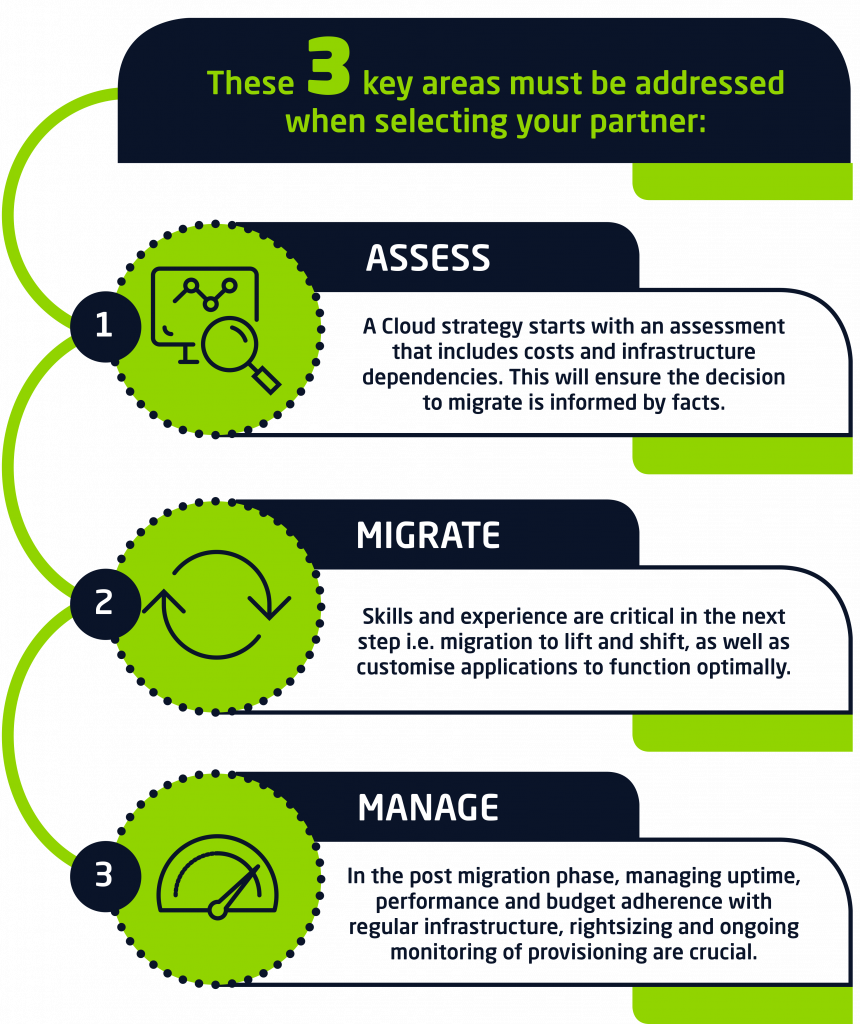
The Cloud journey comes with several key considerations:

  • How much will it cost to move and how much can I save?
  • What can I move?
  • Who has the skills to migrate my infrastructure?
  • How do I find the skills to manage it post migration?

And of course, when in the Cloud:

  • How do I ensure that I adhere to budgets in a world of fluctuating currency and consumptive-based models with on-demand provisioning?

The reality is that today, up to 30% of Cloud migrations result in a roll back to onsite infrastructure, whereas up to 70% of Cloud implementations will experience budget overrun. Without ongoing management and oversight, even the best implemented Cloud strategy will start to exceed budget over time.

Enhancing your strategy is as easy as 1,2,3

Vox offers a three step process for customers looking to move to the Cloud or enhance their current Cloud strategy.

3116.2 CloudMIT Mailer Campaign Infograph V4 24032020 FA 2 | Vox | Key considerations for an effective Cloud strategy


With the current lockdown in place, now is the perfect time to do a remote assessment of your current environment – Cloud or onsite. Let Vox give you a definitive road-map to enhanced and ongoing savings and efficiencies.

Contact your Account Manager or email assessments@voxtelecom.co.za to book an IT assessment today.

ICT services are essential – especially during lockdown

ICT services, specifically fixed and mobile connectivity, have been classified as “essential services” by the President – and confirmed in the regulations issued under section 27(2) of the Disaster Management Act, 2002, on 25 March 2020.

Our government has made it clear that it is an urgent priority to expand and maintain our country’s telecommunications network to allow South Africans to work, study and interact online.

In support of this key directive, we assure customers that we have deployed our organisation’s resources towards ensuring our personnel, infrastructure, policies and procedures are in place. We do this in order to continue to maintain our network, and to install and support our entire range of ICT services, as we are obliged and mandated to do.

Supporting customers is our priority

We are fully operational, and the following critical customer service departments continue to run 24/7:

    • Vox Service Centre
    • Managed services and advanced customer support desks
    • Guardian Eye Nerve Centre
    • Vox Core

Installations and projects continue with as little interruption as possible, subject to the enhanced safety policies we have implemented. Where practical, we have introduced remote and self-install options for customers. Our Finance, Account Management and Sales teams are working remotely and continue to service our customers.

Safety practices to keep us all safe

We are uncompromising in our goal to ensure our new customers are provided with services, and our existing customers remain fully operational. We are also steadfast in ensuring the safety of our team and that of our customers.

To this end we have implemented all the policies as directed by our government and institutions such as the World Health Organisation. Including, but not limited to, the following:

  • Equipping all our administrative and sales personnel (nationally), to work from home, adhere to the lockdown regulations, and continue their essential functions in servicing our customers and business partners.
  • Utilising all the technology at our disposal to ensure the efficient operation of our organisation, uninterrupted communication both internally and with our valued stakeholders.
  • Ensuring ongoing levels of hygiene throughout our operation.
  • Educating our field personnel, enforcing required personal hygiene practices, and equipping them with the protective gear (masks, gloves and hand sanitiser). These practices ensure the safety of our customers and employees when conducting on-site technical work.

Our priority is the continued safety of our customers, staff and contractors. We ask that our customers provide us with any relevant feedback at talk2us@voxtelecom.co.za or at 087 805 0500.


Fibre is Critical to Serving the Country in its Moment of Need

It has been almost a week since South Africa joined several other countries around the world in locking down to limit the spread of the coronavirus. But beyond the impact this has had on people’s lives, it has highlighted how essential access to reliable, high-speed Fibre infrastructure has become for the economy to keep going.

It should come as no surprise that the government has identified it as a critical service. Fortunately, many people are still able to work remotely and fulfil most of their job requirements, albeit in a digital-centric way. Broadband penetration is critical to the economy. In a study conducted by the World Bank, it was proven that for every 10% increase in broadband penetration there is an increase between 1.19% and 1.35% rise in GDP. South Africa is in desperate need for all kinds of economic stimuli, hence the importance of keeping these services running during a lockdown period,

Of course, this entails more than just video conferencing and sending more emails. It reflects a fundamental shift in business approach that will enhance how companies operate.

Once the lockdown ends, the landscape would have evolved to such an extent that nothing will return to normal.

This push to allow for working from home, has put pressure on IT departments to ensure systems still run smoothly. If anything, it has illustrated that aging connectivity such as ADSL can no longer be relied upon. And while much is made about the user-friendliness of wireless technologies such as 4G, LTE, and 5G, the high cost of mobile data and the incapacity of the networks to deal with the influx of demand does not make it a viable option either.

One of the challenges mobile operators face is high contention rates. This means that the more users are on their networks, the slower access becomes. We have seen LTE users experience a speed decrease from 20Mbps to just 0.6Mbps when people started flooding video streaming sites rendering them virtually unusable. And beyond zero rating data to limited educational resources, the mobile providers have given little by way of a fresh value proposition to consumers during this difficult time. The recent price reduction was long overdue and is still not close to rates offered by the Fibre operators.

For their part, many Fibre operators have provided consumers with upgrades that automatically doubled their line speeds, free installations, increased capped products by as much as three times. This faster access is essential given how consumer usage patterns have now changed from download only to needing to upload data as well.

These changes have seen application marketplaces experience a significant shift in focus. During the week of 14 to 21 March, business apps topped 62 million downloads globally, an increase of 45% over the previous week.

Furthermore, Google has made the premium features of its Hangouts application available for free and Microsoft is offering a free six-month subscription to Microsoft Teams, to name just two examples of how changing consumer behaviour is transforming the market dynamics of connectivity solutions.

One of Fibre’s strengths is its scalability and capacity – it is virtually unlimited.

This means users’ line speeds can be upgraded in real-time with no disruption. And because it provides a smooth transition to the Cloud, Fibre also enables companies to automate many administrative-intensive processes thereby freeing up users to deliver more strategic value to the business.

Embrace the new

It is now an opportune time to look at embracing new ways of working and engaging with one another.

Take schools and institutions of higher learning for example. The situation has forced them to start working on distance learning options. If learners cannot return to school, e-learning becomes essential to help them keep up with work. This highlights the significant digital divide in the country where millions do not have access to the systems to allow for this to happen.

This requires educators to think differently and look for viable alternatives. It could very well pave the way for SMEs to come up with more innovative ways of educating and working in this time of crisis.

On the corporate side, the lockdown has forced many companies’ hand in getting them to examine how best to use Cloud-based business tools. This is critical if remote workers are to be empowered and help organisations remain fully functional during the lockdown.

Some of these tools can encompass everything:

  • Transitioning the PBX into the Cloud that redirects company calls to employees’ mobile phones,
  • Embracing unified communication solutions such as Microsoft Teams to ensure team members are still in touch with one another and can deliver on their project deliverables
  • Using the Adobe Sign e-signature service to send, sign, track, and manage signature electronic document processes.

But irrespective of the solutions used, the common denominator is having a fast, reliable connectivity infrastructure. Therefore, Fibre network operators have a critical role to play in the country and must take this responsibility seriously.

Vital to adapt

Agility has become essential for survival. Society must work together to address the critical needs in the country. To this end, people must collectively take ownership of the issues faced. For example, parents need to be more involved in their children’s education and employees accept the responsibilities that come from working from home and ensure that they are disciplined.

South Africa is already starting to see this change. Fewer vehicles are on the road meaning people are spending less money on petrol, there are reduced emissions that benefit the environment, and fewer traffic officials who can be used to assist police and the military with other, more essential services. Small entrepreneurs will start to broaden their target markets placing pressure on large corporates to improve their value proposition.

Once the lockdown ends, it will be evident that Fibre can create a better life for people while still enabling many to continue to do their work.

There are lessons to be learnt from this as the country starts accepting this more effective way of working instead of trying to return to how things were.

Fibre has evolved from a luxury to becoming a utility such as electricity and water – one that has become essential to help grow the economy. Fibre will allow customers to accelerate the migration to Cloud based services as it provides higher speeds, no contention ratios, and higher reliability. As a Fibre network operator, Vox is taking its responsibility very seriously and will use this period as an opportunity to continue serving in the best interests of the citizens of the country.

 

Have your security on lockdown over the Lockdown

As the hard reality of the COVID-19 hits us, businesses have had no other alternative but to instruct employees to stay home and work remotely, resulting in a global shift on how the economy, daily life and human interaction unfolds over the next few weeks.


Unfortunately, these rapid changes have created a threat of exploitation and opened up opportunities where cybercriminals thrive and sweep in to take advantage of the situation, thus putting systems in jeopardy and increasing the risk of ransomware attacks and phishing, especially those that don’t necessarily have adequate IT security measures in place.  The conditions are ripe for cyberattacks of every sort.  It is no wonder that since the COVID-19 outbreak, hospitals and other medical facilities across the globe have been victims of security breaches with sensitive data being held ransom or simply disrupting the operations of such institutes.

It’s a given that people working from home have fewer security defences on their home networks than they would have in the office – think firewalls and VPN vulnerabilities – coupled with stressful times and possibly more distraction than usual, thereby creating a situation whereby they are more likely to fall for malicious scams and hoaxes.

It is therefore extremely important for companies and IT Departments in particular, to continuously communicate with and educate staff on how to be vigilant and exercise caution when clicking on outbound links,and continuously remind them on the negative repercussions that can have.  Also, with more children being at home using streaming services and video games, the home network is further compromised.

So, what should the home worker be looking out for?

Be vigilant and wary of online scams

Unfortunately scammers use current situations like the COVID-19 pandemic to prey on collective fear and ignorance for their fraudulent activities.  They will for example, send emails, malicious domains, or fake applications claiming to provide important information when in fact they bear malware.

Beware of phishing

The hacker’s goal is to get a user to click on an emailed link that downloads malicious malware – don’t click on links from unknown sources!  Only download or install software from trusted sources and verify that the URL of any website that asks users to enter a password is accurate – hackers often set up URLs that are similar to real websites to harvest passwords.

Prevention is better than cure
  • Change default passwords on your home wifi router to prevent hackers from accessing your network, and practice regularly changing your router password if it has previously been shared with others.
  • Use strong and unique passwords (at least 10 characters including special characters such as @#$&) on every account and device.
  • Look out for updates from your employer and IT Department – it’s also important to be up to date on new policies to help keep you and your company safe.
  • Stay current on software and updates and security patches – keep all devices, apps and operating systems up to date. When you get reminders, don’t wait – update!
  • Protect smartphones in the same way as laptops and ensure that they are updated with the latest firmware versions which must be downloaded from legitimate apps from official stores.
  • If you have to use personal equipment, keep it as close as possible to office security standards by following your company’s data protection measures
  • Remember that your company laptop is for your use only – do not allow other members of the household to use your company equipment.
  • Back up your work using USBs or external hard drives in case of connectivity failure
  • Since the whole family is working and studying from home, remember to create a safer digital environment by employing a home network security that not only protects your network against hackers, but also blocks and filters sites, thereby blocking inappropriate sites and content and controls social media usage.
  • And lastly, educate the family around online safety. Ensure that all members of the family understand the dangers of the public nature of the internet.


Just as the world is being urged to practice hygiene for the COVID-19, so should we practice safe online hygiene.


Remote Working: It’s not that bad

They say that life happens in moments and a defining one in my life was when President Ramaphosa called his first press conference on the 15th of March and began to lay out his plans to flatten the COVID-19 curve.

I am a first-generation South African from Italian and Spanish heritages, and with all my family in those respective countries, this for me was a defining moment. I knew, from my family, that shutdown was inevitable and that it was time to set those remote working wheels in motion.

Our marketing team consists of 12 people, each with their complex portfolios and schedules. Interestingly though – maybe because we are used to working with technology, or as perhaps as South Africans we are just so robust – when my team and I decided to start working from home on the 18th of March, they didn’t appear terribly concerned.

The biggest worry from the team was naturally connectivity, and if our different ways of connecting would fail us in any way. We never doubted we could work from home; it was just about figuring out the HOW.

Technology is just a way of life and we’re making use of the following different sets of technology:

  • Skype – We have an existing channel that we all chat on for quick work-related conversations. We also use it to hold our stand-ups every morning at 8 am.
  • Vox Vobi – Not to sound self-promoting, but this is an awesome app. We all have softphones on our cell phones, and if we need to make business calls, we use that instead of our airtime/data. Nice and clean cut. Work is work, private is private.
  • Clarizen – We also use a project management software called Clarizen as our marketing collaboration tool. We track all our jobs and changes on each campaign element. We also monitor our hours, for the sake of transparency.
  • MS Teams – We use Teams to keep our all centralised documents. While we do our stand-up in the morning, our Kanban board is updated and everyone has easy access.

Things I have been surprised about:

  • Everyone seems so much calmer. Maybe it’s not having to sit in hours of traffic, for just being in the comfort of home. But there is a sense of calm.
  • The team is working longer hours. It seems like everyone is just more focused on fewer distractions. We have a mandatory lunch hour everyone goes on, but everyone is back before the hour is up.
  • With more focus comes a higher quality of work. I see how we give each other more detailed and better thought out feedback than before.
  • Meetings are SHORT!!! Everyone gets to the point so much faster. One-hour meetings have reduced to 30 minutes or less.

Things that are annoying:

  • We can’t hear you!!! I must be a real sight at the moment. At times I am entirely hunched over my PC screaming into the mic. The neighbours can all hear me a mile off, and they all think I have a frightfully exciting job. I don’t understand why each platform on which I communicate, my mic volume is different. It’s a mystery to me.
  • Getting comms from every direction: Skype, email, WhatsApp and phone calls. Can be a bit overwhelming at times. But I am learning to use the mute or closing certain things off to concentrate better.

All in all, so far so good. I was reflecting last night that thank goodness, I have my job to keep me busy and my team to constantly chat to. It makes long days go by fast and gives me the courage that we are going to be just fine through the shutdown period.

PS: I would take a picture of myself at my makeshift office, but I thought a pic of this young man is much easier on the eyes.

What has your experience been like? I’d love to hear it. Leave your comments below.

The impact of data deflation on Fibre for business

With South Africa joining many other countries around the world shutting down in efforts to combat the spread of the COVID-19 pandemic, the focus will turn to digital solutions to help people get on with their daily lives as best as possible.


Considering that fibre to the business (FTTB) pricing is now more affordable than DSL, it makes sense to investigate going this route for companies across industry sectors.


Digital engagement is only going to increase as a result of this week’s government announcements as more companies are looking at ways to empower people to work remotely. Even those in the services sector will need to consider providing customers with more value-adds as the economic impact of what is happening will be far-reaching.


Of course, this means that people will need to be incredibly disciplined to work remotely. But even though many home users in major suburban areas have installed fibre, in most instances this has been geared for a download-first experience. Things like movie and music streaming are all designed to have fast download speeds with not many giving any thought to creating symmetry with uploads.


As home offices will grow during this period more attention must be paid to configuring fibre to upload large work files and be conducive to video conferencing. This will see the focus turn to the unlimited upscalability of fibre that delivers a ‘cleaner’ internet experience as opposed to ADSL.


Cost market

Prior to this week’s developments, a fibre link from Vox that used to cost business R6,000 is now less than R900 in certain precincts. This has been designed to make high-speed connectivity accessible to companies of all sizes. Unfortunately, not many small business owners are aware of the price shift and understand what this data deflation means for them.


It is especially in a retail environment where it is difficult to get in touch with business owners as opposed to customer-facing staff and explain the advantages of going the fibre route. Even though these store environments have been looking at enhancing the customer experience, it has not been that much of a strategic focus. But what is happening now means more shop owners will have to look at creating a rich customer experience to truly differentiate themselves.


For example, a hair salon might not even have considered offering WiFi to customers leaving them to rely on their own mobile data to while the time away while having their hair done. By installing fibre, the salon can radically transform how people engage during their time there by having high-speed, high-quality, and free WiFi available to them.


At a time of crisis, customer experience will be everything. So much so that people will pay more for things if they feel they are treated with significant value-adds. Fibre can therefore radically transform the customer journey in this regard.


Economic impact

Even so, many underestimate the financial impact COVID-19 will have on the country. Currently, consumers are mainly buying food and toilet paper as opposed to new cars and hi-fi systems. Pharmaceutical companies are making money as people turn to vitamins while plastic bags to store the goods in are also hot property.


The rest of the market is taking a backseat with restaurants especially hard hit. This negative impact on the economy could potentially lead to bad debt as spending patterns shift. The knock-on effect will likely be job losses and an increase in crime.


Fibre provides a counter-balance to this. Contrary to perceptions that it is expensive, it has become affordable to all market segments especially when compared to slower, less reliant ADSL offerings. But even at a lower price point, it unlocks numerous business opportunities. For example, being able to more effectively access the cloud, use converged communication, collaborate with people anywhere in the world, and of course uncapped voice termination to name but a few.


Unlike wireless services, fibre is not contended. In other words, users have a dedicated connection for themselves and do not have to share bandwidth with anyone else in the neighbourhood or office block. It also scales far more easily than any other technology so businesses can easily upgrade their connectivity as required. This all contributes to an improved customer experience for businesses who provide access as part of their value adds.


But one of the fundamental advantages of having access to more affordable fibre is that companies can eliminate the risk of being reliant on one link to access all their converged communications. At such a low price point, they can easily de-risk themselves and adopt a far more effective, redundant strategy.

Affordable email archiving for SMEs

Email continues to play a vital role in the modern business, with employees using it for engaging with others – whether internally with colleagues or externally with customers, suppliers, sales partners and others.

Integrated ICT and infrastructure provider Vox has launched a cloud-based email archiving service, which is aimed at providing small and medium-sized South African businesses with peace of mind that their email environment is protected in case of a cyber attack, equipment failure, or even accidental deletion.

“For smaller organisations, it is likely that their email inbox acts as a repository for critical business documents such as quotes, invoices and email-based agreements, while their email contacts list serves as the backbone of the company’s customer relationship management efforts,” says Mayleen Bywater, Senior Product Manager for Email at Vox.

The risk for business, however, is that email is increasingly the target of cyberattacks, with methods such as malware, ransomware or spyware attachments, being used to cripple business and hold their data hostage unless payment is made to the hackers. Even beyond having to deal with criminal elements, disaster could strike simply through equipment failure or data corruption.

“Vox Archiving provides local SMEs – ideally with between one and fifty users – with a cost-effective method of storing their email data, and complements their existing archiving and storage, by acting as an alternative repository so that emails can be restored even if they were accidentally deleted. Companies can even share their emails with legal entities should they be required to do so,” adds Bywater.

Vox Archiving comes with unlimited storage, so users do not have to worry about how much space their email inboxes take up, and stores users’ data for up to ten years – longer than most business regulations that require businesses to retain documentation for between five and seven years. This means that while it is primarily aimed at smaller businesses, it can work just as well for larger enterprises.

According to Bywater, all email data will be stored in local data centres – ensuring that customers making use of the service remain compliant with data residency or sovereignty regulation – with built-in redundancy to ensure that information is protected and available when needed.

In addition, Vox can cater for customers who have existing email archives and want to consolidate all their information into a single location, with the service being carried out at a minimal per gigabyte cost.

“Vox Archiving is billed per user, per month, at the maximum number of ‘live’ users over the period, meaning they do not pay for the archival of email inboxes of employees who have since left the organisation. This means that customers can scale up and down the number of users as and when needed,” says Bywater.

Vox Archiving is available to business customers at the cost of R32 per month per active email inbox user with a minimum of 5 users per client and subject to the signing of a 12-month contract. The service complements any email platform; as long as a journal link can be created to connect the inbox and the archive. Visit the Vox website for more information.