Cyber Attacks on Small Businesses

Cyber attacks on small businesses are on the rise – why SMEs are more vulnerable to cyberattacks, and how to stay safe

When we think of cyberattacks, we often picture a giant corporation with hackers trying to break into a billion-dollar cyberdeck (we blame the movies). The truth, however, lies on the opposite end of the spectrum – cyberattacks on small businesses are rising.

Thi is mainly because many SMEs have limited budgets, outdated systems and minimal staff training. Put simply: attackers go where the doors are easiest to open.

Think of it like this: large corporates invest heavily in security teams and layers of protection. Smaller businesses are often leaner, making them attractive targets for opportunistic hackers. Below we explain why, and give practical, affordable steps you can implement right away.

 

business 3639565 1280 | Vox | Cyber Attacks on Small Businesses


Why small businesses are vulnerable to cyber attacks

Limited budget = limited defence: Large firms can afford dedicated security teams, regular audits and enterprise-grade tools. Most SMEs operate on tight margins, so security is often deferred. That can mean unpatched systems, basic antivirus only and no 24/7 monitoring — an invitation to attackers.

A false sense of security: Many small business owners assume they’re “too small to matter”. In reality, cyber criminals treat SMEs as low-effort, high-reward targets. Simple breaches multiplied across dozens of businesses still pay off.

Human error and lack of training: All it takes is a click. Yup. Just one innocent click from a person who doesn’t know better can take down an entire organisation. Employees without regular training often can’t spot scams, dangerous links, or social engineering tricks. Good habits are the frontline defence.

Weak Passwords  and Outdated Systems: Is your team still using the hand-me-down PC that needed replacing about 4 years ago? And when was the last time anyone – ANYONE – updated their software? Nothing screams entry point like an unpatched system. Combine this with weak or recycled passwords, and you’ve basically left the front door open. Attackers scan for known vulnerabilities — if your systems aren’t updated, you’re presenting an easy route in.


Practical Steps Every SME Can Take Today

You don’t need a military-grade budget to reduce risk. Adopt these practical measures and you’ll significantly lower your exposure to cyberattacks on small businesses.

data privacy 9611620 1280 | Vox | Cyber Attacks on Small Businesses

Maintain cyber hygiene

  • Keep operating systems and applications up to date.
  • Apply security patches promptly.
  • Use a password manager and enforce strong, unique passwords.
  • Enable multi-factor authentication (MFA) for all critical accounts.


Train your people regularly

  • Run short, frequent sessions on spotting phishing emails, suspicious links and safe browsing.
  • Make cybersecurity part of employee onboarding and monthly refreshers.


Backup and test backups

  • Use both cloud and offline backups for critical data.
  • Test restores regularly so you know your backups work when you need them.


Invest sensibly

  • Move beyond free antivirus. Affordable endpoint protection, email filtering and a good firewall make a big difference.
  • Consider managed security services if you don’t have in-house expertise — they can be cost-efficient for SMEs.


Have an incident response plan

  • Know who to call and what steps to take if you detect a breach.
  • Assign responsibilities, contact details and a communication plan to minimise disruption.


Quick Checklist — Low-Cost Steps to Reduce Risk Now

  • Update all systems and software this week
  • Enable MFA on business email and admin accounts
  • Start monthly phishing-awareness emails/trainings
  • Implement a password manager and roll out strong passwords
  • Schedule automatic daily backups and test restores monthly
  • Put an incident response contact list where staff can find it


It’s not that small businesses don’t face the same threats as larger ones, but rather they face them with far fewer defences – which is exactly what makes them such attractive targets. However, by combining the correct mindset with easy, practical steps, you can go a long way to reducing this vulnerability.

You don’t need to build Fort Knox – you just have to make sure your doors are locked in order to sleep at night.

Stay safe, stay secure, and stay cyber smart.

Vox has partnered with global cybersecurity experts Sophos for cybersecurity solutions and we are easily able to cater to the needs of SMEs – contact us to find out more.


Some Frequently Asked Questions

Are small businesses at greater risk of cyberattacks?
Yes. Many small businesses have fewer security resources and less training, making them easier targets. Attackers often target SMEs for the same reasons they target larger firms: for data, money or to use compromised systems as launch points.

What types of cyberattacks target SMEs?
Common attacks include phishing emails, ransomware, credential theft, business email compromise (BEC) and unpatched software exploits. Phishing and ransomware are particularly damaging for small businesses.

How much should an SME spend on cybersecurity?
There’s no one-size-fits-all number. Start with basic protections (patching, backups, MFA, endpoint security) and scale from there. Many affordable solutions and managed services are tailored to SME budgets.

How often should employees be trained?
Short, regular sessions (quarterly or monthly refreshers) are ideal. Frequent reminders, simulated phishing tests and clear reporting steps help keep awareness high.

What should I do immediately after a cyberattack?
Disconnect affected systems if safe to do so, preserve logs where possible, notify your IT/security provider and follow your incident response plan. Report significant breaches to relevant authorities and affected parties as required.

Are backups enough to protect my business?
Backups are essential but not sufficient on their own. They protect your data from loss and ransomware, but you also need preventive measures (patching, MFA, endpoint protection) and an incident response plan.


Costs of a Data Breach to Your South African Business

Money, reputation, customers: A cyberattack is costly in multiple ways

It’s estimated that cyberattacks will cost the South African economy R2.2 billion in 2025. That’s according to a recent Vodacom Business report, which revealed that 80% percent of South African businesses had experienced a cyberattack during 2024.

These are incredibly high numbers.

Firstly, the fact that 8 out of every 10 local businesses was attacked last year underscores the persistence and determination of cybercriminals as they attempt data breaches.

As for the resultant costs of a data breach – R2.2 billion – these add up in a number of different ways, both directly and indirectly.


cost 1174936 1280 | Vox | Costs of a Data Breach to Your South African Business

Firstly, there’s the ransomware that must be paid if the cybercriminals succeed in breaching an organisation and encrypting its data. The attackers then demand a ransom to provide the decryption key and restore access, sometimes threatening to leak stolen data if the payment isn’t made.

Even if the organisation pays the ransom, this is not always a guarantee that the decryption key will be handed over. It seems that there isn’t always ‘honour among thieves’.

In addition, there will be incident response and recovery costs to pay, with significant expenses for hiring in consultants to carry out recovery efforts, forensic investigations and system restoration.

But these direct costs aren’t the end of the story – indirect costs are also incurred as a result of a successful cyberattack.

This includes through operational downtime, leading to lost productivity and revenue; reputational damage, causing potential new customers choosing to go elsewhere; and legal and regulatory costs, with companies facing possible fines from regulatory agencies for failing to protect sensitive data (and there may even be lawsuits from affected parties).


Costs of a Data Breach in South Africa

cyber 3324202 640 | Vox | Costs of a Data Breach to Your South African Business 

Over the past two years, advancements in artificial intelligence and machine learning have equipped cybercriminals to orchestrate and successfully execute sophisticated cyberattacks. From phishing, malware, ransomware, identity theft, hacking, social media fraud to social engineering, cyber threats are no longer simply a technology problem but a business problem.

South Africa is no exception – we were recently ranked as being the number 1 target for cyberattacks in Africa. No matter its size, every business is a possible target for cyberattackers[1].

Other frightening statistics include the following:

  • 40% of ransomware attacks in Africa recently occurred in SA; and
  • We also claimed 35% of infostealer incidents across the continent.


Factors contributing to SA’s #1 position as most attacked country in Africa include:

  • A lack of cybercrime investment;
  • Ineffective law enforcement prosecution; and
  • Lack of awareness.


Cybersecurity incidents on government bodies, such as the South African Weather Service and the National Health Laboratory Service, and well-established brands like Dis-Chem, show how vulnerable local organisations can be in the face of these rising threat levels.


How to Reduce the Expected Cost of a Data Breach

Organisations that proactively reduce their attack surface and improve recovery capability materially lower the potential cost of a breach. Focus on four priority areas:

Prevent

  • Deploy layered defences (endpoint protection, firewall, email security and web filtering).
  • Train staff regularly on phishing, social engineering and secure practices.
  • Apply strong access controls and multi-factor authentication.


Detect

  • Implement continuous monitoring and logging to identify anomalous behaviour quickly.
  • Use managed threat detection services where in-house capability is limited.


Respond

  • Maintain a tested incident response plan with defined roles, communication templates and escalation paths.
  • Engage forensic and legal partners on retainer to reduce response time.


Recover

  • Ensure immutable, tested backups and documented recovery runbooks.
  • Use segmented network design and least-privilege policies to limit lateral movement.


Protecting Your Organisation from Cyberattacks

cyber security 1784985 1280 | Vox | Costs of a Data Breach to Your South African Business

firewall is your network’s first line of defence against the cybersecurity threats of the public internet. You could think of firewalls as the gatekeepers to the public internet for your network users, filtering out threats and enabling them to connect safely to the sites and applications where they need access to do their work.

Existing as both hardware and software, firewalls are designed to restrict access to your organisation’s sensitive data while helping you monitor your network for suspicious activity.

Too many organisations still see cyberattacks as an irrelevant global problem, not a high-risk local threat. It’s imperative to make sure that your company has the necessary defence mechanisms in place, starting with identifying the risks and implementing an incident response plan.

Contact Vox and Sophos to find out more about how we can assist you.


Frequently Asked Questions

What is the typical data breach cost for South African businesses?
Data breach cost varies widely, but South African firms face direct and indirect losses including ransom payments, recovery, legal fees and reputational damage, often totalling tens of thousands to millions of rand.

How does ransomware affect data breach cost?
Ransomware dramatically increases data breach cost through demanded payments, extended downtime, forensic investigations and possible double extortion, as well as the risk that paid ransoms do not yield reliable decryption.

Are small businesses in South Africa at risk of cyberattacks?
Yes, small businesses are frequent targets. This is because limited budgets, weak defences and lack of awareness make them vulnerable, increasing the likelihood of high data breach cost and reputational harm.

What are the most common cyber threats facing South African businesses?
Phishing, malware, ransomware, identity theft and social engineering are most common, driven by AI‑enhanced tactics and posing major challenges for cybersecurity South Africa across sectors.

How much does operational downtime add to the overall data breach cost?
Operational downtime can multiply losses through lost revenue, reduced productivity and contractual penalties, often matching or exceeding direct remediation costs in severe incidents.

Is paying a ransom a reliable way to restore data?
No. Paying a ransom is risky, because attackers may not provide decryption or may demand more, and paying can increase overall data breach cost and legal or ethical complications.

What indirect costs should businesses anticipate after a cyberattack?
Anticipate indirect costs like reputational damage, customer churn, regulatory fines, legal claims, increased insurance premiums and long‑term loss of market trust, all contributing substantially to data breach cost.

What practical steps reduce data breach cost and improve cybersecurity in South Africa?
Implement firewalls, regular backups, employee training, incident response plans and patch management; invest in monitoring and third‑party partnerships to lower data breach cost and strengthen cybersecurity South Africa defences.


[1] Source: Newzroom Afrika

Enabling People Through Technology

People of Vox: Spotlight on Natalie van der Merwe

“Technology is best when it brings people together.” ~ Matt Mullenweg

As the Vox Head of Products: Telephony, Natalie van der Merwe is another long-serving Vox employee who embodies so much about what makes the company great. She’s smart as a whip, innovative in her thinking, excited about technology and how it can empower people’s lives, and an all-round ‘Just Plain Nice Person’ who is loyal to the core. As such, she embodies many of Vox’s values and is a great fit within our ‘work family’.

Natalie also played a significant role in facilitating remote and hybrid working arrangements for so many Vox customers when Covid struck the world in 2020 – more on this later!

Having joined in July 2008, she’s now clocked up 17 years at Vox and is surprised to find that the next big milestone – 20 years – isn’t that far off. Let’s dive into Natalie’s pathway at Vox.


The Journey to Date

“The great growling engine of change – technology.” ~ Alvin Toffler

“I feel like I’m part of the furniture at Vox now,” says Natalie with a smile when we talk about her recent 17-year work anniversary. “Actually, no – not part of the furniture, because the furniture’s come and gone more than I have!”

Natalie cropped2 | Vox | Enabling People Through Technology

She explains that “Telephony is just another word for PBX, really. So it’s always been PBXs since I started with Vox, with my role and the parameters changing over time.”

Natalie started at Orion Telecom, in 2008, which was then bought by Vox. Before that, she’d been in the PBX industry since 2000. “When I joined, I discovered that, while Orion was trying to get into the PBX industry, they were still very newly in this space, so I was able to put my experience to good use in helping to build up this new side of the business.”

Since then, says Natalie, Vox has probably offered its customers over 10 different types of PBX solutions while she’s been on board. Her passion and talent meant that she moved swiftly from starting out as a PBX Product Manager to becoming a Senior Product Manager, and then promoted to Head of Products: Telephony.


From Hardware to the Cloud

“Our business is about technology, yes. But it’s also about operations and customer relationships.” ~ Michael Dell

62bad55ed7d2e1904f805d38 phone | Vox | Enabling People Through Technology

“When I first started in this industry, even before my Vox days, telephony was very much a hardware business,” says Natalie. “A PBX was something that you sold – it got installed at the customer’s office and everybody could see, touch and feel it. And then we had an evolution!

“I remember that I was about two or three years in at Vox – around 2010 / 2011 – when we launched our first cloud PBX, which was challenging for me at the time – and no doubt for most of my industry peers – because I’d never been involved with cloud PBXs previously But, as technology marches continually forward, we made the shift.”

Natalie clarifies that from Vox first starting to sell cloud PBX systems, up until early 2020, there was still a significant amount of hardware being sold. “However,” she notes, “at the same time, there was also a serous chip shortage globally, which was a really big issue, because many of the components of the products that I sold needed these chips to function.

“Simultaneously, the word was starting to spread about the advantages of cloud telephony options, with its features that included video calls, remote working and mobility. And then, of course, Covid arrived, with the result that everything just speeded up – significantly!”

Before the first whispers of a frightening new global pandemic started doing the rounds in early 2020, Natalie and her team had already been looking into cloud PBX options, which was to prove highly fortuitous.


The Covid Pandemic Kicks Cloud PBX into Play…

“What new technology does is create new opportunities to do a job that customers want done.” ~ Tim O’Reilly

remotwork Covid 5071617 1280 | Vox | Enabling People Through Technology

“I’d started looking at a couple of cloud PBX competitors, and we’d done some testing. I’d even started out some research and development (R&D) projects before Covid loomed. And so, when it did arrive, we were able to move very quickly, launching around July / August 2020.

“When you think that we went into lockdown at the end of March that year, it was just four months later that we were able to launch and offer our customers fully tested and researched cloud PBX solutions to help South Africans continue working remotely, as efficiently as possible.”

Four months is an astonishingly short timeframe in which to launch a new product!

Natalie continues: “We sold our first PBX solutions as semi-cloud. After that, in just under a year, we went completely cloud-based, and we haven’t looked back! It provides all the functionality to facilitate ease of remote working, and everything a business needs for unified communications, with its core components of voice calling, messaging and video conferencing.

“Those phrases were such buzzwords just 10 years ago, but they really started coming into play in South Africa for us during Covid. At Vox, we were very proud to be able to help South African businesses and individuals carry on thriving during Covid and beyond. Having the right technology and tools really can make life better.”


On the Home Front

“Innovation is the outcome of a habit, not a random act.” ~ Sukant Ratnakar

Moving away from Natalie’s work persona, we find that she has an interesting heritage, with her father being South African ‘to the core’, and her mother born in Italy. Natalie herself was born in the small Karoo town of Beaufort West, where she lived with her parents for the first year of her life.

“My mom came over with her parents on a ship from Italy – as you did in those days – when she was about four or five. I’ve gone over to see where she originally came from, and where my grandparents lived, which was very special. “I’m also married – to my high school sweetheart – and we have a beautiful 15-year-old daughter who keeps us very busy, as all teenagers do.”

Besides doing some very worthy charity work in her spare time, Natalie relaxes and unwinds with a group of friends who all like to craft. “We get together every couple of months to do something creative. So far it’s involved a lot of painting, for example we’ve painted welcome mats, canvases, bags… We’ve also tried out lipstick making, a macrame class, making chocolate truffles and doing ‘zentangling’… It’s nice to just de-stress and have a good laugh with your friends.

20250826 174138 resized | Vox | Enabling People Through Technology

“I still do ‘zentangling’ in my spare time, which is so much fun! It’s actually just scribbling, but you get patterns and you create… Instead of scrolling on my phone at night, I grab a book and the zentangling is a great way to clear my mind a little bit.”

IMG 20250215 WA0009 resized | Vox | Enabling People Through Technology

Natalie works from home three days a week and is at Vox’s Johannesburg head office for the other two, an arrangement that suits her. “It’s great to have the option of really getting through my work while I’m at home,” she clarifies, “but those couple of days in the office also serve to re-connect with my colleagues, and experience the company’s energy and friendly vibe. I’m very fortunate to work with team members who are very hands-on and helpful, and always happy to learn new things.

“I think that Vox’s employees are one of the company’s greatest strengths – our culture is one of hard work, but also being prepared, always, to reach out a helping hand whenever anyone has a need.”

And of course, it’s partly thanks to Natalie and her team that Vox employees – and customers – have the option of being able to work from home in the first place, using Vox’s cloud-based telephony and unified communications solutions!


A Constantly Evolving Journey

“It’s not that we use technology, we live technology.” – Godfrey Reggio

As well as Vox’s friendliness and family vibe, Natalie appreciates the company’s culture of innovation, its agility and senior management’s open-door policies.

“In a way it never actually feels like I’ve worked for the same company all this time, because there have been mergers and acquisitions, new CRM systems, and of course an ever-evolving succession of new product offerings. Within our industry, technology changes so quickly that sometimes it’s challenging to keep up.

“It means that yes, you’re on your toes, but it also means that you’re always offering, or preparing to offer, something relevant. The next thing is always coming along, which is fun and enjoyable. And so that’s a great thing about my job – there’s never a dull moment, and my work is always interesting!”

Natalie believes that the world is at the next phase of a massive change with the advent of artificial intelligence (AI).

“This will affect the work of anybody who’s selling tech and services – it’s the next evolution! And in the technology world, if you’re not on the bandwagon with what’s happening, you’ll be left behind. If Vox had never launched that first cloud PBX, where would our telephony division be today?”

“Technology like art is a soaring exercise of the human imagination.” – Daniel Bell


Natalie art 1 | Vox | Enabling People Through Technology

Your Company’s Telephony Needs: the Right Choice

Considering the differences between traditional and hosted PBX

Even in today’s digital business world, Voice remains a key element in the overall communications offering, and so it’s important to make the right choice for your company’s telephony requirements. This includes whether to choose traditional on-premises PBX or hosted PBX (in other words, cloud solutions).

Being able to speak to a person – rather than engaging with a chatbot or following text-based or voice-activated instructions – allows both a customer and the organisation’s representative the chance to convey the right tone of voice, which sometimes means the difference between a successful sale or retained customer, or lost possibilities. Talking over the phone can also help to build good customer relationships.

In this article, we consider the differences between traditional PBX and hosted Voice. Both options can provide effective and reliable company phone systems that offer different benefits, and each have pros and cons for different business scenarios.

Before we go into more detail on the different telephony systems, let’s look at different factors to take into consideration.


Questions to Consider for your Business

Phone with hand resized | Vox | Your Company’s Telephony Needs: the Right Choice

When it comes to choosing your Voice communications platform, there are many things to factor in, such as the size of your business, existing infrastructure, budget constraints, the number of remote offices, the level of your technical expertise, your tolerance for being dependent on service providers, and more.

And so, when trying to decide between traditional PBX or hosted Voice, you could ask yourself the following questions:

  • Budget: How much money is available and what’s your preferred purchasing model?
  • Maintenance and upgrades: Does your business require full control of your business phone system or will a managed service model be workable?
  • Scalability: Do you foresee significant changes in your number of employees in the future?
  • Security and compliance: Are your IT staff capable of maintaining the system?
  • Features and futureproofing: Does the system of choice offer modern features, or can it adapt to emerging technologies to ensure long-term relevance?


Bearing these issues in mind, we next discuss on-site (traditional) PBX versus hosted PBX options.


On-site PBX: Where It All Began

Alcatel Lucent | Vox | Your Company’s Telephony Needs: the Right Choice

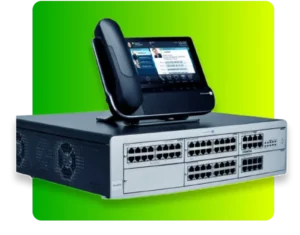
Private Branch Exchange (PBX) has been used for decades between employees and customers, with the PBX hardware installed on-site. The business purchases and owns the phone system hardware, networking and server equipment, and your IT staff take care of all the updates and maintenance regarding the system. The calls are routed through traditional phone lines as well as SIP trunking[1].

  • Budget: On-premises PBX systems usually require a higher initial investment in equipment and installation costs, and maintenance and upgrades will also need to have costs factored in.
  • Maintenance and upgrades: On-premises PBX systems require on-site technical support. This can lead to operational disruptions and additional labour and parts fees.
  • Scalability: Expanding an on-premises PBX can often require physical hardware or licensing additions, which could lead to incompatibility issues between the current PBX version and the latest software updates, resulting in costly, unplanned upgrades or system downtime.
  • Security and compliance: On-premises PBX systems allow companies to directly manage the security policies of their hardware but are more susceptible to data breaches if these policies are not managed correctly. This includes risks from outdated software and weak passwords. On-premises PBXs also require physical security measures to protect them from unauthorised access. This would include secure rooms, surveillance and restricted access, which in turn could be more costly and complex to manage.


Key takeaways: On-premises PBX systems can be more suitable for larger corporations with big budgets and space to host the physical hardware, as well as having the resources to manage and maintain the system. Housing the PBX system on-site brings an organisation maximum control over business communications, which might be a better fit for companies with complex and / or secure communication needs.


Hosted PBX

PBX Featured resized | Vox | Your Company’s Telephony Needs: the Right Choice

A Hosted PBX solution is a telephony solution where the PBX infrastructure is hosted in the service provider’s Cloud or network. Instead of using traditional phone lines, it relies on internet connectivity, more commonly known as VoIP (Voice Over Internet Protocol).

  • Budget: Cloud PBX generally involves a lower initial setup cost because it needs minimal physical infrastructure. Due to economies of scale, providers can offer Cloud PBX services at a nominal monthly fee, making it cost-effective for businesses with limited capital, and easy to budget for with a predictable monthly fee. A reliable Internet connection is a critical core cost factor.
  • Maintenance and upgrades: A cloud-based PBX system is maintained and upgraded by the service provider, and this remote management makes sure your cloud solution is always up to date with the latest features and security patches, with minimal downtime for the business.
  • Scalability: A hosted PBX solution allows businesses to add or remove services as needed, providing greater flexibility and cost savings without software compatibility issues or platform limitations.
  • Security and compliance: With cloud PBX solutions, it’s the responsibility of the vendor to ensure that the systems adhere to the latest security standards and compliance regulations, including the Protection of Personal Information (POPI) Act. Most cloud PBX providers implement advanced security measures to protect the data and prevent intrusions.
  • Redundancy: With the PBX in the cloud, a reputable vendor will implement multiple layers of redundancy, which are not available with on-site PBX systems. These include platform replication across geographically distributed data centres, redundant network paths between data centres, automatic failover mechanisms, and continuous system monitoring to aid in ensuring high availability and minimising the risk of service disruption.


Key takeaways: Due to ongoing advancements in Cloud technology, Cloud PBXs offer more advanced features than traditional PBXs, without the complexity of on-site installation and maintenance. They provide higher cost savings, minimal hardware requirements, and a wide range of useful functionalities. Cloud phone systems also allow your employees to work remotely, enabling employees to stay connected from anywhere they have internet access.


Your Business Communications and Vox

When it comes to the choice between traditional on-premises versus cloud PBX systems, there are many things to factor in, such as the size of your business, your organisation’s technical expertise levels, the number of remote offices, your preference for in-house or managed service providers, and more.

Whatever your preferences and requirements, Vox has a solution geared to assist your company, and its present and future needs. We look forward to hearing from you for more information on choosing the best PBX offering for your organisation.

[1] Session Initiation Protocol (SIP) trunking is a digital method of making and receiving phone calls and other digital communication over an Internet connection.

When Dynamite Comes in Small, Very Passionate Packages

Meet our Experts: Spotlight on Shirley Cross 

At Vox, we value, support and actively engage people with the levels of expertise that we require to keep us moving forward as a company. In this edition of ‘Meet our Experts’, we find out more about Shirley Cross, who works in the Project Management Office as the National Programme Manager. Her dedication as a Vox manager, and her passion for both the company and life itself, make her a force to be reckoned with!

Here is a multiple-choice question – please choose the correct answer from the following options below.

Vox National Programme Manager in the PMO Office, Shirley Cross, has been with the company for:

  1. 30 days
  2. 5 months (30 weeks)
  3. 5 years (30 months)
  4. 30 years.

Well, you guessed it: the correct answer is D – 30 years! – and Shirley’s anniversary date is today, 07 August 2025. Happy Work Anniversary, Shirley – huge congratulations!

johannes w qaIQk1TVon8 unsplash resized | Vox | When Dynamite Comes in Small, Very Passionate Packages

It’s a truly fantastic achievement and an awesome sign of your dedication towards Vox as an employer. We thought this magnificent milestone deserved a special mention here on our ‘People of Vox’ platform, and so we made sure to set aside time to find out more about this small lady (Shirley is very petite!) with the gigantic work ethic.

Shirley joined the company in 1995 as an office administrator, becoming one of only 15 staff members at that time. She’s since seen Vox grow to its current position as one of the country’s leading internet service providers (ISPs), with a mission to bring great connectivity at a fair price to all South Africans.

Today, Shirley is a vital, and very busy, cog in the well-oiled machine that is the Vox Project Management Office, which is an integral part of the company.


PMO: A ‘Perfectly Managed Operation’

Shirley clarifies that the PMO is responsible for ensuring that customer projects are delivered on time and with the highest level of care. She explains: “When I refer to a ‘project’, I’m specifically talking about a customer order that originates from a salesperson. Once the order is vetted, it’s assigned to a project manager, who becomes accountable for coordinating all parties involved to fulfil that order. In essence, we operate in a dynamic and fast-paced order fulfilment environment.”

She adds that the PMO is structured into various teams across the country and organised according to a tiered system.

“This tiered structure not only supports efficient service delivery but also creates clear growth opportunities for our project managers,” Shirley explains. “A project manager can progress from handling consumer-based orders or corporate single-site installations in a fast-turnaround environment, to managing complex, high-value enterprise-level or Tender projects. For example, someone may begin by supporting individual customers, then move on to SMEs, and eventually to large-scale enterprise clients.

“We invest heavily in training to develop our project managers, ensuring they uphold our Project Management Standards and are fully prepared at every stage of their career journey. At the same time, we place strong emphasis on delivering consistent service excellence, whether we’re serving an individual or a large enterprise. What’s important to me is that every project manager understands they have room to grow and is equipped with the right tools to succeed.”


Embracing Both Challenges and Family

And speaking of growth, Shirley is now the National Programme Manager.

“Amongst other things, my focus now includes ensuring that our project managers across the country are fully empowered to deliver such excellent service that Vox customers will never want to leave,” she shares enthusiastically.

“I started out in Durban, where I grew up. Back then, we were just a small team, and everyone pitched in wherever they could. I remember the late nights, sitting on the floor folding invoices by hand, franking them to post to customers. Those were also the times we’d share all the juicy stories! and I truly cherished those moments – it was such special times. I worked across several departments, from planning to debtors and creditors, until eventually I felt it was time for a new challenge. After a few conversations with our director at the time, he gave me the incredible opportunity to transfer to Johannesburg. And that’s when my real journey began.”

Shirley and Eugene resized | Vox | When Dynamite Comes in Small, Very Passionate Packages
Shirley and Eugene Smit

But the move wasn’t without its difficulties, as Shirley explains: “I found it challenging to be without my family at first, especially during the first six months, but after the first year of persevering, I was definitely happy to call Johannesburg my home. I have loved being part of this vibrant city ever since. The initial challenges in my move from Durban to Johannesburg have most definitely been worth it for me.”

Family is very important to Shirley, and with some of her family members now also in Gauteng, and others remaining in Durban, she takes time to stay in touch through regular visits. She’s one of five siblings and they remain close.

Shirley and her mum resized | Vox | When Dynamite Comes in Small, Very Passionate Packages
Shirley and her mum

“My family is my number one support,” she smiles. “I call them my cheerleaders! I wasn’t blessed with kids, myself, but within my family I adore my nieces and nephews – and their children in turn – to bits.”

And of course she has her ‘surrogate kids’ at work also.


The ‘Family at Work’

Shirley and colleagues resized | Vox | When Dynamite Comes in Small, Very Passionate Packages
Shirley and her colleagues in 2025

“I enjoy liaising with the different age ranges within the Vox PMO,” says Shirley. “I make a point of actively engaging with their mindsets, their thoughts and experience, including the younger members in our PMO management team. I believe that people from different generations can think very differently from each other, and it’s a strength when people in the same company can benefit from the knowledge and thought processes of different generations – it’s another form of diversity.

“I’m so happy to have different ages within my working environment, so that I learn from the younger generations as well as having the youngsters learning from me – they give me significant strengths and insights. It’s good to have that balance in your team and that’s what I have.”

Shirley says that it takes time for her to trust people but when she does, “Our friendship will then be for life! For example, Diana Prenner, who is the Vox Marketing Manager for PR and Events, has also been at Vox for a significant time frame, and we’ve been friends almost from her first day, which means we’ve now been friends for about 20 years!”

Shirley and Diana | Vox | When Dynamite Comes in Small, Very Passionate Packages
Shirley and Diana

It seems like Vox really does have ways in which the work environment is like a family… Away from work, my sources tell me that Shirley is an excellent cook, although she’s too modest to mention this herself. She is also a whizz at party-planning and loves making a celebratory occasion – for people of all ages! – even more special with beautiful decorations, matching balloons and giftbags, all set out according to a pretty décor theme.

Party planning resized | Vox | When Dynamite Comes in Small, Very Passionate Packages
Shirley’s party planning!

She does say that she takes pains to be active in mind as well as body: “I love word games – it’s always been my biggest hobby,” she says. “I used to play Scrabble and other board games with my family very regularly – we played at weekends. I still try to play board games as often as I can.

“I also go hiking, with my family and friends outside work. We find different places to go to, about twice a month, and I enjoy stretching my legs and getting out into nature. I’m sticking to the five kilometre routes for the moment but might start building up my distance over time. And I have relatively recently started playing padel on a more regular basis, which I was first introduced to by some of my work colleagues.”

Shirley and padel resized | Vox | When Dynamite Comes in Small, Very Passionate Packages
Getting into the social sport of padel

[Editor’s note:]

Hang on, so not so much ‘away from work’ then – the Vox PMO department is famous for working together and playing together! 😊]

Staying with the Vox ‘family’, Shirley is most appreciative of the Vox Executive team: “I’m so proud to be part of a company where the top management are always ready to show appreciation for their employees and for work well done. From Nathaniel Govender, Vox’s Executive Head of the Project Management Office, to Vox CEO Jacques du Toit and the entire executive team, they are always ready and willing to show us that they are involved with, and care deeply about, Vox employees.

Shirley and Nate | Vox | When Dynamite Comes in Small, Very Passionate Packages
With Nathaniel Govender

“Certainly it’s true that we get paid to do our jobs, but the gratitude and the respect that they give us as people is worth its weight in gold. I am passionate about my job and Vox, and it’s wonderful to know that in turn, the Vox Executive Team is passionate about looking after its employees. This knowledge means the world to me, and is one of the reasons why I have stayed at Vox for 30 years,” she concludes.

And so from Vox to Shirley, we say once again: Congratulations on this stunning achievement. Your long hours, patience, perseverance and leadership are a shining example of dedication, passion and commitment.

We close with a congratulatory message from Shirley’s manager, Nathaniel Govender, who says: “Congratulations on your 30th work anniversary, Shirls! Witnessing your remarkable growth and unwavering maturity as a leader has been truly inspiring. Seeing your transformation over the years has been a genuine pleasure, and your journey continues to motivate and uplift everyone around you. Your dedication is a testament to the incredible professional and person you are. It sets a great standard for those following and leaves a legacy you can be exceptionally proud of. Here’s to many more years of success and positive impact!”

Heading Up the PMO with Leadership, Presence and Empathy

Meet our Experts: Spotlight on Nathaniel Govender

At Vox, we value, support and actively engage people with the levels of expertise that we require to keep us moving forward as a company. In this edition of ‘Meet our Experts’, we find out more about Nathaniel Govender, who is the Executive Head of the Vox Project Office (PMO). Known to friends and colleagues alike as ‘Nate’, he is softly spoken and gentle of manner, but always driven to achieve.

Perseverance, persistence and overcoming personal challenges are all part of the journey for Nathaniel. From starting out as a call centre agent in Vox to achieving the level of one of the company’s directors, he is proof that at Vox, talent is always empowered to rise to the top.

Despite some significant difficulties along the way, Nathaniel has never allowed obstacles to suppress his optimistic outlook on life, or dampen his determination for too long.

We take a look at his story and unpack what drives him.


Ensuring a Strong Career Foundation

Nathaniel is another of Vox’s longstanding employees, having joined the company in 2005 and then going on to clock up 20 years of loyal and innovative service. Today, he says, his role centres on providing strategic leadership and operational oversight for all customer orders in progress – in other words, the ‘projects’ that give the PMO its name – which are sold across the company.

“I’m responsible for defining the vision, structure and governance of the Project Management Office, while also leading its execution. Ultimately, I hold full commercial accountability for the financial performance of all active orders within Vox,” he explains.


Before joining Vox, Nathaniel’s career evolved through a range of operational and leadership roles that gave him a strong foundation in customer service, technology and project delivery.

He clarifies: “While based at a previous company, I started out as a Call Centre Agent, where I developed a deep understanding of customer needs and frontline operations. I was later promoted to Call Centre Manager, taking on team leadership, performance management and process improvement responsibilities, and from there, I transitioned into the role of IT Manager.”

As IT manager at this organisation, Nathaniel led the implementation and support of critical systems, aligning technology with business objectives. These experiences, which included customer service, operational leadership and IT, equipped him with a holistic understanding of business operations, which he was later to carry forward into more strategic roles, culminating in the founding of the Projects Office at Vox.

However, the trajectory of Nathaniel’s relatively smooth career path was to hit a significant bump when, in late 2004, he experienced a cruel setback in his professional life.


Never Give Up…

“I’d love to say that my journey into Vox was a carefully planned progression driven by a passion for operational excellence, customer delivery and technology,” notes Nathaniel wryly, “but the truth is a bit more unexpected. While serving as an IT Manager, I arrived at work one morning to find the office locked and the business liquidated – and just like that, I was out of a job!”

Determined to continue moving forward despite this blow, Nathaniel searched online for the top IT companies in the country, and DataPro (later to become part of Vox) stood out for him.

“I took a chance and sent my CV to the generic info email address,” he outlines, “and to my surprise, I received a reply from the CEO the very next day, referring me to their Helpdesk Manager. That’s how my journey with Vox began: starting over as a Call Centre/Helpdesk Agent. Since then, I’ve grown through the business, eventually founding and leading the Project Management Office in 2016, where I was able to combine everything I’ve learned along the way.”

Nathaniel clarifies that one of his main challenges with the PMO is managing complexity at scale. “Each project involves multiple stakeholders, tight deadlines, shifting priorities and technical variables, often all at once,” he says.

“No two days are ever quite the same, but a typical week for me includes maintaining visibility across multiple active orders while simultaneously keeping teams aligned and customers satisfied.”

Nonetheless, he faces and deals with any challenges in a balanced manner and is highly skilled at staying on top of things while presenting a calm and reassuring manner.


Overcoming Obstacles  

And staying with the topic of challenges, Nathaniel is open about having to overcome some personal obstacles along the way in achieving his current position at Vox.

“One of the biggest was obviously starting over from the bottom, after previously holding a senior role, when I re-entered the workforce as a Call Centre/Helpdesk Agent at Vox. It was a humbling experience, both professionally and personally, but it taught me resilience, adaptability and the value of perseverance. Another challenge was proving myself in a new environment without relying on titles or past roles. I had to rebuild professional trust, credibility and influence from scratch.”

To rebuild his credibility within a new organisation, Nathaniel focused on consistently delivering results, being solution-oriented, and never losing sight of long-term growth: “Even when the day-to-day challenges felt like a step backward! However, when I look back, I see that these experiences built the foundation for my leadership today. They made me more empathetic, grounded and driven to create opportunities for others to grow, no matter where they start.”

When we delve deeper into Nathaniel’s personal history, his ability to rise up from challenges makes sense.

He explains: “I grew up in the small, lively town of Tongaat on Durban’s north coast, proudly South African through and through! My heritage is a colourful mix of Indian and Cape Coloured roots, and I was lucky to be raised in a warm, tight-knit community where family came first, hard work was second nature, and there was always a plan B (and sometimes a plan C) thanks to plenty of resilience and resourcefulness.

“That upbringing shaped my character and taught me to never take opportunities for granted. It instilled in me a deep commitment to leading and serving with empathy, staying grounded, and embracing continuous learning and adaptation: qualities that have guided my career and continue to define my leadership journey today.”

Outside work, Nathaniel has always had a passion for the outdoors and sport.
“Growing up, I spent countless hours playing with friends, and that love for activity has stayed with me. These days, I’m an avid padel enthusiast and currently on track to qualify with my Padel MBA, something I’m incredibly excited about!”

(Editor’s note: We mentioned at the beginning of this article that Nathaniel has a gentle manner, but perhaps the one exception is on the padel court, where he is known to take no prisoners! He remains softly spoken though – a gentleman always… )

Nate on padel court | Vox | Heading Up the PMO with Leadership, Presence and Empathy

Moving Forward

There’s an old saying that goes: ‘Every cloud has a silver lining’, and perhaps it’s not too fanciful to imagine this silver lining shining quietly over Nathaniel on that long-ago day when he arrived at his place of work, only to find the doors shut and barred. After all, if not for that rudest of terminations, he might never have landed up working for Vox, which, he says, has been a uniquely rewarding experience.

“What truly sets Vox apart from other ISPs in South Africa is its entrepreneurial spirit, agility and hunger to challenge the status quo,” notes Nathaniel. “We’re not weighed down by too much red tape or legacy thinking. Instead, Vox is constantly looking for ways to disrupt traditional models, whether it’s through bundling services in new ways, leveraging emerging tech, or delivering faster, more responsive support.”

Nathaniel is part of this innovative thinking within the company, and he really enjoys helping others in the workplace to also achieve their true potential.

He explains: “I take immense pride in mentoring and growing people, helping others step into leadership and taking ownership of their work. I’m passionate about building leadership capacity and empowering the next generation of leaders.

“Creating a culture where people can grow, take ownership, and innovate with confidence is important to me – I really enjoy seeing ideas and people transformation come to life. There’s real satisfaction in building something sustainable, not just in terms of projects, but in terms of culture, capability and customer trust,” he concludes.

Who You Gonna Call?

People of Vox: Spotlight on Greg Gyngell


If there’s something strange

In your neighbourhood

Who you gonna call?

Greg Gyngell!

If there’s something weird

And it don’t look good

Who you gonna call?

Greg Gyngell!

Ghostbusters | Vox | Who You Gonna Call?

Right, well with apologies to the Ghost Busters franchise (do you have an ear-worm now?), it’s time for another peek into the life and times of another of our green-blooded Voxies. In this episode, we shine the spotlight on a man who is normally the MC within the training environment, and so he’s actually used to turning the spotlight on everyone else…but he agreed to be interviewed without too much of a fuss.

And a good thing too, because he’s got some really interesting stories to tell!

“I’m Greg and I look after the Training Department,” says Vox’s well-known and well-loved Soft Skills Trainer. “I’ve been at Vox for about 13 years now and together with my team, I do anything and everything that is related to training, including some video production work.

“I’m always available to do anything else that might be asked of me, and wherever I can assist, I’m happy to step in. No day is ever the same, and that’s exactly how I like it!”

Greg leads a team of four Trainers across the country and reports directly to Head of Human Resources, Pam McLeod. Let’s take a look at how he champions the cause of training throughout the company – another great example of how life and a career at Vox never has to be linear.

Greg Plett nu resized | Vox | Who You Gonna Call?

Starting Out in Film and Entertainment

“When I left school I had only two real passions,” explains Greg. “I wanted to be a pilot – I was one of those kids who built little aeroplanes and hung them off the ceiling – and in my teenage years I got very involved in movies.

“Flight school was unfortunately just too expensive, so when I realised that flying wasn’t a career option, I went into the local film industry. I was involved in making some incredible movies in South Africa and was able to meet some amazing people.

Greg learned his craft from the ground up and thoroughly enjoyed being in the movie world, but it wasn’t to be forever.

bestfilmjob | Vox | Who You Gonna Call?

He clarifies: “The industry in South Africa went through a phase in which international big budget films were being shot here, but the production houses were bringing over their own crews. I went freelance for a while but realised quite quickly that it was unfortunately time to leave the movie industry in the quest simply to earn a living.

“I also dabbled in radio, and DJ-ing at clubs, both of which were obviously great fun. Eventually I landed up at a large cellular company and became entrenched in the mobile phone arena. After some time with this enterprise, my intuitive knowledge and understanding of gadgets and technology, together with my ability to explain things and talk to people, collided in a fortuitous manner and I ended up in my first training position with them, where I stayed for quite some time – over a decade, in fact.”

The end result was a man who understood the value of entertainment, technology and training, as well as being flexible in his outlook on life – not to mention the importance of having fun! The stage was set for Greg to come to Vox.


‘You’d better call…’

We can thank a retrenchment exercise that took place at his previous employer for Greg’s eventual arrival at Vox. He explains: “In the wake of being unfortunately retrenched, one of my former work colleagues phoned me and told me that that @lantic – one of the businesses that was later to be merged into the group of companies under the Vox umbrella – was planning to set up a training department, and they were interested in talking to me. And so I had an interview and was offered a six-month contract.”

At that stage, Greg and his wife Claire were actually planning to emigrate to New Zealand, but in the light of this new development, they decided to stay for a while longer.

Greg continues: “At the end of the six months, I was then offered a permanent position, because my previous background in the film industry, and how I could use it within the training division to create videos when required, was seen to be advantageous. My technical outlook, combined with my training soft skills plus the film experience, all merged neatly into a new position within Vox. And so the rest, as they say, is history!

“I like to tell people that my love for Vox as a company meant that, even though we’d been accepted into New Zealand, we stayed in South Africa and have never looked back since. Everything came together at the right time and I’ve now been at Vox for about 13 years. My passion is training, but at Vox, as I mentioned, I’m able to look after a number of other things as well.”


A Strong Team of Trainers

As far as the Vox Training is concerned, Greg coordinates with his four Trainers every day. “We all work remotely,” he explains. ”Alex McDonald is the Systems Trainer and looks after all systems-related training, including for our partners, while Victor Kemp is in charge of our Technical Training, including our Mikrotik router training; our e-learning system and ‘Friday Bytes Live’. Our other two team members are Ryan Varga, our Sales Trainer, who also takes care of our leadership and mentoring system; and Craig Jewell, who looks after Soft Skills, presenting courses that include themes around customer service, time management and adaptability.”

“One of the Training Department’s innovative initiatives is the ‘Friday Bytes Live’, when Voxies come together every Friday morning to hear and learn about different areas of the company using a fun, interactive quiz approach. Victor runs with this every week, and we have prizes up for grabs to incentivise everyone further.”

Friday Bytes | Vox | Who You Gonna Call?

Greg clarifies that the Training department is in charge of the general training needs of around two and a half thousand people, as well as the monthly Induction training for all new Vox employees.

“I’m the main person at the helm of the induction training,” he says, “and here I run training over a few days at the beginning of every month, when every department in the company sends a representative to introduce the different aspects of Vox to all our new employees. Induction training takes place in person at our Johannesburg head office, and we also facilitate online participation.

“One of the primary elements of Induction is simply chatting! I’m like the MC, if you like, and I try to make new people feel comfortable while I also liaise with the presenters. I’ve always been a big fan of comedy, and so we inject humour into these training days as much as possible. Another large element of Induction training – besides putting the programme together in advance and running with the required logistics – is to keep the sessions on track from a time perspective.”

head 1556568 1280 resized | Vox | Who You Gonna Call?

It’s certainly a mixed bag, bringing a significant variety to Greg’s working days and weeks, which he appreciates. Over and above that, he says: “Another thing that I really enjoy about my job is that, while training is my first love, I am also able to get involved in so many other different things.

“For example, I’ve been able to assist with elements of our recruitment system as well as working on study skills. And funny enough, I love doing the mandatory stuff – the admin challenges that most other people dislike. For example, I really enjoy organising and setting up the meetings required to kickstart a training session.”


‘If there’s something weird…’

Greg Background 2 resized | Vox | Who You Gonna Call?
Greg’s home office reflects his creative approach to life and training


To balance out his day-to-day organisational requirements, Greg’s creative side once again comes to the fore with his off-duty interests. A speed freak, he doesn’t own a car but instead rides a motor bike, and is also a huge Formula 1 fan, as seen in his office space, where the roof is painted with black and white checkered squares to look like an F1 flag – something that any Voxie who’s ever been on a Teams call with him will recognise instantly!

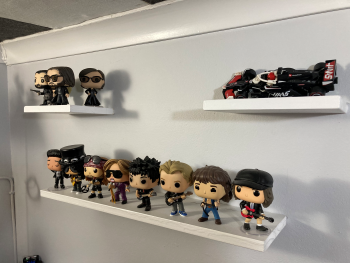
Staying in Greg’s home office, there are shelves filled with Lego versions of Formula 1 cars and drivers, as well as Funko Pop and Skylander collectable figurines, reflecting his taste in music, movies (think James Bond and The Matrix!) and video games. Other interests and hobbies include sports shooting, cooking and coffee – Greg intends to roast significant quantities of his own coffee beans in the future. As a self-confessed coffee snob, he limits himself to just two coffee cups per day, which is just enough to help him keep up with his busy pet Border Collies (just one more daily cup of coffee wouldn’t be fair on the dog…).

Add in his wife of 20 years, Claire, and his two teenage children, and it’s a busy and enjoyable life, he says gratefully.

Gyngell Family nu resized | Vox | Who You Gonna Call?

“For me, there is always something different to do at work. I’ve been exposed to working on new projects because of my line manager, Pam, as well as our CEO, Jacques du Toit – something that I appreciate enormously, and which speaks to the organisation’s culture of being innovative and flexible.

“This, I think, is what sets Vox apart from the other ISPs, together with the passion and heart for the business that our senior executives always display. There is a significant number of people within the company ‘who live and breathe green’, and I am passionately one of them,” he concludes.

And anyone who has a training need of any kind within Vox knows exactly who to call – Greg Gyngell!


AI and Enterprise Wi-Fi: New Frontiers of Possibility

Artificial intelligence (AI) makes it possible for machines to learn from experience, adjust to new inputs and perform human-like tasks.

Using technologies such as deep learning and natural language processing, computers can be trained to accomplish specific tasks by processing large amounts of data and recognising patterns in the data. The Wi-Fi arena is no different in that AI can also make the processing of tasks speedier and more efficient – we are now in the era of AI-driven networking.

AI Wi-Fi refers to wireless networks that make use of artificial intelligence to optimise connectivity, performance, connected user experience and security. This technology uses machine learning (ML) algorithms to analyse network hardware, traffic, user behaviour and environmental factors in real-time. The AI initiates closed loop automation to adjust the network settings, such as resource allocation, to improve performance.

This article discusses how AI can be used in Enterprise Wi-Fi networks, and how AI is benefitting Vox and our Wi-Fi customers.


AI-Driven Business Intelligence for Enterprise Networks

android 7711290 1920 resized | Vox | AI and Enterprise Wi-Fi: New Frontiers of Possibility

Artificial intelligence in Wi-Fi networks today can assist significantly with the configuration of the network, as well as with support thereafter, including being able to spot issues before they become a serious problem.

Vox has partnered with Wi-Fi networking equipment specialist, Ruckus Networks, for approximately the last decade, and within our partnership we proudly offer its AI Managed Wi-Fi offering for enterprise networks, which presents AI-driven business intelligence for enterprise networks.

As a cloud-based service for network intelligence and service assurance, Ruckus AI Managed Wi-Fi with Analytics is powered by machine learning (ML) and artificial intelligence (AI). This in turn helps customers get the most from their network, for example by identifying network assurance incidents, classifying them by severity, tracing root causes and making specific AI recommendations for remediation. It automatically monitors network health relative to configurable thresholds.


Benefits of AI-Driven Enterprise Wi-Fi

ai generated 8310945 1280 resized | Vox | AI and Enterprise Wi-Fi: New Frontiers of Possibility

AI can dynamically adjust Wi-Fi parameters like channel selection and contention window size to optimise network performance, ensuring smooth and efficient data transmission. In addition, it simplifies life for IT departments and technicians, as AI dramatically reduces the time to resolution for service incidents.

It can also eliminate some Help Desk tickets by addressing issues before they affect users, allowing the organisation to be proactive in this regard and solve problems before they arise. Additionally, by addressing the root cause for one incident, organisations can avoid other incidents that might arise from that cause.

Most importantly, it alleviates the need for an organisation’s IT department to manage the Wi-Fi network – Vox will manage this. Organisations can view real-time dashboards and, if required log tickets via the Vox enterprise support desk, because Vox has comprehensive visibility into network operations, which accelerates troubleshooting.

By proactively addressing issues and optimising network performance, AI can contribute to a better overall user experience, with faster speeds, reduced buffering, and fewer connection problems. In addition, AI can simplify network management, by automating many of the tasks associated with managing a complex Wi-Fi network, thereby reducing the burden on IT staff.


Faster Feature Updates Due to Cloud-Based Licences

globe 2679754 1920 resized | Vox | AI and Enterprise Wi-Fi: New Frontiers of Possibility

A question that might spring to mind is the following: ‘How does South Africa compare to the developed world with regards to our access to AI within the Wi-Fi arena?’ and the answer may surprise you on the upside.

In essence, because today we have the option of moving to a cloud-based licence, all users globally are able to benefit from feature updates to cloud platforms, as they could all be on the same version due to simultaneous software updates. In this regard, South African companies will not necessarily be running behind users in other parts of the world, thanks to the cloud.

Vox is very pleased to be able to bring our customers the latest Wi-Fi networking feature updates as soon as they are made available to us from our upstream providers and placed onto the relevant platforms. Because Vox is accessing features as they are rolled out by the supplier, this means in turn that our customers benefit as and when new features and updates become available.

Knowing that we are able to offer our clients first-world AI-enabled Wi-Fi technology, in partnership with Ruckus Networks, is something of which we are truly proud.

Active-Active Failover Solutions from Vox

When your business can’t afford to have its network go down, you need more than a backup: you need intelligent, always‑on connectivity.

Enter Vox Active‑Active Failover: a high‑availability solution that uses two live links at the same time for better performance, more usable bandwidth and seamless resilience when one link fails.

Why failover matters for your business
Imagine driving to work and discovering a massive traffic jam on your usual route. A quick off‑ramp saves the day and you arrive on time. That’s exactly what a failover does for your network. Whether you rely on cloud services, VoIP, payments or remote access, even a short outage can cost time, revenue and reputation. Failover options keep your services running when faults or outages happen.


traffic congestion resized | Vox | Active-Active Failover Solutions from Vox

Failovers make sure that systems stay operational even when unexpected failures occur. They guarantee that users experience negligible disruption, just like the alternative traffic route. Failover is a critical part of IT resilience, helping companies to navigate these challenges with minimal impact to the business.

Vox is proud to announce our newest business Failover bundle options, which go beyond the traditional parameters in an exciting and innovative way. This article unpacks our new ‘Active-Active Failover solution’, which is unique in the South African ISP landscape and designed to assist with significantly reducing and controlling network disruptions.


Active-Passive Failover Operations: Keeping Your Internet Alive

There are many reasons why Internet networks fail, including congestion, physical damage to the Fibre, area outages, planned or emergency maintenance, router issues, DDoS attacks, malware on devices, outdated software on customer equipment, and more.

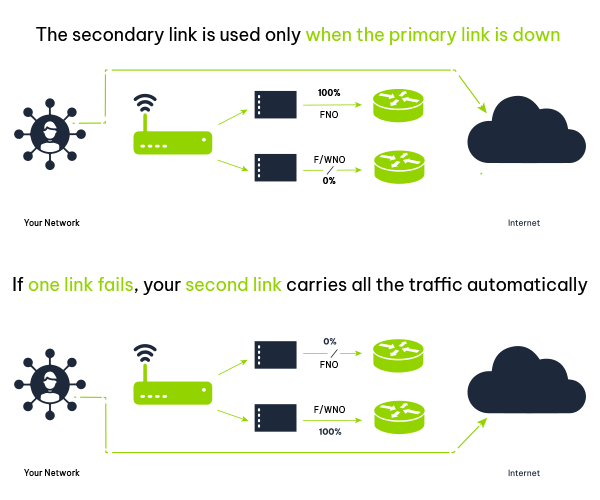
Setting up a Failover option helps organisations to remain ready for any challenge. The alternative option – no Failover plan (unthinkable!) – leads to downtime, causing financial and reputational damage. ‘Active-Passive Failovers’, which have been the standard offering to date, provide a secondary connection to your organisation’s Internet – preferably on diverse infrastructure – where the secondary link is used only once the primary link goes down.

How it works: In a typical Active-Passive Failover configuration, one is configured as primary (Active) and the other as backup (Passive), as shown in the diagram below. If the primary network connection fails or is unresponsive, the backup automatically takes over. Network parameters are shared so that other devices on the network can continue operating as if nothing has changed. When the primary wide area network (WAN) link is restored and once again stable, the connections ‘failback’ to it.

In this example, the primary network link is via a Fibre network operator (FNO). The secondary link can be provided by either another FNO, or alternatively via a Wireless network operator (WNO). The secondary link is used only when the primary link is down.

Active-Passive Failover operations
Active-Passive Failover Solutions


  • When the primary link is active, 100 percent of the traffic goes through it and zero percent via the secondary link.
  • The situation is the exact opposite when the primary link is down, when 100 percent of the traffic goes through the secondary link.
  • When the primary link is restored and the connections failback to it, zero percent of the traffic once again goes through the secondary link.


Vox has been providing Active-Passive Failover systems for many years and has built up significant expertise to assist our customers. Recently, however, we started thinking: ‘What if we can provide more value to a failover customer at similar price points as on Active-Passive?’

And guess what? We can!


Introducing the Active-Active Option: A Failover Plan on Steroids

Vox is proud to present our new ‘Active-Active Failover’ bundle options. (And no, this is not a term that applies to busy toddlers having a meltdown.)

The problem with the Active-Passive Failover option outlined above is that a customer can only use one link at a time – the secondary link hardly gets used. Here at Vox, we thought that this seemed like a waste of potential ‘always-on’ connectivity.

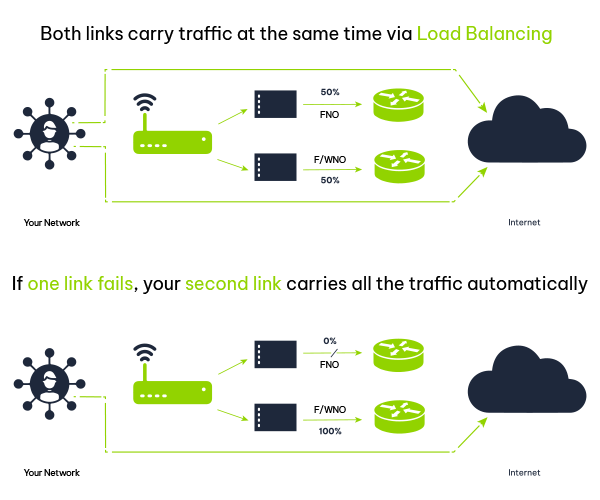
The Vox Active-Active Failover option solves this problem by allowing customers to use both network links at the same time via load balancing, giving them more available bandwidth when both links are up. Then, when one link goes down, the secondary link will still work as a Failover to keep pushing traffic.

  • Technology note: ‘Load balancing’ in this context is the process of distributing network traffic across multiple links.


How it works: In the example in the image, both the networks are used in tandem. Again, the primary link is provided by an FNO, while the secondary link can be provided by either another FNO, or alternatively via a WNO.

Active-Active Failover Solutions
  • When both links are available, the traffic is load-balanced based on the capacities configured per link.
  • When one of the Active links are down, all the traffic fails over to the remaining link.
  • When the broken link is restored, the load balancing will reestablish.


Vox’s Active-Active Failover solution is unique in the South African market, as it delivers customers more value while saving costs, and without compromising on the essence of network redundancy. An Active-Active Failover bundle is ideal for any organisation where having no down-time is vital.


Active-Active Benefits:

The benefits of using your links to their fullest potential all the time are groundbreaking. Think about implementing these positives for your business:

  • Business continuity due to increased uptime: The probability for downtime reduces drastically with two links on distinct networks.
  • More value for money: With both links able to carry traffic, the Failover can almost always be used.
  • Improved cost efficiencies: There is no need for additional devices and licences; it is all delivered on the included router.
  • Bandwidth efficiencies with burstability: More bandwidth is at the customer’s disposal when both links are up.
  • Peace of mind with seamless Failover: If one link fails, the other continues to carry the traffic in an uninterrupted manner.
  • Vox does everything for our customers: We provide the links, the Active Failover setup on the included router, and the support that comes with it.


Our current offerings start from R1,798 (ex VAT) per month. Currently, the Active-Active solution is offered through either Fibre plus Fibre, or Fibre plus Wireless, but the offering could also be offered via other technologies. It depends on what’s available at the customer’s site, and what they can afford.

Vox is enormously proud to be the first local ISP to officially offer the Active-Active Failover solution! We look forward to bringing you even more options in the future.

For more information, please contact us through this convenient enquiry page and we’ll call you back promptly.


Frequently Asked Questions

What is Vox Active‑Active Failover?

Vox Active‑Active Failover is a managed connectivity bundle that uses two live internet links concurrently. Traffic is load‑balanced across both links and automatically fails over to the remaining link if one fails, ensuring continuous connectivity.

How does Active‑Active differ from Active‑Passive?

Active‑Passive keeps a standby link for use only when the primary fails. Active‑Active uses both links simultaneously for increased usable bandwidth and continuous redundancy.

Which link types can be used in an Active‑Active bundle?

Vox currently offers Active‑Active as Fibre + Fibre or Fibre + Wireless. Availability depends on the technologies present at your location.

Will I need extra hardware for Active‑Active?

No additional customer hardware is usually required. Vox supplies and configures the router included in the bundle to manage load balancing and failover.

How much does Vox Active‑Active cost?

Packages start from R1,798 (ex VAT) per month. The final cost depends on the selected speeds and any optional add‑ons such as static IP ranges or QoS VLANs.

What happens if both links fail?

Having diverse links reduces the chance of simultaneous failure. If both links do fail, Vox provides support to restore service and can offer temporary connectivity options where available.

Is Active‑Active suitable for small businesses?

Yes. Any business that values uptime, small or large, can benefit from the redundancy and performance gains of Active‑Active.

How quickly does failover happen?

Failover switching is automatic and happens within seconds depending on the configuration, keeping interruptions to a minimum.

Our Queen of Customer Service and Caring

People of Vox: Spotlight on Bandi Maduna

At Vox, we believe our employees are the beating heart of our company, with merit and value built into all our available positions. In this edition of People of Vox, we meet Bandile (Bandi) Maduna, who works in the Johannesburg Head Office premises as a Receptionist. Bandi doesn’t just get compliments from satisfied customers – sometimes they go out of their way to bring her coffee and muffins, and even flowers! Now that really says something.

There’s something special about amazing customer service, especially when you’re on the receiving end of it. As the world saves time by moving towards service via chatbots, smart apps or telephonic voice prompts, there are still times when talking to a person is the ultimate end-goal.

Here at Vox, our Johannesburg Head Office Receptionist Bandi (Bandile) Maduna is famous for her warm and wonderful way with people.

In this edition of ‘People of Vox’, we shine the spotlight on Bandi and how she has perfected customer service into an art form.

Bandi office view | Vox | Our Queen of Customer Service and Caring


When the Warm Words Keep on Coming

The secret to Bandi’s successful ways with people isn’t a secret at all.

In fact, it’s very simple: she just really likes dealing with people and is always inclined to give them her very best efforts. In turn, she seems to bring out the best in the people she’s dealing with.

Bandi explains: “I deal with phone calls that come in, as well as walk-in queries and deliveries. I could find myself assisting on insurance and payment issues, as well as follow-ups on the status of a technician call-out. I’m always happy to help by trying to move a customer’s challenge along.

“This could include helping the customer to pay on the Vox portal, or following up to find out if a technician is en route. I really enjoy dealing with our customers and trying to help them with their queries or challenges, to move towards an outcome.”

In essence, one of Bandi’s strengths is making people feel that they are being heard. Perhaps this is why she gets the compliments that she does.

smiley 2979107 1280 | Vox | Our Queen of Customer Service and Caring

Here are just two of the warm words that customers went out of their way to pass on via email:

I must compliment your lady at the front desk, Bandi. She was most friendly, calm, efficient and immediately put me in touch with the person I needed to speak to. In my opinion, Bandi is an amazing ‘first face’ to engage with when arriving at your office. I thanked her on my way out, and I hope you pass this message on to her.

AND

I was welcomed by the switchboard operator, Bandi, in the most professional, warm, welcoming, efficient manner. Bandi was extremely polite and assisting. I give lots of praise to this wonderful employee of yours.   

And then there was the time when a satisfied customer dropped in to bring Bandi coffee and a muffin – topped only by the person who once brought Bandi flowers!

When people in today’s busy world go out of their way to say ‘thank you’ like this, taking time and effort, you know that the service must be well deserved.

Bandi behind desk 2 | Vox | Our Queen of Customer Service and Caring


A True People Person and Life-Long Learner

Perhaps Bandi’s skills are also rooted in her deep understanding of ‘Ubuntu’ – the belief that ‘a person is a person through other people’ – with its underlying principles of interconnectedness, kindness, and the importance of community and relationship.

Heritage | Vox | Our Queen of Customer Service and Caring

“I regard myself as being a typical Zulu,” she says. “I was born in Ladysmith in Kwazulu-Natal, and I grew up with a deep respect for Ubuntu – for giving back and being part of your community. When I joined Vox, in 2009, I think this came through in my first job, where I was a tea lady. I spent my days going from desk to desk at set times with a trolley so that I could bring some of the Vox office workers beverages at regular intervals – tea, coffee, water – and in that way allow them to concentrate on their jobs.”

It would not be too long before Bandi, who is versatile and always open to new challenges and responsibilities, was able to start moving into different positions within the company. She completed a course in facilities management, and became a facilities team leader in 2014 and was able to showcase her leadership skills in this role.

Bandi’s people skills began truly coming to the fore in 2016, when she spent time at the front desk as a reliever for the then-receptionist – proving to be so good at this that she was able to begin working in a full-time position in reception the following year. Another highlight was when Bandi became the personal assistant to the chief financial director, which again spoke to her skills with people as well as her organisational abilities. Today, she still assists the current Vox CFO, Gert Koen, by doing various insurance claims for him as part of her duties.

Bandi adds: “I’m always eager to gain knowledge and learn new things. I am open to new challenges, and I like being versatile. I’m very grateful to Vox for giving me opportunities to use my skills in different ways. Vox has also paid for me to do two different one-year courses, to help me with my learning aspirations and my workplace skills. I have completed an administration course through Damelin, as well as a project management course through Boston City Campus.”

While she regards herself being as a lifelong learner, Bandi also notes that it hasn’t always been easy. “You could say that I am a BBT – ‘born before technology’ – and I did find parts of my project management course very challenging, when it was online during Covid,” she explains.

“I was ready to give up, actually, and here I am so grateful to our HR Director, Pam McLeod, who supported and encouraged me to keep going. I am also very grateful to Trudy Truscott for believing in me; she took me from being a tea lady to a facilities manager and receptionist, and she is still my line manager today. She has been very supportive at all times.”

Creative with Her Hands

Away from work, Bandi remains busy in her spare time with her hobbies, which include cooking, crocheting, knitting and making soap.

Bandi kitchen | Vox | Our Queen of Customer Service and Caring

“I like using my hands,” she says. “Recently, I began taking some of my unused plastic bags to make them into a crocheted welcome mat for the entrance to my home. And I enjoy making soap from scratch, which I often scent with ingredients such as cinnamon and lemon juice, and give to my friends and family as gifts from time to time.

“I also like taking part in ‘isipheko’, which is a traditional custom of bringing food or other provisions to a family or community during celebrations or periods of mourning, and which is also part of the spirit of Ubuntu.”

Bandi says she has experienced this same spirit of warmth and community working at Vox, which is another reason why she has been with the company now for 16 years.

“I am grateful to be part of an organisation that takes care of its clients as well as its employees. I find Vox as a company to be very reliable, with a strong ethos of caring and humanity. I think this is very much a distinguishing feature of Vox, and I’m proud to be associated with this constant theme of caring, mixed in with humour and humanity.

“I love working for Vox – I always like to say that ‘My blood is green!’ and am very grateful for all the opportunities that the company has given me,” she concludes.