Understanding the Evolving Cybersecurity Landscape

Given the global disruption that took place last year, it is hardly surprising that malware increased by 358% and ransomware by 435% as compared to 2019. The rapid push to digitalise and embrace work from home solutions meant companies not only had to accelerate data migration projects to the cloud but also remain cognisant of how best to secure employee endpoint devices while keeping the impact on productivity to a minimum.

What makes the likes of malware and ransomware so difficult to combat is that successful attacks on corporate networks and endpoint devices can potentially remain hidden for months giving the hacker access to a veritable treasure trove of information. Attackers can encrypt this compromised data at any time, resulting in significant damage to the organisation. And because a breach can stretch back for a long time, it negates some of the benefits of making backups as the restored data could be infected as well.

Scourge of ransomware

Fundamentally, ransomware centres on maximising the financial gains to be had on extorting businesses (and even individuals) as much as possible. Within this environment, there are different kinds of threat actors. You get the script kiddies that are just getting into hacking and looking to experiment; there are sophisticated hacking groups looking at selling company data on the Dark Web; and then there are nation-state threats that target high-level business executives and government officials to compromise the infrastructure of a country. Other hackers might include research specialists looking to steal patents and other competitive information or those looking at exploiting social networks, creating fake profiles, and friending people to perpetrate identity theft.

When combined with today’s work from anywhere in the operating environment, then you have significant potential for cybersecurity breaches to occur at even the most diligent organisations. Companies must weigh up the cost of a data breach versus the measures needed to keep the data as secure as possible while not making it difficult for employees to still access the systems and processes they need to be effective at their jobs.

Mitigating risk

More recently, South African organisations and individuals have had to contend with an influx of phishing attacks revolving around the Protection of Personal Information Act (POPIA). For instance, a person might receive an official-looking email from a bank asking them to update their personal details by clicking on a compromised link.

It is also incredibly risky to use publicly available hotspot networks to log in to online banking, perform e-commerce, or just access the back-end data of the business. Hackers use ‘sniffing’ tools over these networks or even spoof the networks themselves with their own LTE devices to get personal information from unsuspecting users.

Fast-moving environment

The fact is that IT teams must continually adapt to cybersecurity threats. Anti-virus and firewall solutions are no longer sufficient. Things like email security tools that evaluate content, and endpoint detection and response (EDR) solutions that are designed with artificial intelligence to examine application behaviour have become increasingly important to implement. Cybersecurity is now all about adding layers of defence as the threat landscape evolves.

For instance, polymorphic viruses circumvent traditional anti-virus solutions that are signature-based. And then next-generation firewalls provide more effective defence over legacy ones that are rule-based. It is about fighting the proverbial fire with fire. As hackers get access to more sophisticated tools to perpetrate attacks, so too must organisations use more advanced techniques to defend their data, systems, and infrastructure.

One of the most significant advantages of going this multi-layered route is that organisations will start receiving proactive warnings on potential compromises. Thanks to automation and machine learning detecting anomalies, ransomware and other malware can be stopped in its tracks even before it gets through the proverbial door to the organisational network.

Given how the bulk of attacks in South Africa target the relatively low-hanging fruit of small to medium-sized businesses, these companies will do well to review their cybersecurity footprint. While the financial and reputational damage to a corporate can be significant if a breach were to occur, an SMB will likely not survive a successful attack.


The Benefits of Cell Boosters Go Beyond the Obvious

Estimated Reading Time: 3 Minutes

We all need a little boost sometimes. When your cell signal feels out of reach, we’ve got the perfect solution to save the day.

We’re more dependent on mobile phone technology than ever before. At last count, according to Statista, 36.45 million South Africans accessed the Internet via smartphone. That number is expected to grow to 43 million by 2026.

In 2019, there were 53.4 million smartphone subscriptions in South Africa, according to ICASA, and 100.6 million mobile connections made in 2021. Over 62% of the population uses the Internet, while 94.6% of that group access the Internet using their phones.

We rely on our smartphones for everything from calls to video chat, email, banking and search, not to mention streaming music, GPS navigation and scrolling social media. Without our phones, most of us truly feel lost. In fact, when we find ourselves without signal, most of us truly are…

While there are myriad reasons you could be experiencing crummy cell signal – including everything from your distance from a cell tower to cell tower congestion, the types of building materials you’re surrounded by and, yup, the weather, there’s very little your network provider can do to help.

But, here’s the good news: you’re not completely powerless.

Cell Boosters – What Are They, Really?

While they won’t create a cell signal for you, where there is one available, you can rely on a cell booster to amplify it.

Basically, there are three main components to a cell booster – an outside antenna draws the weak signal in, where an internal device cleans and amplifies it (there are no prizes for guessing, it’s called an amplifier) before sending it to an internal antenna for rebroadcasting, with all three elements connected by coaxial cable.

It sounds simple enough, right? But it can be tricky to find the right components that’ll work best for you, not to mention ones that are ICASA-approved and won’t mess up the cell signal for everyone else around you.

Once you do, you’ll be able to enjoy the benefits of a boosted 2G, 3G, 4G LTE and even 5G signal on your connected devices as those bars go up.

A Boost for You

Before you get started on your cell signal booster journey, it’s important to understand what you’re working with in terms of signal strength to begin with.

The cell booster antenna you choose will depend on the signal strength outside your home.

If the signal is strong outside, but for some reason there’s nothing but dead zones everywhere you go inside, you might want to opt for an omni-directional antenna to pull signal from multiple carriers.

If your outdoor signal is weak to begin with, a uni-directional or Yagi antenna is usually your best bet as they’re designed to pull signal from the nearest tower for a more focused signal strength and reach further than an omni-directional antenna.

With a strong, steady cell signal, not only will you be able to enjoy crystal clear call quality with no dropped connections, but you’ll also be able to make the most of your LTE data speeds with lightning fast 3G, 4G and even 5G connections.

A Boost for Business

As mentioned above – we’re all reliant on our phones for pretty much every decision-making process these days and this is especially true when it comes time to make a purchase.

If you’re in retail, it’s worth considering improving the quality of your cell reception for those who wish to Google information about your products as they’re adding them to their shopping trolley.

The more customers you have in store, the more likely you’ll find yourself having to deal with signal congestion and the right cell booster solution could result in making more sales and creating happier customer experience overall.

Somebody Call 911 – an App for the Worst Case Scenario

911 – what’s your emergency?

If you’re lucky, you’ll never have to hear those faithful words. However, based on the fact that in the USA alone, more than 2.7 million calls (or one every 11 seconds) to 911 were made, you can never rule out needing help in an emergency.

The numbers aren’t better closer to home, as any South African (or ex South African posting angry statuses from New Zealand) can attest to. Looking at just Gauteng, the average cases by year are shocking:

  • Shoplifting/Commercial Crime: 593 205
  • Theft/Burglary: 126 844
  • Murder/Assault/Robbery: 177 737
  • Housebreaking: 260 000

We have some of the highest crime rates in the world and, as such, face our own share of risks on the daily. Sadly, many of us have come to accept that calling a hotline may not be the fastest or most effective means of getting help. People in danger often need an immediate response – and taking the time to explain the problem to an operator may cost you precious seconds.

Most of us have been in a situation where that split second could have made all the difference – both during said emergency and afterwards. And, in those precious moments (particularly in an accident), the knowledge that a loved one is on their way makes a world of difference.

Enter Vox 911, an app designed to make the ‘worst-case scenarios’ a tiny bit easier.

The app essentially turns your smartphone into a portable, easy to access mobile panic button AND tracking system, meaning not only can you sound the alarm, but the relevant individuals can easily locate you no matter where you are. You can raise the panic system within seconds (it literally takes the touch of a button) and, whether an accident or the sound of an intruder in the house, the relevant authority will be instantly notified.

It’s not a case of your loved ones only finding out later either. You’re able to load multiple family members under a single account, who can then receive SMS notifications the moment an alert is sent out. The 911 member just has to press the speed-dial button to be connected to our Vox911 Call Centre, which then uses caller ID to identify who you are and let your listed recipients know.

Medical, roadside assistance, armed response (yes, we have a team, and they’re pretty capable), it doesn’t matter – they’ll be dispatched and en-route as soon as you need them.

From help at the click of a button to location tracking, voice recording and 24/7 availability, you can rest assured that we’ve got your back should you ever need it. And, let’s face it, any parent with kids can rest easier knowing that should disaster strike, they won’t be left sitting in the dark.

You’re probably wondering which of your cars you’ll need to mortgage to afford this service? Please, this is Vox we’re talking about, and your safety shouldn’t cost an arm and a leg. Users can choose between month-to-month and 24-month users from as little as R118.75pm (including VAT) – a small price to pay for what’s essentially your own personal response team.

Truth be told, nothing will ever prevent the inevitable, but you can be prepared when that worst-case scenario does arise.

Vox Fibre and Cloud Services to Bring More Value for SA Businesses

Having achieved great success in the Fibre to the Home market, integrated ICT and infrastructure provider Vox is looking to build on these strengths by expanding their push into the Fibre to the Business market with bundled offerings that are designed to bring more value and savings to local companies in a tough economic environment.

The Covid pandemic and resulting intermittent lockdowns – together with the looming threat of loadshedding – have resulted in a paradigm shift in business, with many having to adopt remote working policies, which includes adopting solutions to make their onsite data and applications more widely available and finding innovative ways of synchronising their IT support with a remotely connected workforce.

“While they might use multiple methods of connectivity to access their applications and data remotely, having a fibre line as the primary means of connectivity ensures a higher level of reliability.,” says Jacques du Toit, CEO at Vox.

According to Barry Kemp, Head of IaaS at Vox, the levels of efficiency, consistency and ease of access all play a role in determining the overall success of a brand, and Fibre to the Business provides the stability, consistency and low latency required to ensure this. Other noticeable benefits for businesses includes:

  • Enhanced speeds: any efficient organisation thrives of speed – whether it is for accessing data, uploading, downloading, sharing files or exchanging information – and using Fibre to access cloud-based services is the best way of boosting organisational productivity
  • Reliability: in a digital age, your business can’t afford to be disconnected, and a Fibre line ensures less downtime, meaning more consistent delivery.
  • Security: while some organisations are hesitant to shift to the cloud (and remote working) due to security concerns, Cloud in most cases is more secure than on premise and with Vox Fibre you are able to run a secure virtual network between your office and the Vox Cloud.
  • Cost: In the long run, users of a combined cloud and Fibre package have noted more cost-effectiveness, more room for scalability, increased ease of access and general improvement in quality control – in essence letting them do more despite spending less.

“Why would you purchase a premium cloud solution and not supplement it with tools to maximise its performance? Our Fibre Solutions are to Cloud what the perfect engine is to your vehicle. Optimised for efficiency, growth, and flexibility, they’re also systemically designed to enhance your overall experience,” says Kemp.

Co-location as a first step

According to Du Toit, with the increasing preference for work from home – or in some cases a hybrid model that blends remote and office based working – businesses are downscaling their office space and are looking for alternatives to hosting servers on their office premises. For those that have decided not to keep their infrastructure onsite, there are a host of options available, including co-location at a data centre, hosted virtual servers, or increasingly a hybrid of the two.

With Co-location, organisations are provided with rack space within state-of-the-art data centres that adhere to international standards and include redundant connectivity and power supply to ensure that they always remain connected to their business critical IT infrastructure. This is ideal for organisations that need to sweat their existing IT investments, or have policies that require certain types of data to be stored within their own environments.

Making cloud work for business

For those who want to move away from maintaining their own IT infrastructure, the Vox Virtual Data Centre offers a truly elastic virtual data centre that offers organisations a virtualised pool of cloud infrastructure and resources including compute, memory, storage, licensing and networking – helping boost day-to-day productivity, capacity planning and management.

Data shows that up to 30% of cloud migrations rolling back, and over 80% resulting in budget overruns largely because they are not scoped correctly, and Kemp adds that Vox has adopted a three-step process – Assess, Migrate, Manage – in order to ensure organisations have the right information, services and skills to make a successful transition into the cloud.

“Vox provides organisations with advice and guidance in order to maximise their IT infrastructure investments. We now offer multiple infrastructure solutions that can be used to mitigate many of the challenges that businesses are facing and to improve their overall IT – allowing them to concentrate on running their business,” says Du Toit.

Automate COVID-19 Forms with Innovative Mobile App

With slightly over nine million South Africans fully vaccinated (6% of the population) and registrations opening for the 18 to the 34-year-old cohort on 1 September, the country still has a long way to go before it reaches its herd immunity target (67% of the population) by the end of 2021. The paper-based process of completing COVID-19 forms at any establishment that requires it does little to alleviate the pressure on overworked personnel.

To address this, Braintree, by Vox, has introduced the Engage Patron mobile application. The app enables establishments and even vaccine sites to automatically capture and record the details of every person that enters the premises using a QR code. Built on the Microsoft PowerApps platform, Engage Patron allows every person that enters a vaccination site to effectively communicate that they do not have COVID-19 symptoms and are not aware of any existing COVID-19 risks.

Engage Patron also provides additional features to make contact tracing that much easier in case a risk is identified. This makes it an incredibly effective way of managing the information of groups of people and can be applied to any number of industry sectors beyond healthcare.

“Manually completing forms not only takes a significant amount of time, but because the information is contained on paper, it is inherently insecure. Given the implementation of the Protection of Personal Information Act (POPIA) and the need for the private and public sector to ensure personal customer data is kept secure, these COVID forms present a significant risk,” says Nishie Sewpersadh, Product Manager: Microsoft at Braintree.

As is the case with any paper-based process, if the person managing the forms is not vigilant, then people can easily take a photograph of the ID numbers, physical addresses, and other sensitive information of those who had already filled in their information. This can then be sold to hacker groups who can use the data for identity theft and other nefarious activities.

This is where Engage Patron provides a secure and convenient way of protecting the information. An individual at a vaccination site, retail store, restaurant, school, and so on, can scan the QR code without slowing down the process of entering the premises while still complying with all safety protocols.

“And because Engage Patron only requires one license per site, both the private and public sector can securely and effectively manage thousands of people entering their premises. This also reduces the risk of waiting in line to fill out forms and people needing to cluster together,” concludes Sewpersadh.

Engage Patron is available on the iOS App Store, Android Play Store, or in a Web browser on a desktop computer or laptop.

The Future of Work is Hybrid

The new era of hybrid work is here, and Vox has all the solutions you need to thrive today, and in the years to come.

There is one thing the last 18 months have made undeniably clear: The expectations of both employer and employee have shifted and there’s no turning back.

Businesses need connectivity and communications tools that can support their workforce wherever they happen to be working from; at the office, on the road, at home or another country altogether.

Hybrid working is the name of the game – providing organisations with an opportunity to cut costs and simultaneously improve company and individual performance.  Creating a sustainable hybrid work environment is also a necessity to attract and retain top talent.

Finding a single service provider that can help you capitalise on the unique opportunities presented by hybrid working is invaluable.  They’ll guide your thinking to design, implement and support the platforms you need to support your distributed workforce in performing their roles, on any device. The right service provider will offer a seamless experience for everything from voice and video calls to chat and presence, without the need for expensive hardware and complicated application downloads.

Besides keeping workforce productivity levels up and frustration levels low, hybrid working brings a number of cost saving opportunities to businesses.  This includes reduced office coffee and toilet paper consumption, to Fibre connectivity, collaborative applications and competitive voice rates that negate the need for costly cellular expense claims from staff using their personal phones to remain in contact.

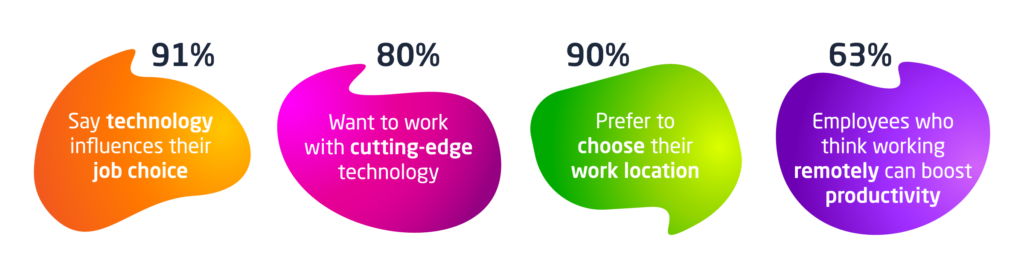
The shift to remote working has boosted productivity and cost savings.

70% of organisations believe that the productivity gains of remote working are sustainable beyond the pandemic. 

Removing Geographical Boundaries

Hybrid work is more than a location decision.  Designing a hybrid work model requires leaders to acknowledge that while certain roles can be performed remotely, some require permanent on-campus presence, while others need to be a mix of the two.

With remote job listings on the rise, Microsoft’s Work Trend Index: 2021 Annual Report found that 46% of remote workers are planning to move to a new location in the next year.  Removing geographical restrictions for work not only gives everyone qualified a fair opportunity to apply for the position, it also offers businesses access to an essentially unlimited global talent pool featuring a diverse range of applicants, creating a stronger work environment for all.

This is only possible if organisations can attract, and then retain, talent from this global workforce – organisations need to intentionally select the connectivity, technology platforms and service partners required to enable a hybrid work model tailored to their specific distributed workforce needs.

It is essential that users spread across the globe should always feel included with a uniform experience across any device in any location.  And with the potential for multiple time-zones, status setting is key in maintaining personal and business life balance.

Access to the tools, platforms and user-support needed to enable everyone means communications platforms should be cloud-based and the provider of the solution needs to be equipped to support your workforce around the clock 365 days of the year.

4130.5 FTTB Voice Campaign Thought Leadership Pic V2 06092021 1 | Vox | The Future of Work is Hybrid

41% of employees are considering leaving their current employer

Organisations that don’t purposefully enable a hybrid work model will run the risk of becoming irrelevant if existing or prospective employees are not equipped with the tools, platforms and support to work flexibly.

The Tools Needed to Embrace Hybrid Work

The new era of radical, agile working patterns requires a technological shift.

Not only will this shift create user-centric experiences for the connected workplace, it will also allow companies to embrace other benefits hybrid work has to offer, including increased productivity, cost-saving and security.

The key lies in choosing a technology partner that not only offers fast, reliable connectivity, but access to cost-effective, future-proof communications tools that allow you to make the most of all hybrid work has to offer, simplifying communications and saving money in the process.

Vox offers the most competitive Voice rates and Uncapped packages tailored to your specific needs, as well as highly competitive Business Fibre bundles, and a choice of Cloud PBX solutions, enabling you to enjoy all the benefits of an on-site PBX with none of the drawbacks. The benefits include maximising your investment in your Fibre connection for both your data and communication needs, without having to buy or maintain expensive servers and hardware, not to mention the additional costs needed to house this equipment and keep it cool.

Vox’s Cloud PBX solutions, like 3CX Cloud and TeamsVOICE, take Unified Communications to the next level – allowing you to call, chat, video call and host conference calls – remotely, in the office or a combination of the two for all participants, with ease.

By selecting your Connectivity, Cloud PBX and Voice services from one provider, you’ll have one point of contact, one lower bill, quicker turnaround times and, ultimately, better service.  Because you can optimise the performance and cost profile of all three of these essential services by partnering with us, why would you consider talking to anyone else?

Home Security Cameras – Your Smart Home Must-Have

Shop Wi-Fi Security Cameras

Your home is your castle, and in the 21st century, the right home security cameras will act as your high-tech moat. It’s a little more subtle, but it works.

Smart home tech is on the rise.

Sure, we’re not quite living in the future the Jetsons had us believing we would be just yet. But we do have fridges that let us know when the milk is about to expire and apps that allow us to control the lighting and temperature in each room of our home.

And that’s just for starters.

According to Statista, spending in the smart home industry will top 170 billion US dollars by 2025, with over 400 million smart homes globally.

If we had to choose the most exciting innovation in smart home tech, it would have to be the home security camera.

Whether you’re a homeowner, renting a place or looking to keep an eye on your holiday home, there’s a security camera solution to suit every need.

The products themselves will only get better. And renting home security cameras is the easiest way take advantage of those tech upgrades. Renting gives you the flexibility to scale your solution up or down without blowing your budget.

Wired vs Wireless Wi-Fi Cameras

When it comes to home security cameras, you have three main types to choose from. Wired cameras connect to the Internet via Ethernet cable, wireless cameras connect directly to your Wi-Fi network, but need to be connected to a power supply. Wire-free cameras don’t need any cabling at all, they rely on batteries for power and connect via Wi-Fi.

Of the three, wired cameras offer the most stable connections, but need professional installation. Wireless and wire-free cameras are a lot more DIY and a great solution if you’re renting or looking to add security somewhere temporarily.

After that, you’ll need to decide if you want indoor or outdoor surveillance or both. Outdoor cameras need to be durable enough to deal with a range of temperatures and weather conditions, and this is where an IP66 rating (or higher) makes all the difference.

Security Cam Essentials

So, you’d like add security cameras to your home. The good news is, as mentioned above, there’s a home security camera to suit every home and need, indoors and out. Not only are they great for acting as a deterrent to potential thieves and intruders, they’re also allow you to keep an eye on your home, inside and out in real-time, at the touch of a button via your smartphone.

There are a few non-negotiables worth keeping in mind, though. The first: image resolution. If you can’t see what’s happening on screen, what’s the point of having a camera? Never settle for anything less than full HD image quality at 1080p – this way, you’ll always have a clear view of what’s going on.

It’s also a good idea to choose a camera with a wide field of vision to give you the big picture and the best idea of what’s happening in your surroundings at all times. Better still, opt for a camera with pan/tilt functionality and zoom capabilities so you never miss a thing.

While we’re on the subject of image quality, placing your cameras in well-lit areas is also key to ensuring you get the clearest view possible. To keep an eye on your home 24/7, infrared lighting and anti-glare are essential to staying in the know and out of the dark.

The Nice-to-Haves

Having a range of storage options to choose from also ensures you’ll have access to the footage you need, when you need it. While some cameras include the option of saving footage to a microSD card or your own network via a Network Video Recorder (NVR), most suppliers will offer encrypted cloud storage on subscription. The best solution? A device that offers all three storage options for the ultimate backup and redundancy.

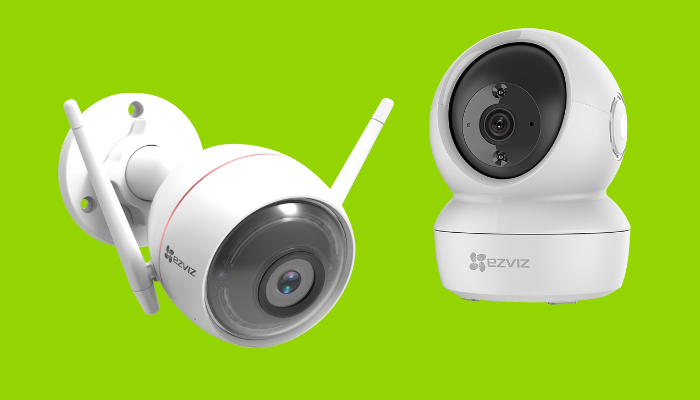
What if your camera not only allowed you to hear what was happening outside, but talk back too? And it included a booming siren and strobe light as added deterrents? Look no further than our Wi-Fi Cameras.

Our Guardian Eye range of home security cameras check all the boxes and include all the (sometimes literal) bells and whistles but remain accessible via a choice of rental plans to suit almost any budget.

Because there really is no place like home.

New Internet Optimisations from Vox to Give SA Gamers the Edge

With pandemic related lockdowns resulting in South Africans keeping to their homes, a growing number are turning to gaming as a form of entertainment, or even a livelihood, as can be seen with professional gamers. To give them an advantage, integrated ICT and infrastructure provider Vox has launched Gaming Essentials, a Quality of Service feature that ensures a superior connectivity experience for local gamers.

“Today’s homes now have multiple devices connected to the internet as different family members engage in working online using cloud-based services, surf the web and watch YouTube videos, and stream series or movies off Netflix – all at the same time. This can have a negative impact on gaming traffic, and ultimately the gaming experience,” says Andrew King, Head of Product: Voice, Visual Comms and Gaming at Vox.

According to King, Gaming Essentials – only available to Vox FTTH customers – includes proprietary gaming-specific configurations added to a service-provider grade Mikrotik router on the customers premises, that minimises jitter and eliminates latency spikes due to buffering under high load. By prioritising UDP traffic – the traffic type used by most modern games, this Quality of Service (QoS) feature shields gaming traffic from other internet traffic on the household’s network, reducing latency for gamers.

“This is critical when playing online or multiplayer first-person shooter games. Enabling the optimisation of gaming traffic on your local network can be key, as the slightest bit of latency can be the difference between you placing first or your opponent winning the game. The lower your ping and latency, the smoother, more responsive, and lag-free your gameplay is. Gaming traffic isolation also means that you won’t experience latency spikes when someone in the house starts watching a YouTube video, for example.” says King.

Enjoy Hassle Free Internet Usage

For the configuration to work properly, you will need to forgo a small portion of your line speed (1Mbps on links less than 50Mbps, and 2Mbps on 50Mbps or faster links). Your gaming traffic will flow over a dedicated portion of your link, unaffected by other Internet traffic flowing over the same link. Furthermore, with the router being controlled by a centralised management server, Vox can remotely configure the device so that you always get to enjoy the best experience possible on your specified device, regardless of you upgrading or downgrading your link over time.

“Vox’s Gaming Essential QoS can give local gamers the edge over the competition with improved real-time gaming, particularly on lower speed links – all while the rest of the family gets to enjoy hassle free internet usage, without their streaming or your gaming being affected,” says King.

Taking Gaming to More South Africans

King says Vox is looking to make quality gaming more accessible and affordable to South Africans with multiple offerings, including latency optimised internet connectivity (with Fibre the primary choice for gamers), affordable access to the latest generation of gaming consoles from Microsoft, and now Gaming Essentials.

“We have also introduced a streaming relay service for PC who have a Vox FTTH subscription. Traditionally, local gamers had to stream at low resolution – often at 480p.  By using the Vox service, they are able to stream in high definition, increasing the possibility for more views and gaining more subscribers and followers. This is made possible by streaming to the local Vox edge server, which then relays the stream – at much higher resolution – to the relevant global platform be it Twitch, Vimeo or YouTube.

“All of these offerings together are aimed at aiding and enabling our customers, and to ensure that they get to enjoy a superior gaming experience.”

Back Up or Back Out: How Data Storage can Save your Business

Lately, it seems like everyone from T-Mobile to Uncle Cyril is learning about external business threats the hard way.

Seriously, with Virgin Active being hit, we normal folk need to be on high alert. If it were us, we’d hack something a bit less dangerous like the National Chess Association, but messing with the gym queuing system at 5am just shows that cyber criminals are not playing around.

The scary part, however, is that it’s not only distant businesses from faraway lands which are being targeted.

Here are some of the biggest (and most notorious) hacking scandals of the last year alone.

  • In Jan 2020, Travelex needed to be pulled offline due to Malware attacks.
  • Estee Lauder: 440 million (think of how many that is) individual records were released.
  • Mitsubishi: their May 2020 Data breach led to their missile designs (we know!) being stolen.
  • Google: They mitigated the largest attack in history, a 2.54 Tbps DDos.
  • Home Depot: this US Retailer had to pay a $17.5 million settlement to release their Data.
  • ABSA: A rogue employee led to personally identifiable customer information being leaked.

But our personal favourite? The revelation that 10 000 South African Android Users were identified as being compromised just last month. We know, it may sound like doom and gloom, but we’re not one for the ostrich method of burying our heads in the sand – Data theft is real, and unless your business has about $17.5 million to pay on ransom fees (in which case, look us up), a breach in safety could also be the endgame. And we don’t mean the cool Avengers vs Thanos type either.

Okay, cool – but that’s just digital, and I have a Firewall. So what must happen?

Well, the last few years have been challenging, with many organisations struggling to stay afloat even prior to the pandemic. Enter the incredibly disruptive socio-economic climate we still find ourselves battling today, and pretty much everyone has had to rethink their business models.

Covid-19 happened. Level 5 happened. Eskom happened. Things stabilised, then came back in December. They went away. They came back. As if that weren’t enough, the third wave made an appearance in July, along with some new restrictions from Uncle Cyril. Well, it can’t get worse, right? Wrong. Enter looting and riots, which had a devastating impact on KZN and a knock-on effect on other provinces, almost bringing the country to its knees. It felt like the end times, but thankfully we survived – yet that week alone cost an estimated 0.7% of our National GDP in damages.

Be it strategy, operations, the supply chain or ground staff, everything changed, yet as South Africans we have this inherent ability to rebuild, work smarter and establish a way to persevere. In fact, we thrive on competitiveness and an opportunity to be resilient, so on we push.

But what does any of this have to do with Data Storage?

Well, all these events have served only as a reminder of the fragility of running a business. In a second, things can change. Be it the Macro-environment, political landscape or a hacker behind a keyboard, our business world is vulnerable and faces ever-looming threats on all sides.

With this in mind, it is paramount that organisations operate with the mindset of intelligent solutions which can withstand said external circumstances.

It’s one thing to rebuild, but how can we do it smarter?

This is not for the sake of making more money, but rather to lay a foundation capable of handling any future turmoil.

Consider, for example, the damage caused by looting. These events have shown us that the old ways are completely perishable, and as such we should now strive for the ability to connect from anywhere, anytime and pick up where you left off – or, better yet, being able to instantly recover your business information in the event of disruption (with minimal interference). The goal of any brand should be resilience and non-dependence on external circumstances.

How many times have we as a nation heard the words “my fellow South Africans”, and had our entire economic landscape turned on its head (literally overnight)? It’s been long enough and frequent enough that the ability to continue working on short notice and allowing normal service to resume should be a natural part of the process.

In fact, an informed organisation is one which looks at current events and asks itself how technology, software and intelligence can play a role in protecting itself moving forward.

The answer, of course, lies in the Cloud (and no, we don’t mean going to heaven)

Designing an effective Cloud strategy not only reduces your costs and allows for accessibility, flexibility and scalability, but also incorporates the principles of backup and recovery as part and parcel of its foundations. You as a business can access your info whenever, wherever, which has become the most fundamental component of ensuring that today’s business even has a tomorrow.

If anything, the recent disruption has forced us all to introspect while propelling our humble nation on a similar trajectory as its first world counterparts (when it comes to Cloud, at least). One of the most remarkable things about this entire pandemic was that it created an almost level playing field – changing mindsets, circumstances, ushering in a universal era of adaptation.

We’ve written a million words about Cloud (which you can find here), but an empowered modern business cannot afford to overlook the most modern solution available.

Whereas the brands of yesteryear needed a strong physical presence to survive, today’s organisations require the ability to flip the switch and keep moving forward. It’s tough enough running a business without the added damage of Data Theft, breaches or damage.

We’ve all learned some hard lessons these last few years but, for us, the one that stands out most is that information is priceless – and so too is the need to protect it.

Vox Security: Level Four

Kia Motors. CD Projekt Red. CNA. Virgin Active.

It may sound like a list of our favourite brands, but these are just a few household names who’ve been hit by cyber-attacks in 2021 alone. With one occurring every 11 seconds and damages estimated to hit $6 trillion this year alone, the recent barrage of Ransomware attacks is enough to keep anyone awake at night.

The reality is that every industry faces its share of challenges – particularly when it comes to crime.

In retail it would be theft, hijacking, looting and so forth. These have been around for generations and, while nothing new, there are ample safety measures and protocols in place to not just avoid them, but minimise damage incurred should they happen.

However, the digital world is different in that threats are varied and ever evolving.

The reality of this has come to the forefront of conversation as a result of Cyber Attacks on some of the world’s biggest brands. From the Irish Health Service to Virgin Active SA and beyond, these industry titans were guaranteed to have some of the best defensive software, yet even they found their walls breached. It’s a scary reality and, with both Internet usage and Ransomware Attacks at an all-time high, many a brand finds itself at a crossroads.

The key issue is that these are far less in-your-face than dangerous hotspots or screaming attackers. Perpetrators are calculated, skilled and experts in circumventing many a previously impenetrable defense. Day-by-day, their craft evolves, and security specialists the world over are forced to deal with previously unseen challenges.

Enter Security Level 4, which is designed to not only counter security threats, but detect them before they even occur.

Top of our list are threat feeds, which work with a concept called Zero Day. Think of the Delta Variant of Covid-19 – a new, previously unseen virus with seemingly no cure. When coming out the blue with no warning, it can be impossible to diagnose or get rid of, but Zero Day technology is the digital equivalent of a clairvoyant vaccine. Zero Day feeds systemically work to detect brand new viruses, malware or phishing threats that haven’t been seen before. Rather than wait until these have breached your security and leave everyone scrambling for a solution, this ability to pre-emptively detect and deflect these threats means you don’t have to end up a victim of cyber crime to avoid its effects moving forward.

This isn’t some pie-in-the-sky theory either, as some of the biggest Zero-Day threats in the last few years have occurred to some pretty surprising organisations:

  • In 2021, Google Chrome suffered a series of breaches which caused the platform to issue malicious “updates”. This was made possible by a bug in their V8 JavaScript engine, which was first identified, then exploited.
  • In 2020 (as if we weren’t going through enough) a vulnerability in Zoom allowed hackers to remotely access user’s PC’s if they were running an older version of Windows. These hackers could then access files and Data or just take over the PC completely if they desired.
  • Similarly, Apple iOS (which was considered impenetrable by many) fell victim to at least two sets of vulnerability exploitation, including a bug which allowed iPhones to be compromised remotely.

In fact, as little as a week ago, our own President Cyril Ramaphosa discovered spyware on his personal cellphone which allowed him to be spied on (in addition to about 34 other world leaders). So, if you think you or your brand couldn’t be a target, the reality is quite the contrary – but these issues can be avoided with relative ease.

The solution, of course, lies in the correct software.

At Vox, we also advocate for a platform called Kiuwan, which analyses your code and diagnoses what’s wrong with it. Not only this, it detects bugs, increases efficiency and allows you as a user to regulate specific standards in adherence to protocol.

This rolls over into Digital Security, with specific emphasis on IOT and Mobile Devices. Level 4 of our Security not only protects your devices (be it mobile or PC), firewalls and information, it expands into the territory of security, monitoring and web applications. When accounting for operational technology (such as Guardian Eye or Webcams), this software ensures that your devices can’t be breached. We’ve all heard horror stories of webcams being hacked into and innocent people spied upon (no, it’s not a myth, it even happens with phones), but Level 4 is capable of securing your security measures.

Furthermore, the technology also delves into Web Application Firewalls, which in turn protect your websites from being hit (this is done through Fortinet). Combine this with our Penetration Testing, which lets you scan websites, detect issues and safeguard vulnerable areas, and you can tighten up both your brand and personal security in the blink of a (Guardian) eye.

Gone are the days where the biggest threat to our devices was a misplaced laptop bag or a cell phone snatcher at a restaurant. As technology and education has evolved, so too have the propensities of those seeking to exploit them. Thankfully, however, there are still heroes who are willing to face these threats head-on, in doing so providing the man or business in the street with the equipment required to do the same.

Security Level 4 is all about Device Security, protecting your Websites, Code and Threat Feeds. Whether a large corporate or company focused on user awareness training or just an average Joe who fears the worst, there’s a solution within our solutions that can make your Online Security impenetrable.