So, What’s the (Sweet) Deal with Vox Wireless Lite?

Vox Wireless: Just as fast as Fibre, and more widely available


What do Coca Cola and Vox Wireless to the Business (WTTB) each have in common? Besides being leading brands in their arenas, that is.

The answer is in the word Light. Or Lite.

Coca Cola gave the world Coke Light, for those who wanted the same original sweet taste but with zero sugar. Vox Fixed Wireless to the business (WTTB) gives you two options, including Vox Wireless Lite – because we also believe in providing a fantastic product, but with choices available for different requirements.

Wireless Lite is especially good for start-ups and SMEs. It’s also on promotion right now.

Let’s see how well it could work for your business.


A Quick Technology Outline

Fixed Wireless can deliver a Fibre-like experience if the service provider gets it right with regards to capacity and area coverage. This, of course, goes without saying at Vox.

Vox Fixed Wireless is a high-quality, high-speed Fixed Wireless connection, using Microwave technology that can be deployed around South Africa, to ensure that your business is always connected. It’s an excellent alternative when Fibre cables aren’t laid in your area, or as a redundancy option if your Fibre goes down. It’s also a fantastic solution if you need to be connected in a hurry and can’t wait weeks for your Fibre installation.

Coca Cola never officially reveals its recipes, but here at Vox we believe in being transparent, so let’s take a look at how WTTB works.

It’s pretty simple.

 

700x400 Wireless blog | Vox | So, What’s the (Sweet) Deal with Vox Wireless Lite?


  • A device is pointed at a tower, which services the area in which your business is situated.
  • The device provides a high-speed Internet connection using Microwave technology, whose access towers are served and connected to Fibre lines as the ‘backhaul’.
  • Because the station is close to and in view of the premises, a Fixed Wireless connection can deliver a very fast Internet experience with low latency.


Vox Wireless Lite

Vox Wireless Lite is one of two different Fixed Wireless offerings for businesses that we offer, with the other being Vox Wireless.

Vox Wireless Lite – Licensed is a more cost-effective service than Vox Wireless, without compromising on quality. This service is available as a Broadband Primary service but will also make an excellent Failover solution to cater for all your business needs.

We offer a Symmetrical service (same upload and download speeds) of 10 Mbps and 20Mbps, and an Asymmetrical service of 50Mbps and 100 Mbps.

Vox also offers Vox Wireless Lite – Unlicensed, in which different speed profiles are once again offered, but with this option, all speeds are Asymmetrical.

With Vox Wireless Lite, just like Coke Lite, we leave out one ingredient, so where the beverage is minus the sugar, we help you streamline your costs by leaving off the Voice offering that comes with Vox Wireless, which includes a Voice VLAN to streamline your VoIP (Voice over Internet Protocol) communication.

But don’t worry – if your business grows, you can add more ‘sugar’ later – it’s simple to change options.


Something for Every Business with Vox Fixed Wireless Options

The famous beverage company has a range of refreshing drinks available in several varieties and sizes to suit different lifestyle, and in the same way, Vox Wireless to the Business is able to cater to your different needs and speeds.

 

choice 2692466 1920 | Vox | So, What’s the (Sweet) Deal with Vox Wireless Lite?

All Vox Wireless packages include data and line rental, and speeds can range from 5Mbps to 1Gbps – the flexibility and choice of packages is a real value-add, allowing you to match your speeds to your business needs.

The main features and benefits of Fixed WTTB are as follows:

  • Quick to deploy in feasible areas: If your business has a remote site where no fixed-line connectivity is possible, Vox Fixed Wireless options are an ideal alternative. They are also generally quicker than Fibre to install.
  • Duplex Service enables you to transmit and receive data at the same time, giving you dual efficiency.
  • Managed Service 365/24/7 Support ensures that we’re there when your business needs us the most.
  • Scalable: It’s easy to upgrade your link to grow with your business.
  • Business continuity: Can be deployed as a primary or failover service to ensure you are always connected.


Depending on the area and requirement, Vox Wireless works with the following Wireless connectivity providers: Comsol, Easyweb, Kliq. MTN, Rapidnet, Tech5 and VO Connect.


Sweet Offerings to Refresh Your Business

Vox Wireless offers speeds comparable to Fibre, but is more widely available. With quick deployment and low latency, it’s geared to help your business stay connected. Whether you’re in the city centre or out in the country, Vox Wireless ensures your business stays connected, competitive, and ready to grow.

For high speeds and the most innovative, cutting-edge microwave technology on the market, you can’t go wrong with Fixed Wireless to the Business from Vox. Whether it’s Vox Wireless or Vox Wireless Lite, we’ve got you covered with great options.

And we think that’s a pretty sweet and refreshing deal.

 

artem beliaikin rNQ3TFuLkQU unsplash Coke | Vox | So, What’s the (Sweet) Deal with Vox Wireless Lite?

Affordable High-Speed Broadband, Plus Value-Adds, for Every South African

Is that all? The importance of offering ‘more’ in a saturated environment


Today’s world is defined by Connectivity in ways that seemed unimaginable when the clock first ticked over into the current millennium. Whether it’s WhatsApp, X, LinkedIn, Pinterest, Facebook, Snapchat or TikTok, people love being connected, and online is here to stay.

Here at Vox, Connectivity lies at the heart of everything we do.

As a leading South African Internet Service Provider (ISP), we are all about connection, communication and conversation – but we also know that we’re not alone. The local telecoms landscape has more than 20 ISPs in operation – you could call it a saturated market.

And so Vox goes above and beyond to offer our customers more than the competition – you definitely won’t hear the phrase: ‘Is that all?’ about any of our offerings! At the heart of our multiple solutions is the goal of being able to offer every South African access to affordable high-speed broadband.

Let’s take a look at how we can get our customers connected.


Rocket1 | Vox | Affordable High-Speed Broadband, Plus Value-Adds, for Every South African 

Dealing With Market Saturation

In addition to high-speed broadband, Vox provides many excellent value-adds. As well as lightning-fast Internet, we offer Wi-Fi solutions to keep you connected; cost-effective and quality Voice over Internet Protocol (VoIP) offerings; energy back-up products for power outages; and even cell boosters to enhance your mobile phone experience – no more ‘dead’ zones in the house!

You can look to Vox for the following:

  • Our connectivity solutions begin with Vox Fibre, which comes with value-added extras upon sign-up, like free installation and a free-to-use router.
  • When Fibre is unavailable, other options are provided:
    • Vox Wireless presents high-speed, fixed Microwave Data Connectivity that uses the most innovative microwave technology on the market. It comes with free installation, meaning more money to invest in your business.
    • Consumers and businesses also have the option of choosing Fixed LTE, 5G, and satellite, depending on factors such as their needs and budget, and geographic location.
  • To ensure that our customers get the most out of their Internet solution, we supply best-of-breed Wi-Fi devices, which allow you to maximise your Wi-Fi experience. We also offer managed Wi-Fi network solutions, which enable remote software, firmware updates and reduced technician callouts with remote troubleshooting and fault remediation. Additionally, our expert advice is always available to enhance your overall network experience.
  • We also provide excellent access to power solutions for those times when the power goes down, to keep your Wi-Fi running even in an energy outage.
  • Vox’s shared Mobile Data offering is an ideal mobile wireless solution for a family with multiple SIM-enabled devices, to keep everyone connected while maintaining control over your mobile data bill using our simple online portal.


AdobeStock 478762309 | Vox | Affordable High-Speed Broadband, Plus Value-Adds, for Every South African

What Sets Our Connectivity Options Apart?

Vox offers our clients high network availability and an extensive national footprint, as follows:

  • We have a huge range of subscription and pricing solutions, and our sales agents will help you choose the best package for your needs, rather than upselling you on the most expensive.
  • Vox subscribers, both consumers and businesses, have the option of adding backup Internet solutions to their Fibre packages (like LTE or Wireless) to ensure they stay online all the time.
  • Our Proactive Network Monitoring offers safer, more secure Internet access and lower latency.
  • A 24/7/365 in-house Service Centre is available for troubleshooting and incident response for all our customers, across any product.
  • As far as Voice offerings are concerned, we believe that we’re the number 1 VoIP provider in the country.
    • Individual consumers and SMEs can make use of our Vobi softphone application, which is unique to Vox, and allows customers to make and receive high quality Voice and Video calls over Wi-Fi, 3G, 4G-LTE and 5G on the Vox network.
    • Organisations can make use of our Titanium partnership (the highest status possible) with global cloud PBX leader 3CX, to experience a comprehensive communication platform that includes Live Chat, WhatsApp, Facebook, SMS and Video Conferencing.


Orange woman megaphone resized | Vox | Affordable High-Speed Broadband, Plus Value-Adds, for Every South African

Vox teams are situated in multiple locations across the country, supported by our extensive footprint of over 1 000 business partners to ensure that our customers receive fast, efficient service wherever they are, whenever needed.

Value-Added Service Offerings

We take full responsibility for all our technical implementations and systems, from concept to installation.

  • The Vox Service Centre offers immediate support to all our customers.
  • The Service Centre also continuously monitors all of Vox’s networks and infrastructure, to ensure that quality of service is always maintained.
  • Specialist product managers are assigned to oversee each portfolio, for continuous research and development to ensure each product is always of the highest standard.
  • An extensive team of account managers and technical engineers offers convenient customer service and solution implementation.
  • If you’ve decided to upscale your business with better Connectivity, don’t stop there! Vox can also organise a customised domain and email address for you, to turbocharge your professionalism, as well as taking care of your email archiving needs with the most comprehensive and hassle-free cloud email and compliancy solution on the market.
  • There’s always a good time to sign up with us – you could win with our ‘Refer a friend’ campaign, and there’s always a fabulous promo running that allows you to sign up and save.

Expertise, innovation and superior quality products are at the heart of Vox. Ultimately, we have everything required to meet our customers’ needs at every stage of their journey – both now, and in the future – and that’s how we keep South Africans staying connected together.

With us, there’s always more.


AdobeStock 399195503 resized | Vox | Affordable High-Speed Broadband, Plus Value-Adds, for Every South African

Cyber Space? No, Cyber Oceans…

How the Internet is powered in the depths of the sea

Subsea cables, which are bundles of fragile glass Fibre protected by heavy armour, carry roughly 98% of international internet traffic, linking continents via light pulses and landing stations that connect to national Fibre networks.

Did you ever wonder how the Internet reaches across oceans so that we can communicate – via Email, social media or Internet Voice functionality – between South Africa and the rest of the world? And how is it that, in the blink of an eye, a local gamer can execute a tactical manoeuvre with a team-mate in England to annihilate an ‘enemy’ in Australia? And what enables us to download American-made YouTube videos and watch X rants in real time from Donald Trump?

The Internet is able to reach across oceans like this because a huge chunk of it is actually placed in the oceans. Many people don’t realise that around 98 percent of international Internet traffic is carried around the world by subsea cables.

Let’s take a look.

The Hidden Deep-Sea Internet Highway

The Internet ‘superhighway’ joins continents and countries through both subsea as well as terrestrial cables. The data wires in this interconnected web bring high-speed Internet access to all parts of the globe, through around 1.5 million kilometres of cable criss-crossing the ocean floor.

These cables are laid on the seabed at an average depth of 3,600 metres. Today, there are about 500 subsea cables that are either live or under construction, and if their total lengths were combined, they could stretch – roughly – from the Earth to the moon, about three times over.


TeleGeography submarine cable map headline | Vox | Cyber Space? No, Cyber Oceans…
Image courtesy of https://www.submarinecablemap.com/


The cables are typically funded by the telecom industry, sovereign nations and technology companies such as Facebook and Google. So the reality is that the backbone of the planet’s Fibre cables are deep in the sea, quietly linking people and businesses to each other, all the time (except when something happens, but that’s a different story).

Thin Cables, Extraordinary Power

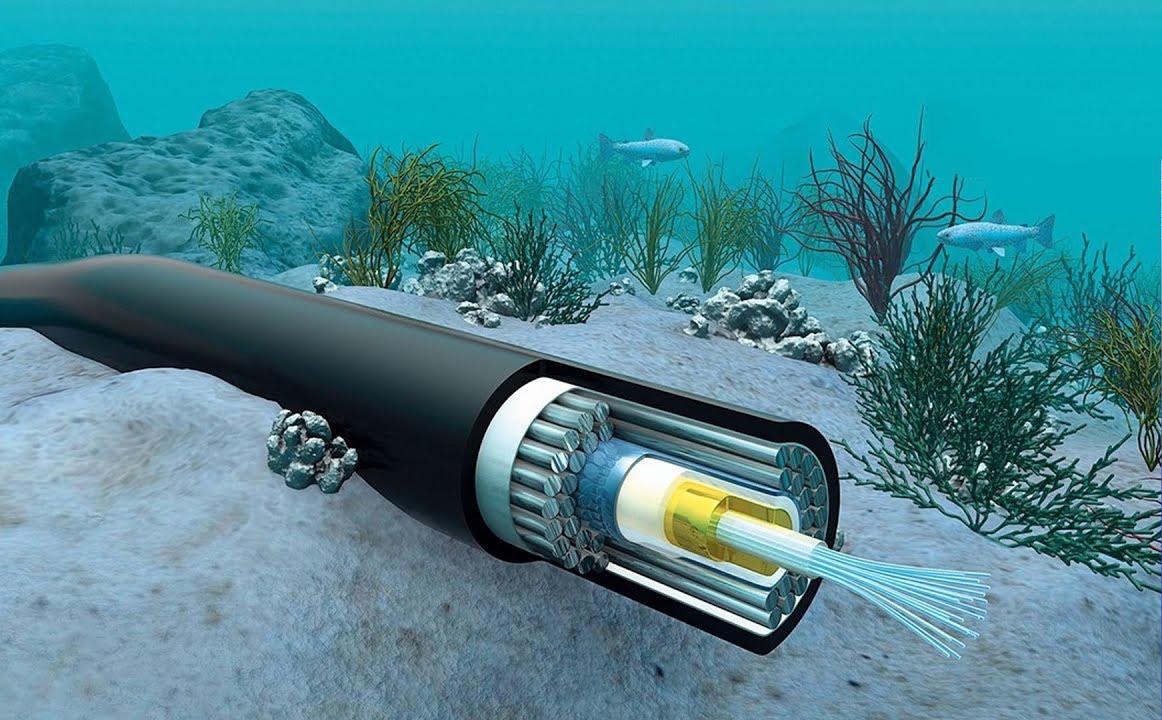
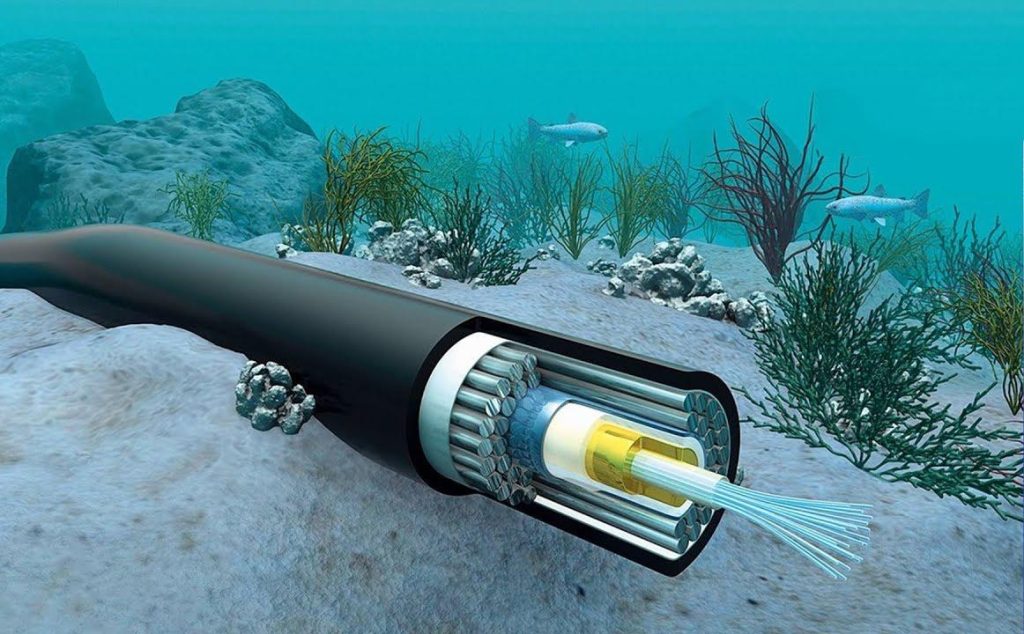
Fibre Optic cables transfer data across the world in the blink of an eye via light pulses, which travel through fragile wires just thicker than a needle. Fibre Optic cables are tiny tubes made of glass or plastic, which are in turn protected by multiple layers of hard materials like metal and rubber.


cabo submarino | Vox | Cyber Space? No, Cyber Oceans…


A single Fibre Optic can transmit 100 gigabits of data a second, with new cables able to transmit around 400 gigabytes per second. Thousands of Fibre Optics get bundled together and insulated, making one Fibre cable.

Subsea cables typically include a protective jelly around Fibre Optic cables and are also contained within multiple layers of plastic and copper wires. Under the water, ‘repeaters’ are connected at certain points. They amplify the signal and boost signal strength over long distances. The copper wires contained within the cable casing carry around 10 000 volts of electricity to power these repeaters.

The bottom line (pardon the pun) is that both within the sea and on land, the fine tubes that carry data packets at the speed of light need to be protected, which makes the cable overall – once properly wrapped up and protected – look much bigger than the thin part that actually does all the work.


underseacable | Vox | Cyber Space? No, Cyber Oceans…


From Sea to Land

When subsea cables under the world’s oceans reach the shore, they are then connected to landing stations, which are an essential part of the Fibre network infrastructure – they distribute the data carried on the networks, joining the submarine cables to terrestrial cables.

For example, there’s a landing station in Mtunzini in KwaZulu-Natal, where the SEACOM cable reaches South African shores. This cable connects the subsea cable directly to a data centre in Midrand, Johannesburg.

Once plugged into the landing stations on shore, the cables take on their overland mutation and are distributed by FNOs (Fibre network operators). The FNOs are responsible for deploying, managing and maintaining Fibre Optic networks – their role is the physical infrastructure, or, in short, running the cables under and next to roads and buildings.

Be Connected with Vox

As an Internet Service Provider (ISP), here at Vox we don’t physically lay the cables ourselves, but instead partner with a number of FNOs around the country to bring South Africans high-speed Fibre to the Home (FTTB) and Fibre to the Home (FTTH) offerings. Some of our local FNO partners include Openserve, Vumatel, Frogfoot, Metrofiber Networx and Octotel (you can find out more here).

An ISP – like Vox – provides Internet access to businesses or residential customers. An ISP’s role is to operate on top of the existing network infrastructure and manage services by offering different plans and packages based on speed and other features.

So next time someone talks about cyber ‘space’, you can point them in the right direction – that it’s mostly all about the ‘cyber oceans’. Except, of course, when it comes to a small section of Internet connectivity that’s powered by Satellite in outer space (just to talk about actual space here for a second).


Featured Image Content Hub Vox launches high speed uncapped data and voice satellite plans | Vox | Cyber Space? No, Cyber Oceans…


Satellite really comes into its own in regions where Fibre cables can’t be laid, perhaps because of rough terrain (like mountains) or because the area is just too remote. Vox also offers Satellite services – because as modern life becomes increasingly dependent on the Internet, reliable connectivity is more important than ever before.

Whether it’s for following the news, being connected for work, gaming, staying in touch with friends and family, or streaming shows and movies in your down-time, it’s great to live in today’s connected world. Whatever your needs, Vox will get you connected and keep you in the conversation.


Frequently Asked Questions

Q: What are subsea (submarine) cables and why do they matter?
Subsea cables are bundles of Fibre optic strands laid on the ocean floor that carry roughly 98% of international internet traffic. They form the global backbone that determines international speed, latency and reliability for streaming, gaming and global business traffic.

Q: Does Vox lay subsea cables?
No, Vox does not lay subsea cables. Instead, we partner with Fibre Network Operators (FNOs) and make use of landing‑station capacity so we can deliver international bandwidth into South Africa and on into local networks.

Q: How do subsea cables affect my home or business connection?
Subsea capacity affects international latency and throughput. Good access to landing stations and local distribution networks means smoother streaming, faster international downloads and better performance for cloud apps and gaming.

Q: How can I check if Vox Fibre is available at my address?
Plug in your home address on the Vox availability tool and select ‘Connect me’ to see whether Vox Fibre to the Home is offered at your location.

Q: What if Fibre isn’t available where I live?
Where Fibre is not yet available, for example in very remote or rugged areas, Vox offers Satellite services as an alternative to keep you connected.

Q: What support and contract options does Vox offer for business and residential Fibre?
Vox provides 24 / 7 / 365 support at no extra monthly cost and a range of contract terms to suit different needs. Business Fibre can include dedicated options, static IPs and VLANs; residential plans may offer zero upfront fees on qualifying 36‑month contracts. Contact Vox for package details and tailored service options.

How 5G Networks Can Strengthen Your Business Cybersecurity

The rollout of 5G technology is revolutionising more than just network speeds—it’s reshaping enterprise cybersecurity. With stronger encryption, smarter authentication, real-time monitoring, and network segmentation, 5G delivers an advanced security framework that helps businesses proactively defend against cyber threats.

Below, we explore how 5G enhances cybersecurity and strengthens your company’s digital resilience.

Key Cybersecurity Benefits of 5G Networks

  • Enhanced data encryption

  • Stronger privacy protection

  • Network slicing for isolated security zones

  • Multi-layered authentication

  • Real-time threat monitoring and anomaly detection

  • Edge computing security advantages

  • Automated security responses

  • Secure connectivity for large device ecosystems

  • AI and machine learning-driven threat prevention

  • Improved global roaming security

Let’s unpack how these 5G capabilities work to secure your business.

1. Enterprise-Grade Data Encryption

5G introduces next-generation encryption, including 256-bit encryption standards and advanced cryptographic algorithms—future-proofing networks, even against emerging quantum computing threats.

Why this matters:
Sensitive business data is significantly harder to intercept or decrypt, drastically reducing exposure to cybercrime.

2. Stronger Privacy & Identity Protection

Unlike 4G, 5G masks user identities using a Subscriber Concealed Identity (SUCI) instead of transmitting personal identifiers in plain text.

What this means for business:
Better protection for confidential internal data, customer profiles, and proprietary information.

3. Network Slicing: Custom Security Zones for Your Business

5G allows multiple isolated virtual networks to run on the same infrastructure. Each can have tailored security controls, access rules, and monitoring.

Security advantage:
If a breach occurs in one slice, it can be instantly quarantined—leaving the rest of the network untouched.

4. More Secure Authentication

5G strengthens access control through:

  • Multi-factor authentication (MFA)

  • Secure device verification

  • Asymmetric encryption-based identity validation

Result:
Fewer risk points, less impersonation, and tighter access control across networks and connected devices.

5. Real-Time Threat Monitoring and Detection

Powered by machine learning analytics, 5G monitors networks in real time to detect unusual activity and security anomalies at internet scale.

Security outcome:
Faster detection = faster response = fewer breaches.

6. Edge Computing for Reduced Attack Surfaces

5G can process data closer to its origin rather than routing everything through central servers.

Benefits include:

  • Lower risk of data exposure

  • Faster incident response

  • Fewer network choke points for attackers

7. Automated Cybersecurity Response

5G networks can support self-automated threat detection and mitigation, reducing reliance on manual intervention.

Impact on business:
Shorter vulnerability windows, fewer successful exploits, and less operational downtime.

8. High-Volume Device Security

With capacity for up to 1 million connected devices per square kilometre, 5G delivers scalable, secure support for large device ecosystems.

Security benefit:
Centralised security oversight, real-time monitoring, and stronger endpoint protection across massive connected environments.

9. AI-Driven Cyber Defence

The ultra-low latency and high throughput of 5G allows AI and machine learning security models to respond instantly to emerging threats.

Bottom line:
Cybersecurity becomes predictive, not reactive.

10. Safer Global Roaming & Network-to-Network Security

5G replaces outdated roaming protocols like SS7 and Diameter with the Security Edge Protection Proxy (SEPP)—creating a unified, encrypted communication layer between global networks.

Advantage:
Improved protection for businesses operating across borders, especially those with mobile or roaming workforces.

5G Is a Major Leap Forward for Business Security

5G is no longer just about faster internet—it is a cybersecurity enabler that provides:

  • Stronger encryption

  • Smarter authentication

  • Intelligent threat monitoring

  • Network isolation and control

  • Faster automated responses

For businesses navigating an increasingly unpredictable digital threat landscape, 5G delivers a future-ready security foundation.

🔐 Secure Your Business with 5G-Enabled Cyber Protection

The companies that adopt 5G aren’t just upgrading their networks—they’re upgrading their security strategy.

Want to explore how 5G can protect and enable your business? Get in touch with Vox to future-proof your organisation today.

5G’s Role in Enhancing Business Communications and Operations

Not Just Entertainment: The Future of 5G in Business Communications

5G was developed to handle the growing demand for data and deliver faster, more efficient mobile networks. In doing so, it brings major improvements to how we connect, work, and communicate. While most people get excited about 5G for entertainment — lightning-fast downloads or smoother gaming — the real game-changer lies in what 5G can do for business communications and business operations.

Why Effective Communication Still Decides Business Success

Business communication — internal and external — is the backbone of operational success. When communication is strong, companies see higher productivity, quicker problem-solving, better relationships, and healthier company culture.

DecisionWise, a global consulting firm, found:

  • Companies with low employee engagement earn 32.7% less in operating income compared to engaged companies.

  • Companies with a highly engaged workforce see operating income rise by 19.2% within 12 months.

The message is simple: when communication improves, engagement improves, and the bottom line follows.

How 5G Transforms Business Communications

5G theoretically delivers up to 20Gbps download speeds, 10Gbps uploads, and latency as low as 4ms. Tests in South Africa reached average speeds around 250Mbps, equivalent to high-end fibre.

Its biggest strengths — speed, latency, bandwidth and efficiency — directly improve how companies communicate, collaborate, and operate.


1. Faster Speeds for Instant Collaboration

5G can reach speeds up to 100x faster than 4G LTE.
This means:

  • Faster file transfers

  • Smoother video calls with clients and teams

  • Instant software updates

  • Faster access to cloud platforms and business tools

For fast-paced businesses, speed equals efficiency.


2. Ultra-Low Latency for Real-Time Performance

Latency is the time it takes data to travel from point A to point B. With 5G, latency drops to 1 millisecond — compared to 30–50ms on 4G.

Ultra-low latency benefits:

  • Real-time communication tools

  • Live collaboration

  • AI-driven decision-making

  • Virtual reality (VR) and augmented reality (AR) applications

  • Data-heavy IoT devices

Web pages load faster, systems respond instantly, and real-time technologies finally work the way they’re supposed to.


3. More Bandwidth for More Devices

Modern workplaces rely on multiple connected devices. 5G’s increased bandwidth allows:

  • More IoT devices operating at once

  • More users connected without slowdowns

  • Better performance in high-density environments

  • Reliable smart office automation

As businesses add more tools, sensors, and platforms, bandwidth becomes non-negotiable.


4. Improved Network Efficiency and Reliability

5G introduces technologies like:

  • Dynamic spectrum sharing

  • Network slicing

Both ensure users get the network resources they need without interruptions — even during peak usage.

This allows businesses to:

  • Automate processes

  • Host high-quality web conferencing

  • Enjoy consistent, reliable connectivity

  • Reduce downtime and performance bottlenecks

Reliable networks aren’t a luxury. They’re a requirement.


The Future: 5G Unlocks the Next Wave of Innovation

5G doesn’t just improve communication — it enables entirely new business models and capabilities.

5G supports advanced technologies such as:

  • Internet of Things (IoT)

  • Artificial intelligence (AI)

  • Augmented reality (AR)

  • Virtual reality (VR)

These aren’t new concepts, but 5G finally gives them the infrastructure to scale.

For example, VR in education and training is already accelerating. Forbes projects the global VR education market to reach US$13 billion by 2026.

With 5G, innovations like VR classrooms, remote diagnostics, AR-assisted engineering, and predictive automation move from “future tech” to daily reality.


Bring Your Business Comms Into the Future with 5G

The advantages of 5G — speed, low latency, bandwidth, and efficiency — make it a powerful upgrade for any organisation looking to improve productivity and communication.

If you’re ready to modernise how your business connects, collaborates, and operates, explore the 5G offerings from Vox.

The future of business communication is already here. 5G just makes it faster, smarter, and more capable.

Sustainability and Telecom Businesses: Why Green is the Way to Go

Business Benefits for Organisations Aiming to Reduce their Carbon Footprint

We are living in interesting times.

A number of local events so far are all pointing to this year going down in history as being a big one. To name just a few, this includes the 2024 local national elections resulting in a Government of National Unity (GNU); the recent floods in parts of the country, including the Western and Eastern Cape areas and KZN; and an actual tornado in the Durban area.

This year’s local historic events also include the 2024 Springbok Home Fixtures Rugby series, which is truly juicy (and did you know that you could win double tickets with Vox?).

So it’s a big year for South Africans.

But if we circle back to those extreme weather incidents, it reminds us that the planet seems to be fighting back against humanity’s eco-unfriendly practices – and let’s face it, no one wants a tornado to hit one of those big rugby games.


Durban Tornado 2024 | Vox | Sustainability and Telecom Businesses: Why Green is the Way to Go
Tornado near Tongaat, Durban, in June 2024 (Image courtesy of The Witness)


More seriously: the call to action for businesses and consumers alike must therefore be: Embrace Sustainability.

(And the same goes for the GNU also, of course, but that’s a ‘wilde-beast’ of a story all on its own.)


For the Planet – And Future Generations

Most people today agree that people – individuals, organisations, countries – MUST become more environmentally sustainable. We all rely on the Earth’s resources for the air that we breathe; water to drink; plants and animals for food; wood and metals for construction; and fuels, whether fossil or renewable, for energy resources.

If we use them up too fast, and if we burn energy unsustainably so that it over-heats the planet, these resources won’t be there fore future generations. We must bring our consumption in line with what our planet can support.


Spotlight On the Telecommunications Industry

businessman 2682712 1920 geralt Pixabay | Vox | Sustainability and Telecom Businesses: Why Green is the Way to Go


The telecoms industry is vital for allowing our world to remain connected – but it also has a considerable negative impact on the environment.

Data centres on their own account for about one percent of the world’s electricity use, and the telecom industry overall produces about three to four percent of global CO2 emissions. To put this into perspective, it is twice as much as the civil aviation industry[1].

This is quite a significant amount to come from an industry that at first glance doesn’t seem to be directly associated with environmental concerns.

In addition, the telecoms sector also contributes to electronic waste through rapid device turnover, when outdated cell phones, modems and routers often end up in landfills, creating an additional environmental challenge.

With the growing concern over climate change, the telecoms sector is now embracing more sustainable practices, aiming to reduce its carbon footprint significantly.

Solutions to reduce carbon footprint in the telecommunications industry include the following:

  • Embracing renewable energy: In moving towards reduced carbon emissions, it makes sense to shift towards renewable energy sources such as solar and wind power to run data centres and network operations.
  • Smart energy management in operations: Energy consumption and in turn operational costs can be reduced by upgrading equipment to more energy-efficient models, optimising network operations, and implementing smart cooling systems in data centres.
  • Equipment sustainability: Manufacturers can design more durable devices that are easy to repair and upgrade, which will extend their lifespans.
  • Creating a circular economy: Programmes for the recovery and recycling of electronic equipment contribute to reducing electronic waste overall.
  • Eco-friendly infrastructure development: Adopting eco-friendly design and construction practices for new infrastructure sites includes using sustainable materials, minimising land use, and ensuring that new projects have a low environmental impact.


The carbon footprint of telecommunications presents significant environmental challenges, but there is hope. Through initiatives like renewable energy usage, equipment sustainability, and consumer and business awareness, real progress can be made in reducing its impact.

At the same time, extreme weather conditions such as flooding, storms, a lack of water, and wildfires have potentially disastrous consequences for telecommunications, causing damage to infrastructure and essential equipment, as well as business- and supply-chain interruption. If the world as a whole embraces sustainability issues, we can hope to reduce these natural disasters.


Business Benefits for Telcos in Going Green

As far back as 2022, multinational professional services experts Ernst and Young (EY) urged South African businesses to embrace sustainability issues voluntarily before they were made essentially compulsory for all. However, never mind being forced to embrace global trends: there are actually intrinsic business benefits for telcos around the world, including locally, in ‘going green’ anyway.

  • Energy cost reduction feeds into improved OPEX: In 2023 the GSMA, the global technology standards organisation for mobile operators from over 100 countries, published a report entitled: “Green is good for business: making the financial case in telecoms”.

According to the report, mobile telecom operators can potentially reduce operational expenses (OPEX) by 4% through a 20% reduction in energy costs, achieved by implementing power-saving technologies such as 5G, artificial intelligence (AI), and lithium-ion batteries.

  • New customers: Additionally, the report notes that customers worldwide are willing to support telecom operators that invest in sustainability. The study reveals that 30 to 60 percent of telco subscribers surveyed in 16 countries would be willing to pay more for mobile airtime tariffs certified as carbon neutral.
  • Reputational wins: In a follow-up report entitled: “Green is good for business: the reputational in telecoms”, the GSMA notes: “The reputational impact of corporate green credentials and actions extends to brand perception and purchasing decisions. …Analysis of data from a recent GSMA Intelligence survey indicates that 60 percent of people, on average across 16 countries studied, consider climate or sustainability criteria an active part of product purchasing.”


The lesson is clear: by investing in sustainable practices and driving the adoption of digital solutions, telecom operators can contribute to their own financial success through reduced energy and operating costs, a potential increase in eco-friendly customers, and reputational and branding wins, while simultaneously supporting global sustainability efforts within the industry overall.


Proudly Green

The journey towards a smaller carbon footprint in the telecom industry is complex and requires a multi-faceted approach. This commitment benefits the environment and also sets a new standard for responsible business practices in the digital age.

Overall, reduced energy consumption, the adoption of renewable energy sources and the implementation of a carbon reduction strategy are the three vital elements that must work in tandem for a telco to be considered green.

Vox is always proud to work with telecommunications partners that are committed to environmental sustainability issues, for the overall benefit of the country and the planet in turn. After all, you just have to look at our own branding to know that our blood runs green (and gold).


[1] https://explore.intellias.com/hubfs/Whitepapers/Intellias_Sustainability_In_Telecom_Whitepaper.pdf  page 4

No 1 in Teams: Unpacking Voice Solutions with Vox and Operator Connect

A quick and easy way to integrate Voice calling into Teams – no matter where your employees are working from


Using Microsoft Teams has proven itself as an excellent platform for calling, holding meetings and collaborating with colleagues working remotely or from office spaces in different parts of the country. Teams has been proven to keep effective communications going among skilled colleagues no matter where in the country – or the world – they might be based.


Did you know that in addition, with Microsoft Operator Connect, businesses can quickly and easily integrate Voice calling into Teams, saving on costs and enhancing communications and efficiencies further?


As a Microsoft Operator Connect partner, Vox hosts and manages the infrastructure required for VoIP (Voice over Internet Protocol, or calls made over the internet) as well as PSTN[1] calling (meaning calls made over landline), using Teams, powered by Microsoft Azure.


By enhancing the integration of Vox’s low-latency, quality-controlled Voice Network with Microsoft Teams, Operator Connect offers streamlined, fully-managed Vox Voice services and radically improved call quality. With Operator Connect, users can make, receive, transfer, forward and put a Voice call on hold from any location via a Teams-enabled computer or smart device.


Vox and Microsoft Operator Connect


Customers can connect their existing phone numbers to Microsoft Teams or obtain new numbers, manage their calling plans, and configure their call routing right from within Microsoft Teams. This is particularly helpful for the IT department – your technicians can quickly assign numbers without needing to go through external providers, and can manage everything from one place.


By subscribing to Operator Connect, Teams users get a telephone number on which they can make and receive calls. Users can call any phone number in the world and receive calls from anyone in turn, from their mobile phone or computer.


With Operator Connect, Teams replaces the company’s old handsets, and users make and receive phone calls directly within Teams.


Benefits of partnering with Vox and Operator Connect include:


  • Migrate your current Vox Voice services or port numbers from your existing operator quickly and easily (Geographic and Non-Geographic numbers).
  • Operator Connect is designed to be easy for the IT team to use from the Teams Admin Centre.
  • The solution is budget-friendly: One of the benefits of Operator Connect is that by enabling Voice calling directly from Microsoft Teams on PC or mobile phone, no other hardware is required.
  • Vox provides tech support and service level agreements (SLAs) for excellent trouble-shooting and ongoing reliability.
  • Significant savings: With either Unlimited or Post-Paid Voice packages to choose from, Vox will tailor a calling plan suited to your business needs.
  • Every customer receives the most secure and value-rich solution as default, with active 24/7/365 fraud monitoring and guaranteed 99.9% uptime, with punitive SLA clauses should we not deliver on our promise.
  • Quality of service: Your Microsoft Teams and Voice traffic is prioritised above all other traffic travelling across your Fibre connection. This means that your Teams and Voice calls will not be interrupted by other activity happening on your network. This is a proprietary service offered by Vox on your Vox home or business Fibre last mile link.


Teams and Vox: A Winning Combination


Subscribing to Operator Connect is not difficult at all – just click here to enquire, and then a Vox expert will contact you and guide you through the quick and simple subscription process.


Once you accept, we’ll establish a trunk connection for you, assist you to provision users and assign phone numbers directly from the Teams Admin Centre so you can start making calls – it’s friendly on the bottom line, hassle-free, secure and tailored to your unique business requirements.


Simply subscribe to Operator Connect from Vox and leave the rest to us.

christin hume Hcfwew744z4 unsplash | Vox | No 1 in Teams: Unpacking Voice Solutions with Vox and Operator Connect


[1] The PSTN (Publicly Switched Telephone Network) is the network that carries your voice calls when you call from a landline or cell phone. It refers to the worldwide network of voice-carrying telephone infrastructure, including privately-owned and government-owned infrastructure.


Good Things Come in 3s

The days of on-site PBX systems connected via theft-prone, vulnerable copper cables are gone.

Even in today’s digital era, every organisation still needs to make and receive telephone calls. And with as many as 28.2% of American employees working in a hybrid manner, and up to 16% of companies fully remote[1], businesses have found that Cloud-based phone systems have helped employees – and therefore the companies they work for – to remain productive.

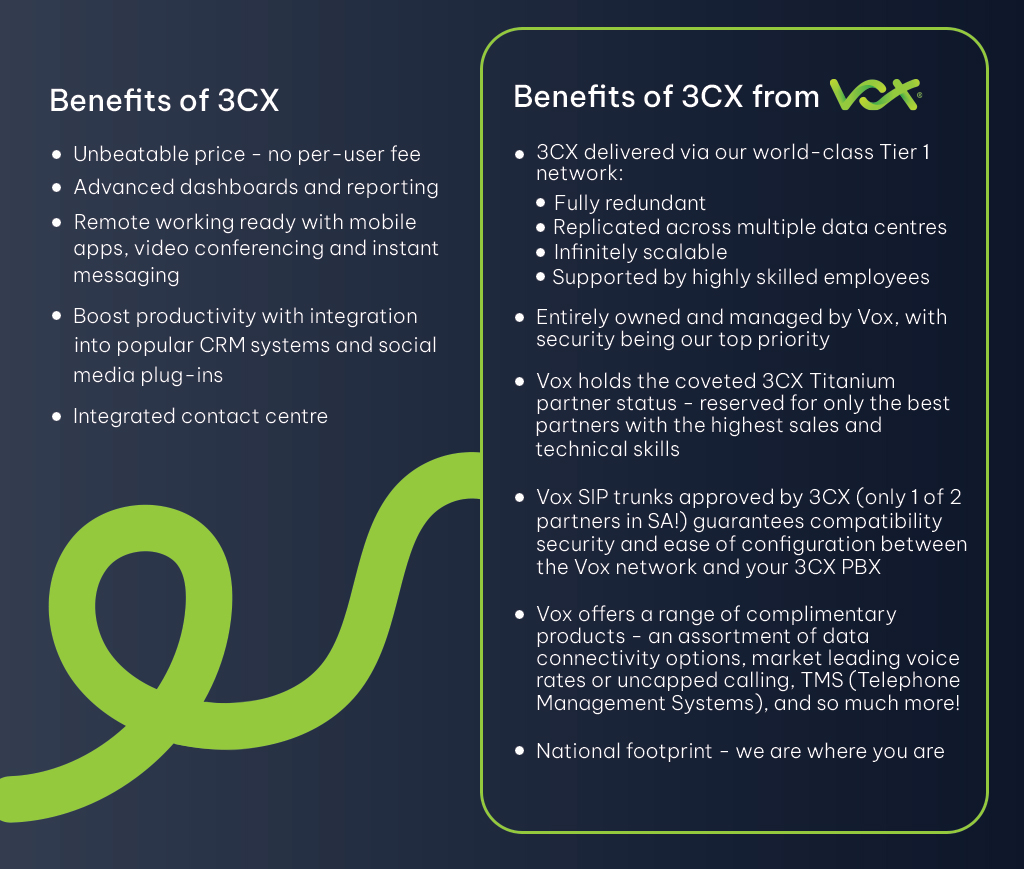
3CX is a leading global, software-based Cloud PBX provider that uses Voice over Internet Protocols (VOIP). This innovative brand has made the business world sit up and take notice.

3CX is accessible via the Cloud over any means of data connection, and empowers organisations to embrace hybrid working without sacrificing the essential features and functions needed for their business. In South Africa, according to the BrandMapp 2023 annual survey, 53% of employed adults earning R10,000+ per month are working remotely or according to a hybrid work model[2].

Embrace the Future of Communications

The days of on-site PBX systems connected via theft-prone, vulnerable copper cables are gone.

As a hosted phone system – meaning a Private Branch Exchange (PBX) – using VoIP, 3CX eliminates the need for legacy infrastructure.  Instead of relying on traditional copper lines, your business can make calls over the Internet and have access to a wide range of advanced features, such as video calling, instant messaging, an integrated call centre, mobile applications and more.

3CX was founded in 2005, when VoIP was still an emerging technology, and since then, it has gone on to establish itself as a global leader in business communications. Today, the company is a Cloud PBX leader empowering more than 600,000 customers across 190 countries.

You could think of 3CX as being the pioneers in the Cloud PBX space: the Cloud PBX provider that dared to dream beyond traditional boundaries, making communication smoother, smarter and more efficient. And as one of the largest 3CX partners in South Africa, Vox is proud to carry a 3CX Titanium partner status – 3CX’s highest partner tier, reserved only for 3CX all-stars – and offers tailored solutions for businesses of all sizes. Our Advanced Technical Certification guarantees you excellent service and support.

How Can 3CX Help Your Business?

Many people still want to be able to contact a business through a voice call, as they feel more comfortable talking to a person, instead of sending emails into the ether that may or may not be read – let alone receive a reply. Combine this with the new world order in which people work from home at least some of the time, and 3CX is a winning choice.

With 3CX, you can ensure that your business operates smoothly, while also keeping the costs of communication down. Because the company uses the Internet to transmit and receive calls, 3CX provides more features while allowing for better flexibility.

With one unified system, your team is able to work efficiently from anywhere at no extra cost – so there is no need to purchase any add-ons for web conferencing, mobile apps, live chat, business text messaging and Facebook integration, because they are all included in the annual cost. Employees can easily make inbound and outbound calls in or outside the office.


V055.2.6.1 Good Things Come In 3s Table 1024x869 250624 RESIZED | Vox | Good Things Come in 3s


As a hosted phone system, 3CX offers great functionality and reliability across desktop and mobile devices, and can also be used with conventional SIP phone handsets.

At Vox, we work with respected SIP phone providers like Yealink, SNOM and Gigaset.  3CX has evolved from its roots as a PBX phone system to a complete communications platform, offering customers a simple, flexible and affordable solution to call, video and live chat. Your business will be enabled to increase productivity and enhance customer experiences, while cutting costs and giving management something to smile about.

And with 3CX and Vox, there’s a lot to get excited about, because this partnership is not just about phone calls – it’s about transforming the way you do business with 24 / 7 support when you need it.


As a Titanium 3CX partner, let Vox help your business to keep growing, without outgrowing your phone system.


[1] Info obtained from Forbes report: Remote Work Statistics & Trends In (2024) – Forbes Advisor

[2] https://www.linkedin.com/posts/whyfive_hybridwork-brandmapp-newinsights-activity-7159136052845129729-tQ7i/

Vox selects Teraco to Grow Data Centre Footprint

Vox has selected Teraco’s Riverfields Hyperscale data centre facility near Kempton Park as an additional location in the Gauteng region, from which to provide services to a wide range of customers.

“Provisioning of our routing, switching, compute, storage and associated redundant fibre infrastructure has been completed with our co-location and cloud services now in full production. The Riverfields facility forms part of the Vox strategy for Geo redundant services for Carrier, Voice and Cloud customers,” says Keith Laaks, Executive Head: Core, at Vox.

“Vox will deliver open peering as per our policy at the Riverfields location, in addition to NAPAfrica peering. Migration of co-location customers from our Waverley data center to Riverfields is progressing well. We are shutting down the Vox operated Waverley data centre in November, having opted to outsource a non-core activity, such as data centre facilities management, to a competent provider.”

According to Laaks, the reasons for choosing the location include the trusted long-term relationship between Vox, Teraco and NAPAfrica; its close proximity to the existing Isando facility that ensures minimal latencies delivering high performance data replication essential for our geo-redundant storage products; the availability of 6000 m2 of deployment space and over 24 megawatts of stable power.

Carrier connectivity into the Vox footprint is provided by redundant rings delivered by Frogfoot.

The data centre in Bredell is the fourth carrier, cloud and vendor neutral facility to be built by Teraco. In addition to Isando and Riverfields, Vox also uses Teraco’s Durban and Cape Town data centres thorugh which it delivers its extensive range of services.

“We are very happy with the new facility’s design, level of fault tolerance, maintainability and operations in line with global industry best practices”, concludes Laaks.