The Importance of Cloud-Based Data Archiving

One of the most significant challenges facing organisations today is dealing with the exponential growth of data. The entire digital universe was expected to reach 44 zettabytes at the end of last year – 40 times more bytes than there are stars in the observable universe. And with the amount of data in the world doubling every two years, it’s no wonder that businesses need to better manage the data at their disposal. This is where archiving fulfils a vital strategic function.

Evolving into a mission-critical advisory practice at businesses across industry sectors, effective data archiving puts management in a position to know how much data the company has, what kind of data it has, who is using it, and how fast it is growing. With the enforcement of the Protection of Personal Information Act (POPIA) set for 1 July, ensuring the security and integrity of personal identifiable information becomes even more essential if the organisation is not to fall foul of compliance and risk significant financial fines, reputational damage, and even potential jail time for executives.

There are two types of data available – structured and unstructured. The former is the data used in databases. This is data that adheres to a predefined data model and is straightforward to analyse. Think along the lines of names, dates, addresses, credit card numbers, and so on. Unstructured data is information that either does not have a pre-defined data model or is not organised in a pre-defined manner. Examples include emails, word processing documents, audio or video files, instant messages, and social media posts. Some estimate that this forms more than 80% of the world’s data.

From an organisational perspective, it is not too difficult to imagine how quickly unstructured data can become challenging to manage. Especially in a distributed work environment, documents can easily be saved in multiple locations, resulting in multiple versions of the same files spread across the network making collaboration even more difficult.

Perhaps most significantly, only a third of this data is used within a year of it being created.

The rest just sits there taking up storage space. This is not only a costly exercise when it comes to on-premise hard drives, but also storing in the cloud, which is a premium service especially when high availability is attached to it.

Archiving to the rescue

Archiving can address the spiralling cost of storage by taking inactive information, and securely storing it for long periods of time. But to be more reflective of the digital age, archiving must be modernised by providing organisations with cloud functionality while still serving up on-premise availability.

Leveraging the cloud to assist in the archiving function means a business can inject specific high-performance computing capabilities into this strategic process. This means data analysis can be done to identify priority data and allocate the best location to store it. As such, it makes the right data easily accessible to employees while archiving that which is not required for the daily operations of an organisation.

And because it is a cloud-based service, companies do not have to be concerned about making significant upfront software or hardware investments. An archiving solution can be priced per gigabyte of data stored so costs will always be completely manageable.

Transitioning

Making the move to this more digitalised approach to archiving does not have to be a complicated process. With a solution like Vox Archiving, companies can install an agent on-premise that links to the cloud platform. This manages the analysis of data and decides where the best location is to store it. And because this is an intelligent solution, companies do not have to be concerned that the data transfer process will take up all their internet connectivity. The agent analyses traffic flow and optimally manages the transfer of data.

Furthermore, companies will have access to a portal that provides a detailed breakdown of their data, the file types, who is accessing it, and how long ago it has been opened. It provides a more efficient way of performing deep insights into their data that is securely encrypted in a compliant data centre while delivering the redundancy features essential for today’s business.

The ongoing storage cost savings even as data continues to evolve across the organisation is significant when going the cloud-based route. With the user experience of accessing data remaining the same, companies can have the confidence that there is no disruption to operations when it comes to archiving data. And with data usage and analysis becoming increasingly important strategic differentiators, archiving becomes an important enabler to drive business value.

SMEs Need a Bespoke SD-WAN Solution

The normalisation of a distributed working environment has seen significant global demand for SD-WAN solutions that provide enhanced connectivity and security for organisations with a geographically dispersed employee base. Research shows that the adoption of cloud platforms that enable this connected work experience is helping fuel SD-WAN growth projected to create a $53 billion market by the end of 2030. The question now turns to how SMEs can benefit from this as these solutions have typically been targeted at larger corporates.

And yet, SMEs are ideally positioned to benefit from SD-WAN technologies. They certainly have greater agility when it comes to their network infrastructure and application footprint. For them, driving operational improvements as cost-effectively as possible is part of their DNA. Not having to worry about a legacy framework in this regard makes an SD-WAN solution ideal for them as it maximises the throughput of what certain applications and business processes require. This becomes even more important when linking remote employees to cloud environments. And when combined with a firewall, an SD-WAN system is simultaneously a robust traffic management system and a flexible, reliable security solution.

With Fibre becoming increasingly widespread and mobile packages more affordable, access is less of a concern for SMEs than previous years. The connectivity available to them now becomes an enabler to embrace innovative technology like SD-WAN, the cloud, and all the related high-performance computing features that come with it. Think artificial intelligence, real-time data analytics, and even automation that can significantly enhance operations for smaller businesses without breaking the bank.

Unique requirements

Even so, SMEs do not require all the functionality that enterprise-class SD-WAN products provide. For them, it is about having high-resilience Internet connectivity, reliability, and excellent voice quality when it comes to making VoIP calls. Moreover, they need to have a detailed view of their network performance to identify the areas that need optimisation.

An ideal SD-WAN solution can help reduce the cost of expensive dedicated connectivity solutions while improving the quality of connectivity to support voice services specifically in under-serviced connectivity areas. By using an SME-focused SD-WAN solution, the company can improve the uptime ratio of connectivity through the likes of an automatic failover. Importantly, it also provides relevant information about the performance of the network environment  enabling the SME to focus any investment in their network to be focused where it will provide the greatest benefit to the business.

Another benefit of using a solution designed from the ground up geared to the needs of the SME, is the fact that it will be more affordable. While streamlined, this ‘lite’ version of SD-WAN still delivers the required monitoring and alerting services to notify management when their Internet links become unavailable. However, it caters for a range of connectivity options that include Fibre, wireless, 5G, LTE, satellite, and DSL to ensure there is failover when required.

Even though the way companies are doing business has changed considerably over the past 16 months, the focus remains on delivering products and services as effectively as possible. As part of this, ensuring a quality customer experience is central to creating much-needed differentiation in a market filled with uncertainty on what the future will bring. The glue tying all this together is an SME-focused SD-WAN solution that links the connectivity to the cloud environment for the company to be able to keep fulfilling its strategic mandate.

The Perks of Being a Pensioner

When we were kids, most of us couldn’t wait to get older.

Whether it was being fed up with school, an eagerness to flash your (real) ID at a bouncer while pretending to be outraged, the ability to drive or, let’s face it, for most of us the appeal of the legal drinking age, many of us spent some portion of our childhood wishing we were old enough.

Somewhere along the line, however, that changed. Maybe it was the onset of wrinkles or hairlines receding faster than Chad Le Clos in a kiddy pool. Maybe it was the first night out with friends where you couldn’t wake up, get into track pants and carry on like everything was normal. Maybe it was a belly straight out of a Pillsbury ad or that “crrr” in your back as you bent down to tie your shoe. Or maybe it was the day you realised you have a favourite Checkers, a Tupperware you’re emotionally attached to and the latest ‘hit’ single was just a man screaming in tongues about money, cars and um, twerking?

Sure, there are a wealth of superficial benefits. You get significantly better parking and nobody asks when you’re getting married, for starters, while you’re never expected to stack up chairs after a wedding or carry the groceries out the car. You get the best seat in the house wherever you go, discounts on quite a lot, and even taxi drivers hoot less when you cut into their lane.

For many of us, our bodies may be a bit slower and the grey in our hair (what’s left of it at least) a little more pronounced, but we feel like we’re at our mental peak. We’re wiser, wittier and have seen and done it all, so what’s the deal with getting older, you ask?

Well, maybe it’s not getting older that’s the problem, but rather the world not understanding just how cool it is to be a pensioner.

For starters, research suggests that people tend to get happier as they age. It’s no surprise, really, because from age 16 upwards most of our lives are dictated by image, peer pressure, financial uncertainty, unstable relationships and, of course, Keeping up with the Kardashians – which is enough to make any generation fear for the future.

As you get older, you become more comfortable both internally and with your surroundings. Your relationships are generally deeper rooted and more meaningful, you’ve likely settled into an emotional and financial comfort zone and better understand who you are as a person. Then there’s retirement (no early mornings, angry bosses or deadlines on the daily), emotional maturity (well, this may start a tiny bit later if you’re a guy), reduced taxes (just for once, Uncle Sam takes a break) and, of course, the luxury of quality time with your kids and (hopefully) grandkids to keep you going.

Our elderly are the pinnacles of our society and can pass on invaluable life skills, lessons and advice. And no, they’re not cool despite being old, but rather because of it.

It’s not all mush and tender loving care, however. We know plenty a feisty one who hasn’t simmered down with age. In fact, they’d tell you in no uncertain terms where they’d like to put their walking stick if you so much as inferred they’re worthy of sympathy. And don’t get us started on trying to explain to them that they’re getting older. You’ll likely hear a few outdated, but no less impactful, choice words guaranteed to make even the most hardened sailor blush. The weird thing, however, is they get away with it because they’re charming – just don’t tell them that.

You may have noticed, but we’re passionate about our senior citizens.

Studies have actually indicated a longer life expectancy than ever thanks to better living conditions, improved health care and easier access to medication. While this thankfully means more senior citizens to know, love and appreciate, the reality is that they’re not just there to appreciate from a distance. Sadly, many of us only understand the magnitude of growing older when the first signs start to creep into our own lives, but with the natural ageing process comes certain limitations and the risk of serious injury.

However, just as we’d never treat all kids the same, we shouldn’t assume that everyone past a certain age requires full time attention and personal care. Many of our beloved senior citizens are capable enough to live fully functional and independent lives or are not quite at the stage where their complete independence needs to be taken away from them. With this in mind, we’ve introduced Vox I.C.E, the first of it’s kind monitoring system created for keeping a watchful eye from a distance. You can read all you need to about the product here, but in a nutshell, it allows you to track and respond to any deviations within a single person’s residence. The sensors record their normal behavioural patterns and notify you should any changes in routine occur, allowing you to almost immediately know when something is wrong.

We really, really love our elderly, which is why we want them to enjoy the fruits of their labour well into their old age. Who, if not them, is going to make inappropriate jokes in front of your parents or slip you a R100 when nobody is looking? With Vox I.C.E, we don’t need to take away all their freedom prematurely, but rather allow them to live normal and free lives while resting easy knowing all is well.

And that’s all anyone can ask for, is it not?

The Beginner’s Guide to Vox In Case of Emergency

Estimated Reading Time: 3 Minutes 25 Seconds

Do you have an independent loved one capable of living on their own but can’t seem to shake those nagging ‘what ifs’ should anything happen when you’re not around? Vox I.C.E is the answer.

They’re happy, independent and don’t want to be a bother. You know you can’t be there 24/7, but you also need constant reassurance that everything is A-OK for your own peace of mind. Well, technology has come to the party to bridge this gap with an affordable, ambient monitoring solution. It’s Vox I.C.E (In Case of Emergency) and it helps provide care, without compromise.

It’s non-invasive

IoT (Internet of Things) and monitoring technology all tends to sound a little bit too science fiction-like sometimes, but this solution is anything but.

Vox I.C.E consists of sensors easily placed throughout the home to detect general movement and whether important doors are left open or closed.

These sensors detect movement only, so there’s no need for either party to worry they might be crossing boundaries – like you might with cameras or voice-activated devices.

Once the sensors are activated, they send this information through an IoT network to our Vox I.C.E. platform where an algorithm works magically in the background to analyse this data. The algorithm ‘learns’ the normal day-to-day behaviour of your loved one, you’ll be able to configure the app to send alerts for anything you might need to worry about.

If they’re prone to sleeping in, then that’s what the I.C.E app will record as normal behaviour without any alarms being raised. Those late evening TV binge sessions? That’s normal too. No one needs to adjust their lifestyles in any way with Vox I.C.E – it just acts as an early warning if there are any abnormal changes to their routine.

As incredible as this algorithm may be, for the moment it can’t distinguish the movement and behaviour of more than one person at a time and that’s why Vox I.C.E is only suited for anyone living alone in need of a little extra support and backup.

It’s low maintenance

If you’re wearing a smart monitoring watch right now, you’ll know how much monitoring technology can improve and enhance your well-being. The great thing about Vox I.C.E is that once it’s up and running, your loved one doesn’t have to worry about it at all.

There’s no device for them to ‘forget’ to wear or recharge. There’s no need for them to wear a clunky, cowbell-like object around their neck either.

All you need to do is remove the motion sensors from the boxes, insert standard AA Lithium batteries in each one and place them where needed. You’ll barely even notice they’re there. We also have a detailed User Guide available as backup if you run into any installation issues. Did we mention the batteries can last up to two years before they need changing?

It takes the algorithm a few days to gather enough data to work with, but once it has, you’ll receive insight into everything from your loved one’s sleeping patterns and movement to and from home to their room temperature in easy-to-understand graphs and dashboards, without having to nag.

You’ll also have access to the data gathered on the Vox I.C.E app from wherever you are, on any connected device of your choice.

Woman in a wheelchair at home with Vox I.C.E | Vox In Case of Emergency | Monitoring Technology | Vox IoT | image


It won’t deplete your data

This is because Vox I.C.E connects automatically to the made-for-purpose Sigfox Network. This is where your devices send all the information they gather, so there’s no need to worry about the solution creating eye-watering data bills while it monitors your loved one 24/7.

You don’t even have to configure them yourself – like we said, it’s low maintenance in the best way. Setting up your profile and downloading the app are a breeze too. The only time you’ll need to use data of your own is when you check the app on your device.

Vox I.C.E will never be a replacement for personal care, but it does offer an additional layer of constant support with an emergency backup plan that allows both of you to live your best lives.

How Wi-Fi 6 Will Create Even Smarter Homes

Estimated Reading Time: 3 Minutes 25 Seconds

Our Wi-Fi routers have been given a major upgrade and it’s the start of bigger things to come. Get ready for the Wi-Fi revolution.

We’re talking faster speeds, way less congestion and stronger coverage overall – a router that allows our home networks to actually deal with all the connected devices we just have to have as human beings living in the 21st century. It’s the dream. And now it’s real.

It’s better in almost every way

The buzz about Wi-Fi 6 and how it would change our user experience for the better first started in 2019, but it’s only really coming into its own now that Wi-Fi 6 capable routers and devices have started making their way into the market. The timing is spot on, especially with most of us living and working from home.

Honestly speaking, the routers we all still use were only designed to communicate with a limited number of devices at once. This hasn’t stopped us from trying to add more users and devices into the mix, which is clearly taking a toll on our connectivity and bandwidth.

Multiple new technologies combine to make Wi-Fi 6 the wonder that it is. One not only capable of doubling your throughput, but also the number of devices you’ll be able to add to your network at any given time.

Imagine going to a party with 40 people and being able to hold a conversation with every person there at once. That’s Wi-Fi 6 – it’s the life of the party.

Sweating about streaming your new must-watch series while your teen is online gaming? Those days are over. What about conference calls clashing with your kid’s online class? No problems there either. It’s also smart enough to recognise which of your devices are furthest away from an access point and in need of stronger signals to allocate bandwidth accordingly.

More is more! Finally

A smart home might sound like something out of the Jetsons, but it won’t be long before we’re all enjoying the life-enhancing capabilities of IoT (Internet of Things) to various degrees.

Whether it’s Wi-Fi security cameras, smart lighting, smart locks on our front doors, Wi-Fi enabled kitchen appliances or all of the above – soon we’ll all be able to turn our ovens and lights on and off via app, check to see if we really have remembered to lock our front door or even see who’s at the front door without getting up from the couch. How about a fridge that sends you updates if the milk is running low or about to expire? We can have it all.

But… the more connected devices we add, the more robust our home network needs to be to cope with this demand. And Wi-Fi 6 is one of the first steps in preparing to shoulder that burden.

If you’re looking to create a seamless Wi-Fi 6 network with ease, we’ve got the perfect solution. Our TP-Link Deco X20 mesh units are Wi-Fi 6 capable, which means not only do they offer faster connection speeds on both frequency bands (2.4GHz and 5GHz) but, like our other mesh units, they also connect seamlessly with one another to blanket your home in Wi-Fi for total convenience.

Wi-Fi 6 also brings enhanced security protocols with the introduction of WPA3 encryption and our TP-Link Deco X20 units are no exception. Your passwords will be even more difficult for hackers to crack, ensuring your data remains fully protected.

As with all our TP-Link devices, you’ll also be able to control your Wi-Fi network from the palm of your hand, including adding parental controls and custom user profiles, via the Deco app.

Wi-Fi 6 routers are backward compatible, so you don’t have to worry if you haven’t upgraded any of your devices, like your laptop, smartphone or gaming console just yet. You might not enjoy Wi-Fi 6 to it’s fullest, but if your network is overloaded as it is, you’ll definitely start feeling the benefits right away with your router upgrade, taking comfort in the fact that your future-proof Wi-Fi network is ready and waiting for your smart home living to begin.

The future is now.

How Much Speed Do You Need? A Guide to Choosing Your Fibre Package

Shop the latest Fibre deals

Having a Goldilocks moment when it comes to selecting your Fibre package? We’ll help you find the option that’s just right.

If you had to stop and think about it, it’s truly incredible how far we’ve come when it comes to having access to fast, reliable connectivity at home. With Fibre, the Internet basically travels at the speed of light. And it’s beautiful.

While we might not all have access to Fibre in our neighbourhoods right now (but believe us when we tell you, we’re working on it), those of us who do are spoilt for choice when it comes to speed selection – 1000Mbps for home use? That’s crazy fast!

But this much choice brings another dilemma: how much speed do you really need? And how can you be sure you’re not paying for a package you don’t use to the fullest?

We’re so glad you asked.

Unpacking the jargon

If you find yourself confusing broadband with bandwidth and always mixing up your upload with your download speeds, don’t worry, we’ve got you. Deciphering the tech speak is your first step in figuring out your Fibre needs.

  • Broadband – the blanket term for all types of high-speed Internet. No prizes for guessing: Fibre is the fastest.
  • Megabits per second – the amount of data (measured in bits) that moves between two devices in a second. The higher the number, the faster your speed.
  • Bandwidth – the maximum amount of data your ISP allows you to send and receive per second at home.
  • Throughput – the actual amount of data successfully sent and received by your connected devices at home. This is what a speed test will measure.
  • Download Speed – how fast you can receive/download data – crucial for buffer-free Netflix binge sessions, streaming music and browsing the web. We list this number first.
  • Upload Speed – how fast you can send/upload data – crucial for seamless video calls and online gaming. We list this second.

Checking all the boxes

For most of us, our Internet needs pre-pandemic were basic. We’d check our mails, stream a few movies, scroll through social media and maybe do some online shopping.

Once the pandemic struck and work from home protocols were put in place, we realised we’d need a lot more bandwidth just to make it through the month. In the past, where 10Mbps for downloads and 5Mbps for uploads for the average single person might have cut it, back-to-back video calls, online schooling and the need for upgraded Cloud storage quickly proved otherwise.

Suddenly, our upload speeds became a lot more important – especially when we needed to transfer large files to make deadline, get our kids into their virtual classes on time or make sure we didn’t freeze mid video call in the most unflattering, screen-shot worthy of ways.

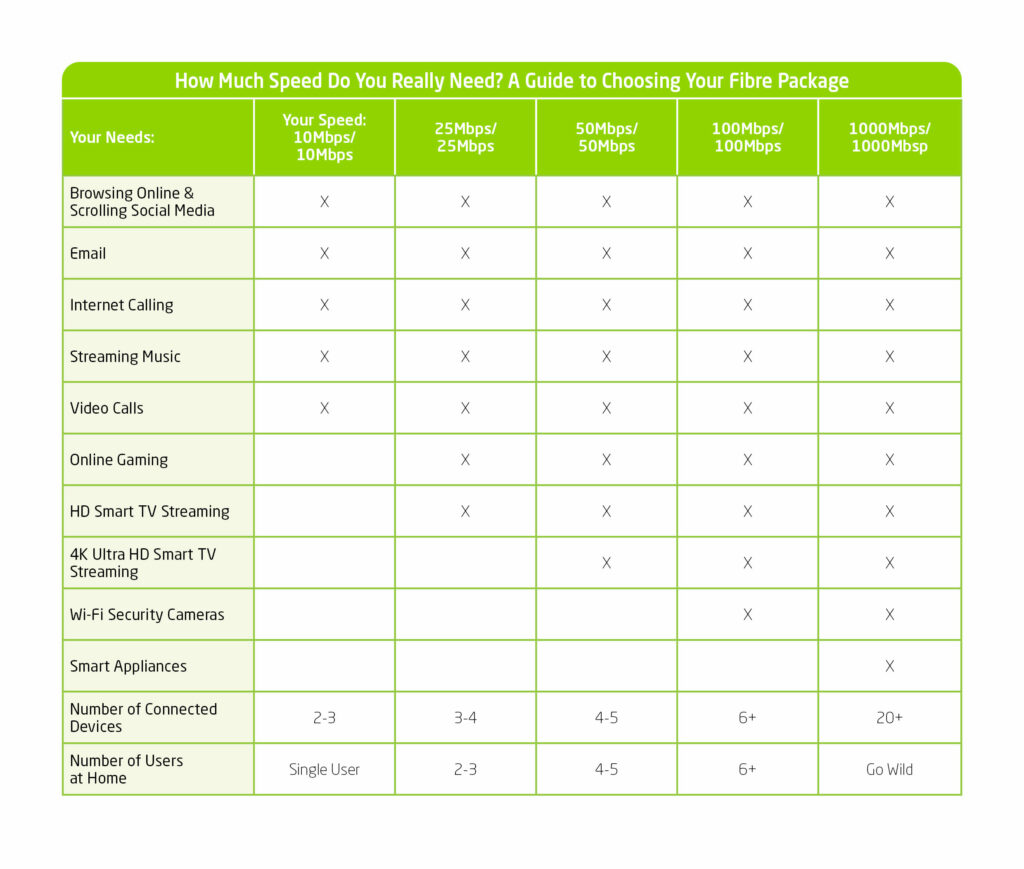
So, where do you go from here? We’ve broken it down into a handy table below:

Vox Fibre To The Home Needs vs Speed Table | Vox FTTH | imageUltimately, your choice of Fibre package should be based on the number of people who will use it, what you’ll need to use it for (i.e. work from home, gaming, streaming or social media browsing) and how many devices you’ll need to connect to it at any given time.



As we offer month-to-month contracts, there’s no need to panic if you feel you’ve underestimated your needs. That Fibre upgrade is only a simple click away.

You’re Spoilt For Choice With Our LTE Deals

Shop the latest LTE Deals

Looking to connect in a hurry? Our Fixed LTE-A is the Internet superhero and reliable sidekick you never knew you always needed.

When it comes to connectivity solutions, there are few options as flexible and ready to meet your needs as Fixed LTE-A. It’s fast. It’s widely available. And, best of all, it doesn’t require installation.

The reasons to love LTE are endless. Guess what? That list is growing by the day – but we’ve narrowed down our top three.

It’s almost everywhere

These days, cell towers are almost everywhere you look – yes, even when they’re masquerading as poorly disguised palm trees – and this means the odds are absolutely in your favour when it comes to checking for your neighbourhood’s LTE-A compatibility.

There are two types of LTE, and we back Fixed LTE-A. Because it’s fixed, you won’t be able to pack up your SIM and router and take it on holiday, you’ll only be able to use it at home. What you might sacrifice in mobility, you more than make up for in user experience.

Once you plug in, your Fixed LTE-A SIM automatically locks with the closest cell towers to offer you the fastest speeds and most reliable connection. You’ll be sorted for basically everything – including streaming in HD. Welcome to the Internet.

It’s quite fast, actually

Have we mentioned speed? Okay, great, let’s dive in.

There are a couple of factors that can affect your network – like your distance from the nearest cell tower, user congestion and, yes, the weather, but more often than not, you’ll be treated to pretty fast speeds.

You’re looking at up to 150Mbps – which is enough to cover those Netflix binge sessions or work-related video calls without worrying about buffering or freezing in any unflattering screengrab-worthy moments.

It’s budget friendly

We have three different Fixed LTE-A deals to choose from as well as a wide range of Anytime Data packages. Meaning you can enjoy your data whenever you like – whether you’re a night owl, morning person or none of the above. It’s your data.  Use it your way.

If you happen to have any data leftover, it rolls over to the following month. If you run short, Top Up packages are available and any unused data left from that rolls over for use the following month too.

There’s no need to panic if you choose a data package that doesn’t quite cut it, either. Just upgrade to a higher package the following month. We’re always just a phone call or email away – especially when it comes to offering the best LTE deals.

Give Yourself a Boost: What to do When There’s No Signal

What’s worse than not having signal?

If you’re like us, it’s having Internet that doesn’t work. See, we can learn to live with the load shedding and Amish life, but to have the promise of that sweet, sweet connection only to see it snatched away – we wish that little jumping dinosaur really was extinct.

And don’t get us started on dropped calls, especially when running a business from home. Sure, a phone that can’t connect is expected during hiking trips in the ‘Berg, but shouting “hello, hello” into the ear of your CEO at 1pm on a Wednesday is far from ideal.

Both are frustrating in equal measure. But what can you do about it? Well, you actually have a few options. You can either:

  1. Turn it on and off again for the next hour (or go on and off Airplane Mode. We see you).
  2. Scream, shout and let it all out.
  3. Read the rest of this article to find out a better means of staying sane during these tough times.

First and foremost, let’s unpack all the reasons your signal from both the Cell and Wi-Fi ends could possibly be saying “nope, not today”.

Let’s start with Internet:

Routers are not meant to stay in the attic. Or, as cool as they look next to your PC, if there’s five walls, three stories and a very large sheet of plywood (hey, we’ve seen it happen) between this tiny little device and your master bedroom, chances are your Netflix will be more of a “Nah-flix”. Building materials, distance and obstructions all interfere with the strength of your connection which, in bigger homes with multiple users, can lead to quite a few screams of frustration.

You also need to consider that certain equipment can cause interference. This includes microwaves, power lines, baby monitors, cordless phones and satellite receivers. Plus, if you’ve got 4 smartphones, 3 PC’s a tablet and a Playstation connected to one router, you can expect a lot of lag, very slow loading speeds and a long, tumultuous relationship with that spinning wheel that comes when things are buffering.

All-in-all, as much as we’d love to sell every house on more than one FTTH package, the honest truth is that unless you’re mining Bitcoin (in which case, give us a call), one router with the right package should be sufficient. The difficulty comes in navigating the strength of your signal which, thankfully, is very easily circumvented – but bear with us, we’ll get there soon enough.

Now, let’s take a detour to Cell Signal:

Poor Cell Signal is actually a very common problem – and not just in Kuvukiland. An often-seen problem in many homes is a home, office or home office with zero signal bars, wherein even basic functions like making calls becomes an exercise in patience.

Your Cell Signal can actually be affected by many of the same factors as connectivity, with one major difference. In the case of your phone, there’s no router to move around, turn on and off and smash with a closed fist until it breaks and gets you in the dog box. Your reception is actually dependent on cell towers, meaning factors such as geographical distance, localised poor coverage and destructive interference all play a role in you not being able to hear your sweet nothings on the phone.

Both can be equally frustrating, but we wouldn’t be Vox if we focused on problems without solutions.

Our Wi-Fi Home Mesh (of course there was a pitch coming) was designed purely to save family peace and expand Wi-Fi coverage. Not only does it say goodbye to Dead Zones for good (the signal, that is, we can’t fix your teenagers’ expression), it also ensures quality, high-speed Internet evenly distributed through every corner of the home.

Browse on the can or stream on the roof. You can Google ‘101 ways to fix a geyser’ while you’re down in the basement or enjoy your movie in peace regardless of the Fornite battle in the next room. It gets better, though. The software also comes with a host of parental controls, including setting device limits, filters and monitoring time spent online – we meant it when we said it would save family peace. The only thing it can’t seem to do is sort out Cell Signal. If only we had something for that…

Oh, wait.

Who are we kidding? Of course we do. Our Cell Boosters are to phones what Wi-Fi Mesh is to Wi-Fi. The theory is simple: take an existing signal (no matter how weak), amplify it and make sure you never have to experience a dropped call from your home again. It’s basically the digital equivalent of Popeye’s Spinach – except this one can save your business time, money and peace of mind. The devices require no maintenance, ensure better communication, easier texting and compete peace of mind. Good weather or bad, it doesn’t really matter – all you need is a little Boost(er).

Life is tough enough without the stress of your paid services not delivering as they should.

With such an emphasis on staying at home and keeping your loved ones safe, your family deserves to enjoy the benefits of unimpeded streaming, easy browsing and stress-free connectivity without playing The Hunger Games over bandwidth. What’s more, your business shouldn’t need to deal with distractions which may cost you money in the long run.

And, if there’s anything we’ve learned from living in South Africa, it never hurts to have a well placed “connection”.


Why is my Fibre Taking so Long?

We know how it goes.

You’ve finally decided to sign with Vox. After all that head scratching and Googling, waiting for responses to your Facebook status and scrolling through Twitter, you’ve made up your mind and you’re ready to join our family.

At this point, everyone’s happy. You’ve checked the boxes online, submitted the forms, spoken to our (admittedly rather lovely) sales agents and you’re ready to go. Imagine your surprise, then, when you’re not instantly connected?

What gives? Where’s the little green fairy that gets my browser going? I had plans of the Office, FIFA Tournaments and and a weekend of Netflix in bed, but I’m not online yet?

We get it.

The only thing worse than not having Internet (and load shedding) is having Internet that isn’t working right now.

Gone are the days of simple distractions. Everything from our phones to our TV’s to our 9 – 5 work time is now dependent on being online.

What many people don’t realise, however, is the incredible amount of work behind the scenes that goes into making sure your connectivity happens. It’s not as simple as turning on a switch and waiting for an astronaut to connect a wire, nor is it as easy as plug-and-play. Fibre is our pride and joy because it works, but the reality is that getting it off the ground can take time. So, before you start attacking your keyboard and throwing more shade than an umbrella store on Black Friday, here’s our guide to surviving the wait for Fibre (as well as possible reasons for any delays).

Step One: It’s in the Deets.

The first point of contact when signing up for FTTH is the equivalent of a first date. We can’t help you if we don’t know you, so we need to start by finding out your information (because we get catfished too. Don’t ask, you’d be surprised).

This immediately leaves room for delays because, as much as we’d love to be fully automated, parts of this process rely on human engagement (we knew we should have invested in robots). Be it reliance on the client to provide the info or on a physical salesperson to process the order, at least two people are involved in the early steps – meaning there’s room for a bit of lag on either side.

We also have to proceed with contract vetting and assessing whether there’s an existing line on any registered address. Stay with us, because this is where it gets slower than Gilloolies on a Friday (and clogs our Twitter feed just as much).

If there’s an active connection on an existing line , we must ensure that this is removed before we can do our thing. It’s not that we want to take our time, but new tenants can’t start unpacking their belongings while the previous tenant is having an afternoon nap. Most ISP’s have a  cancellation notice period before the line is inactive (ours is a clear calendar month), which means there’s already room for delay in the first stage of the process. Yay?

Step Two: It’s not me, it’s you.

Remember what we said about being catfished? Step Two is designed to counter that.

Herein, we proceed with the RICA approval and certification of our new applicants. We need to ensure that you’re a real person (and who you say you are) because, let’s face it, the Internet can be crazy. Herein, we validate your information AND ID copy against a Home Affairs Database (and, thankfully, our process doesn’t require gum chewing employees saying “the system is currently offline”).

If you’re like us and you took your ID photo when your hairline was still within the same hemisphere as the rest of your face, don’t stress, most times any failures we get are a quick fix with some human intervention. Again, there are two checks, meaning two points of failure – this is another vetting stage of the process which can (and sometimes does), take time.

Step Three: PMO, FNO, L-M-N-O…

This isn’t really a delay stage, but more us verifying the order and making sure the Fibre line is going to the right place. We need to factor in your street address, unit number, and all the nitty-gritty stuff that nobody wants to read in a blog, so we’re going to move to the next point.

Step Four: Line Me Up, Scotty.

Herewith the bearer of bad news and destroyer of moods, installing your actual Fibre line. Okay, some (or most) areas don’t require us to come in and destroy your rosebushes, in which case you should be good without the hassle. For those who need our technicians to do their thing so you can do yours, however, this presents its own share of potential delays.

Firstly, the actual installation depends on availability and a convenient time for both parties. Then there’s the actual digging, the installing and making sure everything is up and running. Sometimes, clients want the  technicians to take a less disruptive route around the newly laid lawn which could lead to an additional once off charge, and this invoicing step can add delays . In simple English, installing a line isn’t fun – and everyone knows that anything that isn’t fun takes the longest. Like an episode of Bridgerton.

Step Six: Don’t Call Me, Maybe.

A big component of getting you going is actually getting hold of you. It may sound simplistic, but you’d really be surprised. Some steps of the process can’t move to the next level without us speaking to our newest family member. These include finding out availability, arranging for the Router to be delivered, installation suitability and running a test once everything is set up to ensure you’re really connected.

Some people don’t answer numbers they don’t know, others have us listed in Truecaller as “big Green scammer”, while some are just notoriously tricky to get in touch with. We get it, we’ve spent a fair amount of time convincing call centre agents we’ve moved to Tokyo, but when it comes to Fibre, we don’t call for fun.

All-in-all, there are a plethora of reasons your connectivity can be taking a little bit longer than expected. Now, we’re not saying ignore it until we’re ready for you, but sometimes things can take a while to get running.

However, you know how they say, “good things come to those who wait”?

They were talking about Vox Fibre when they said it.


In the Age of PoPIA, Hacking Yourself Has to Become the Norm

With the Protection of Personal Information Act (PoPIA) coming into full effect in July 2021, and bringing with it the threat of financial and reputational damages for organisations that are found to be in contravention, businesses need to take a more proactive approach toward cyber security, including ongoing penetration testing, and continuous refinement of policies and procedures around dealing with personal information.

In a digital age where businesses are more reliant on online and cloud services to interact and engage with customers and even sell their products and services, the impact to organisations and the rewards to threat actors in bringing down or breaching these services are increasing rapidly. Not only are the threats increasing daily, they are becoming more dynamic and growing in complexity. This can leave defence technologies – which are by nature more static than the evolving threat landscape – exposed.

The breaches have been growing in number, with more businesses around the globe being targeted, and the personal information of tens of thousands or even millions of individuals being compromised. In the past, such was often greeted with uproar and indignation from consumers, only for the story to fade away over a matter of weeks. This has been changing locally and abroad; the implementation of data privacy regulations in the US, UK and EU have seen large corporations being penalised for the loss of customer data during breaches, including British Airways, Equifax, Google, Uber and Yahoo amongst others.

Similarly, the PoPIA Act states that organisations must take appropriate measures to protect personal information against unlawful access or processing, as well as loss, damage, or unauthorised destruction. In a nutshell, it is all about first getting consent from an individual, and then putting in place policies, procedures and technologies to ensure proper protection and confidentiality of personally identifiable information, from point of capture, to transmission, processing and storing.

Non-compliance can result in the Information Regulator imposing sizable penalties of up to R10-million, imprisonment of up to 10 years, or even both. Worse than the financial impact (which larger companies might be able to cough up), is the reputational damage, with the Act requiring affected organisations to publicly acknowledge breaches, disclose what was affected and more, putting their brand in a bad light.

Considering that network and data breaches now go beyond the realm of technical challenges and into having a financial implication for businesses, what can they do to better protect themselves? Organisations will have to be more diligent in identifying all of their assets, looking at where and how data is stored, discovering what information sits on every system across your organisation (what about confidential data stored on employee laptops and not on secure shared drives?) and more. Systems are also continually changing as updates are rolled out, and controls and policies need to be put in place to keep track of all information.

Making ongoing testing the norm

As such, rather than just implement measures and hope it does the work, it is becoming increasingly important for organisations to carry out regular penetration tests to uncover exploitable vulnerabilities and identify the impact to the business – before a hacker does.

Ongoing testing militates against future issues, provides assurance of the security of a system, evaluates how a potential threat actor could gain access, prioritises gaps to be dealt with and to be better equipped to protect themselves against cyber attacks.

Organisations should turn to partners who fully understand the requirements of regulation such as PoPIA, as well as cyber security, data privacy and more, as well as use trusted methodology – tailored to meet the customer’s environment – that takes into account guidelines from sources such the Open Web Application Security Project (OWASP), Payment Card Industry (PCI), METRE Attack Framework and the Technical Guide to Information Security Testing and Assessment. At the very least, these tests should encompass the following:

  • Gathering publicly available information – using sources such as search engines and websites to map out an organisation’s public footprint and point out areas of concern
  • Network scanning – performing automated sweeps of IP addresses of systems provided and discovered from on-network and off-network sources
  • System profiling – identifying operating systems and version numbers running on the system for further testing
  • Service profiling – identifying services and applications running on systems, as well as their version numbers for further testing
  • Vulnerability identification, validation and exploitation – potential vulnerabilities are identified and validated to minimise errors (false reports of problems). This involves attempts to exploit the found vulnerability

There is also a growing need to drive awareness around PoPIA – as has been stipulated by the act – in order to build familiarity with the regulation, and to ensure that employees working with personally identifiable information are fully aware of what the act requires from them. It goes beyond just one act however, and organisations need to use non-technical language so that employees are clearly aware of the sensitivities around working with such data, as well as the dangers of storing such data on unsecured personal devices.

This has become especially critical in an age of remote working, so that organisations can ensure that confidential data is only accessible by authorised persons, and put in place the necessary policies and procedures to ensure that such information is only stored to the organisation’s secured and shared storage space – be it a data centre or a cloud service. With PoPIA in full effect, not getting this right has become an exceedingly costly proposition for business.