How to Choose the Right Internet Plan for Your Household

The Genius Guide to Choosing an Internet Plan:

So, you’ve finally cracked and decided to sign up for Home Wi-Fi. Welcome to the party – or should we say welcome back?

Maybe you’ve had your fingers burned by your ex-ISP. Maybe your father is cost conscious, and you’ve been leeching off the next-door neighbours Wi-Fi (pro tip: 1234Surname is NOT an adequate password). Maybe you’ve moved out, and you’re in the market for high-speed Internet to occupy those lonely nights (minds out the gutter, please). Whatever your reasons, you’re here, and it’s time to get Connected.

We already know that the Internet is the window to the world. Whether a source of endless TikToks or supporting our Netflix addiction, Connectivity makes the world go round. Choosing the right Internet Plan, however, can be more complicated than deciphering why adults choose to do dance challenges. Between the multitude of ISP’s and their respective price plans, it’s a lot.

Sadly, even though this is SA, there’s no Coalition to appease everyone – so we’ve put together a nifty guide designed to help you choose the plan that’s right for you.

When it comes to your Wi-Fi, size does matter. Here’s what we suggest:
1. The Lone Ranger:
Are you riding solo like a Jason Derulo song? If so, you don’t need to break the bank for a 1GB Business line – a modest plan should be sufficient. We imagine you’re not mining Bitcoin, and that your primary needs consist of streaming, surfing, potentially gaming and (if you’re luck) working from home. Why break bank on a Ferrari when a Ford will suffice? If you play within the 25Mbps range, you should be golden here.

2. The Dynamic Duo:
Are you a young couple, or roommates looking to split the bill? 25Mbps may lead to some domestic issues. Double the users would naturally mean double the Connectivity needs – so look around the 50Mbps range (esp. if both parties work from home or have a Netflix addiction).

3. The Whole Squad:
When it comes to families, it’s more about the devices than the amount of people. Seriously, only someone with a household of individuals understand how we accumulate devices. One day it’s two phones, then it’s four, then there’s a tablet, a TV, a teenager with a gaming hobby and a fridge that’s smarter than some of the adolescent inhabitants. The more users generally equals the less merry, meaning 100Mbps and up is where you need to aim.

Usage Habits: What’s Your Internet Personality?

But what about your Usage? Understanding your Internet Personality:
1. The Streamer Squad.
In many households, it’s not entirely uncommon for the people inside to spend more time on Netflix/Amazon/Disney+ (definitely not DSTV) than on, you know, actual human interaction. If this sounds familiar, you’ll require a plan capable of handling pretty much 24/7 streaming needs. If you’re going up to 4K, this gets worse – so work between the 50-100Mbps range for everyone’s peace of mind.

2. The Gamers:
If you’re a gamer, you know all about lag, disconnecting, and the impacts thereof (we have a few broken controllers which can testify in court about this). Fact is, your entry level plans are nowhere near capable of handling serious (or even moderate) gaming needs. What you need are fast speeds and low latency – meaning 100Mbps (or higher, if you can afford it) with a meaty upload speed will ensure less long-term Gaming frustration.

3. The Home Grinder:
If your home is your Fortress of Solitude, where serious work in your pyjamas gets done, then reliable Connectivity is non-negotiable. Remember when you’d take a 5-minute break after hours of studying, only for your angry parent to walk in? Not being able to join an unexpected Teams call is the adult equivalent. Plus, things like Video Calls, large file sharing, and the dreaded VPN all place demands on your Internet – so nothing under 50Mbps (with at least 10Mbps upload) should suffice.

4. The Socialite:
Are you an (shudder) influencer? (Yes, this is a genuine question in 2024). If the answer is yes, then you’re all about Social Media, a few online rabbit holes, and plenty of digital shopping. Herein, a mid-range plan should suffice – with speeds of between 25-50Mbps more than adequate.

Bonus Marks: Factors to Consider when making the final call:

• Availability: remember that not every plan can be connected in your locality. Be sure to identify who and what’s catered for in your area, and plan accordingly.
• It’s in the details: many plans come with throttling or data caps – meaning what you think you’re getting is a bit different from what they provide. Read the fine print so you’re never left wanting (or ranting on Twitter).
• Find the hidden costs: does your ISP offer free Routers or installations? You’d better find out. There’s nothing worse than bill shock – or budgeting a certain amount, then having to pay more.
• Aftercare matters: reputationally, how good does your potential ISP fare (in the words of customers?). Everyone is great when it’s time to pitch – it’s what happens after that matters more.

Let’s wrap it up…
Fact is, choosing the right plan doesn’t have to be a PITA. It’s actually an exciting process – and your gateway to one less thing to stress about. All it takes is a little bit of homework, understanding your needs, and the ability to identify what’s right for you.
And, that’s it. Go forth, conquer, make your choice and enjoy the ride!


No 1 in Teams: Unpacking Voice Solutions with Vox and Operator Connect

A quick and easy way to integrate Voice calling into Teams – no matter where your employees are working from


Using Microsoft Teams has proven itself as an excellent platform for calling, holding meetings and collaborating with colleagues working remotely or from office spaces in different parts of the country. Teams has been proven to keep effective communications going among skilled colleagues no matter where in the country – or the world – they might be based.


Did you know that in addition, with Microsoft Operator Connect, businesses can quickly and easily integrate Voice calling into Teams, saving on costs and enhancing communications and efficiencies further?


As a Microsoft Operator Connect partner, Vox hosts and manages the infrastructure required for VoIP (Voice over Internet Protocol, or calls made over the internet) as well as PSTN[1] calling (meaning calls made over landline), using Teams, powered by Microsoft Azure.


By enhancing the integration of Vox’s low-latency, quality-controlled Voice Network with Microsoft Teams, Operator Connect offers streamlined, fully-managed Vox Voice services and radically improved call quality. With Operator Connect, users can make, receive, transfer, forward and put a Voice call on hold from any location via a Teams-enabled computer or smart device.


Vox and Microsoft Operator Connect


Customers can connect their existing phone numbers to Microsoft Teams or obtain new numbers, manage their calling plans, and configure their call routing right from within Microsoft Teams. This is particularly helpful for the IT department – your technicians can quickly assign numbers without needing to go through external providers, and can manage everything from one place.


By subscribing to Operator Connect, Teams users get a telephone number on which they can make and receive calls. Users can call any phone number in the world and receive calls from anyone in turn, from their mobile phone or computer.


With Operator Connect, Teams replaces the company’s old handsets, and users make and receive phone calls directly within Teams.


Benefits of partnering with Vox and Operator Connect include:


  • Migrate your current Vox Voice services or port numbers from your existing operator quickly and easily (Geographic and Non-Geographic numbers).
  • Operator Connect is designed to be easy for the IT team to use from the Teams Admin Centre.
  • The solution is budget-friendly: One of the benefits of Operator Connect is that by enabling Voice calling directly from Microsoft Teams on PC or mobile phone, no other hardware is required.
  • Vox provides tech support and service level agreements (SLAs) for excellent trouble-shooting and ongoing reliability.
  • Significant savings: With either Unlimited or Post-Paid Voice packages to choose from, Vox will tailor a calling plan suited to your business needs.
  • Every customer receives the most secure and value-rich solution as default, with active 24/7/365 fraud monitoring and guaranteed 99.9% uptime, with punitive SLA clauses should we not deliver on our promise.
  • Quality of service: Your Microsoft Teams and Voice traffic is prioritised above all other traffic travelling across your Fibre connection. This means that your Teams and Voice calls will not be interrupted by other activity happening on your network. This is a proprietary service offered by Vox on your Vox home or business Fibre last mile link.


Teams and Vox: A Winning Combination


Subscribing to Operator Connect is not difficult at all – just click here to enquire, and then a Vox expert will contact you and guide you through the quick and simple subscription process.


Once you accept, we’ll establish a trunk connection for you, assist you to provision users and assign phone numbers directly from the Teams Admin Centre so you can start making calls – it’s friendly on the bottom line, hassle-free, secure and tailored to your unique business requirements.


Simply subscribe to Operator Connect from Vox and leave the rest to us.

christin hume Hcfwew744z4 unsplash | Vox | No 1 in Teams: Unpacking Voice Solutions with Vox and Operator Connect


[1] The PSTN (Publicly Switched Telephone Network) is the network that carries your voice calls when you call from a landline or cell phone. It refers to the worldwide network of voice-carrying telephone infrastructure, including privately-owned and government-owned infrastructure.


Fibre to the Home: How Fast is Fast Enough?

Slow internet isn’t just annoying; it also costs time and productivity. Whether you’re joining an important Teams call, uploading large work files, streaming 4K video or gaming online, insufficient speed creates delays, buffering and poor call quality. Choosing the right Fibre to the Home plan reduces interruptions and keeps your household or small business running smoothly.


Nobody wants to look like a zombie in a bad freeze-frame moment.

So there you are: working from home, and one minute away from joining the most important conference call of the week.

Your outfit, hair and outward demeanour are all on point. You have great input to share when it’s your five minutes in the spotlight.

And then your Internet speed lets you down.

You are hit with the dreaded freeze-frame scenario in which your eyes are closed – but only halfway – giving you the dreaded Undead-Look-of-the-Day.

Never mind the hair and outfit: perhaps it’s time to upgrade your Internet speed.


When Good Internet Goes Bad

Slow internet can have clearly negative effects on people’s lives, including detrimental results on efficiency, communication, and access to information and opportunities. For example, slow internet can:

  • Reduce productivity: Slowing down work processes and making it harder to access and share information.
  • Have a negative effect on communication: Causing delays and disruptions in online conversations and video calls.
  • Limit access to online resources and opportunities: Certain websites and services may not load or function properly.
  • Affect your leisure time: Slowing down your streaming and gaming down-time.


From faster file downloads to interruption-free video and music streaming, you don’t have to be an IT expert to appreciate the benefits of high-speed internet service.

internet speed for gaming

How Fast is Fast Enough?

Your internet speed sets the framework for what you can do online, so it needs to be able to support your daily internet usage.

Ranging from less than 1 Mbps (very slow) to 5,000 Mbps (really fast), you can choose an internet plan to suit your needs. We recommend that a good download speed is at least 100 Mbps, while a good upload speed is at least 10 Mbps.

Let’s take a look at understanding the parameters of your internet speed in relation to your devices and usage.

  • Number of devices: If you have multiple devices (for example computers, smartphones, smart TVs, gaming consoles, etc.), you’ll want a higher speed to accommodate simultaneous usage without slowdowns.
  • Consider your specific needs: For basic web browsing, email and social media, a moderate speed should be fine. However, if you work from home and need to be online on platforms such as Teams, or else you enjoy streaming high-definition videos or participating in online gaming, you’ll benefit from faster speeds.
  • Upload versus download speed: Internet speeds are often quoted in terms of both download and upload speeds. The first number is the download speed and the second is the upload speed. If you frequently upload large files (such as videos or photos), prioritise a good upload speed.
  • Future proofing: As technology evolves and your own needs change, having a faster connection can prevent the need for upgrades later – so it’s wise to choose a speed that allows for future growth.


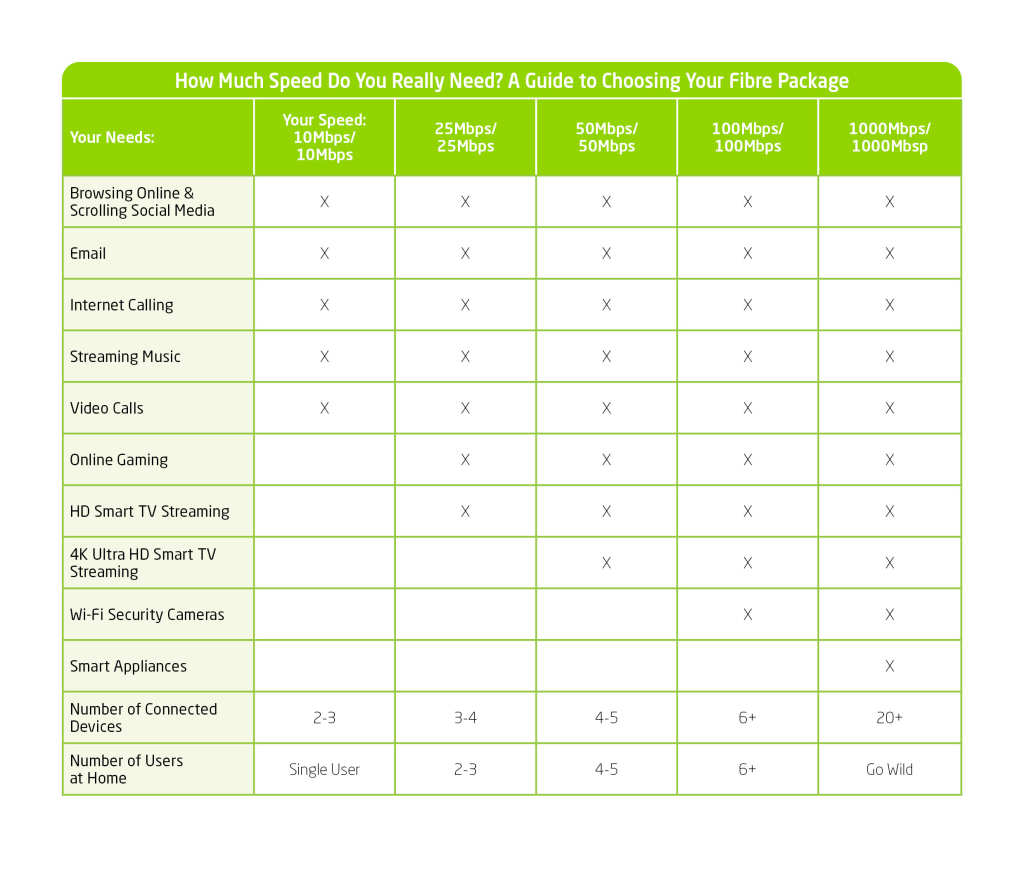
The table below shows how you can match your needs to your speeds, and you can check out some of our current offerings here.


What internet speed do I need

How About a Speed Test?

Higher internet speeds results in faster downloads and uploads – so you could notice that your internet searches are bringing up results faster, while your movie and audio downloads take just seconds.

On the flip side, if there are too many devices or users trying to use the internet connection at the same time, you’ll notice a lag, which is known as latency.

To conduct a speed test, you can:


For a more accurate speed test:

  • Connect a LAN cable directly from the router to your computer or laptop.
  • Perform the broadband test from the ONT/CPE to your device.


The bottom line: Why live with a situation in which slow internet causes tasks that should be quick and easy to become time-consuming and difficult?

At Vox, we have multiple solutions for your every speed requirement. We like to call it ‘The Vox Factor’.


FAQs

Q: What internet speed do I need for remote work and video calls?
For reliable remote work and multi‑participant video calls, aim for at least 100–200Mbps download with 10+ Mbps upload. If multiple people work from home simultaneously, choose higher tiers or symmetrical options.

Q Is 100Mbps enough for a typical family?
Yes, 100Mbps is a strong baseline for a family streaming HD video on several devices, browsing and video calling. Heavy 4K streaming or multiple simultaneous uploads may need higher speeds.

Q:What is symmetrical fibre and do I need it?
Symmetrical fibre provides the same upload and download speeds. It’s useful for content creators, frequent file uploaders, and businesses that require reliable two‑way performance.

Q How can I get the most accurate speed test results?
Use a wired connection from your ONT/CPE to a computer, close other apps and test at different times (peak and off‑peak). Use reliable tools like Speedtest.net or Nperf.

Q: What if fibre isn’t available at my address?
If Fibre to the Home isn’t yet available, Vox offers LTE and 5G, Wireless and Satellite options and works with FNO partners to expand coverage. Use the availability tool to see current options and timelines.

Q: Does a higher Mbps plan reduce latency?
Higher Mbps improves throughput but doesn’t always lower latency. Latency depends on network routing and congestion; however, better plans and lower contention ratios typically give a more responsive experience.

Q: How many devices can a 200Mbps plan support?
A 200Mbps plan comfortably supports multiple simultaneous 4K streams, several online gamers and multiple work‑from‑home users. Exact performance depends on device usage patterns.

Q: Are there cost‑effective ways to future‑proof my connection?
Choose slightly higher tiers than your current need, opt for symmetrical plans if you upload often, and check for bundle or contract options that include upgraded equipment and support.

Good Things Come in 3s

The days of on-site PBX systems connected via theft-prone, vulnerable copper cables are gone.

Even in today’s digital era, every organisation still needs to make and receive telephone calls. And with as many as 28.2% of American employees working in a hybrid manner, and up to 16% of companies fully remote[1], businesses have found that Cloud-based phone systems have helped employees – and therefore the companies they work for – to remain productive.

3CX is a leading global, software-based Cloud PBX provider that uses Voice over Internet Protocols (VOIP). This innovative brand has made the business world sit up and take notice.

3CX is accessible via the Cloud over any means of data connection, and empowers organisations to embrace hybrid working without sacrificing the essential features and functions needed for their business. In South Africa, according to the BrandMapp 2023 annual survey, 53% of employed adults earning R10,000+ per month are working remotely or according to a hybrid work model[2].

Embrace the Future of Communications

The days of on-site PBX systems connected via theft-prone, vulnerable copper cables are gone.

As a hosted phone system – meaning a Private Branch Exchange (PBX) – using VoIP, 3CX eliminates the need for legacy infrastructure.  Instead of relying on traditional copper lines, your business can make calls over the Internet and have access to a wide range of advanced features, such as video calling, instant messaging, an integrated call centre, mobile applications and more.

3CX was founded in 2005, when VoIP was still an emerging technology, and since then, it has gone on to establish itself as a global leader in business communications. Today, the company is a Cloud PBX leader empowering more than 600,000 customers across 190 countries.

You could think of 3CX as being the pioneers in the Cloud PBX space: the Cloud PBX provider that dared to dream beyond traditional boundaries, making communication smoother, smarter and more efficient. And as one of the largest 3CX partners in South Africa, Vox is proud to carry a 3CX Titanium partner status – 3CX’s highest partner tier, reserved only for 3CX all-stars – and offers tailored solutions for businesses of all sizes. Our Advanced Technical Certification guarantees you excellent service and support.

How Can 3CX Help Your Business?

Many people still want to be able to contact a business through a voice call, as they feel more comfortable talking to a person, instead of sending emails into the ether that may or may not be read – let alone receive a reply. Combine this with the new world order in which people work from home at least some of the time, and 3CX is a winning choice.

With 3CX, you can ensure that your business operates smoothly, while also keeping the costs of communication down. Because the company uses the Internet to transmit and receive calls, 3CX provides more features while allowing for better flexibility.

With one unified system, your team is able to work efficiently from anywhere at no extra cost – so there is no need to purchase any add-ons for web conferencing, mobile apps, live chat, business text messaging and Facebook integration, because they are all included in the annual cost. Employees can easily make inbound and outbound calls in or outside the office.


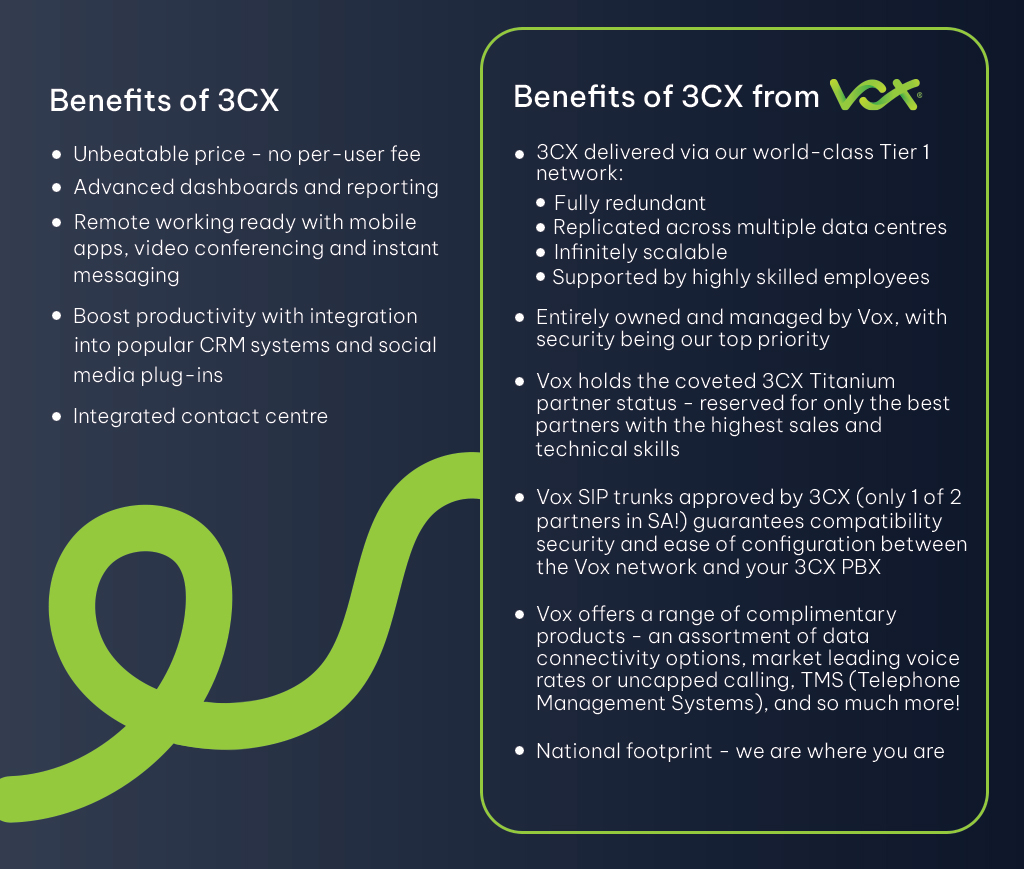
V055.2.6.1 Good Things Come In 3s Table 1024x869 250624 RESIZED | Vox | Good Things Come in 3s


As a hosted phone system, 3CX offers great functionality and reliability across desktop and mobile devices, and can also be used with conventional SIP phone handsets.

At Vox, we work with respected SIP phone providers like Yealink, SNOM and Gigaset.  3CX has evolved from its roots as a PBX phone system to a complete communications platform, offering customers a simple, flexible and affordable solution to call, video and live chat. Your business will be enabled to increase productivity and enhance customer experiences, while cutting costs and giving management something to smile about.

And with 3CX and Vox, there’s a lot to get excited about, because this partnership is not just about phone calls – it’s about transforming the way you do business with 24 / 7 support when you need it.


As a Titanium 3CX partner, let Vox help your business to keep growing, without outgrowing your phone system.


[1] Info obtained from Forbes report: Remote Work Statistics & Trends In (2024) – Forbes Advisor

[2] https://www.linkedin.com/posts/whyfive_hybridwork-brandmapp-newinsights-activity-7159136052845129729-tQ7i/

Stay Connected with Vox Email Solutions

When people think of Vox, they probably think of us as being a market-leading Internet Service Provider (ISP). But did you know that we offer many more additional solutions to connect South Africans to the world?

One of these is our range of email products, to help keep you continuously in contact and running your life and your work affairs easily, efficiently and cost-effectively.

We’ve created solutions that will meet your requirements to keep you communicating safely and continuously.

 Snail-Mail? What Snail-Mail?

In addition to email’s speed advantages (when compared to the original postal offering), it also provides a written record of communication that has taken place. It’s a powerful tool for business as well as personal use, helping with clarity, accountability and references, for future communication and decision-making.

The invention of electronic mail is generally credited to an ARPANET engineer named Ray Tomlinson, who, in 1971, successfully sent a short message to himself from one computer to another in the same room. After that, though, email took a while to kick off, and was initially used almost exclusively in academic and research circles.

When people still used the post office as their only option, written communications were limited by time and distance. Today, our default expectation is that email messages can be sent and received instantly from anywhere in the world, which changes both the speed as well as the reach of text-based interactions, across borders as well as time zones.

The arrival of email – which originally stood for ‘electronic mail’ to distinguish it from the paper kind – provided a faster, more efficient and more convenient way to communicate with others in a written format. Email first began transforming communication on a global scale in the 1990s, when it became increasingly accessible to the public. At its height, Hotmail, the world’s first free internet-based email service, had over 400 million users.

(Fun fact: Hotmail was bought in 1997 by Microsoft and became the basis for what we today know as Outlook.)

Email Changes Communications

Unsurprisingly, email has forever changed the way we send and receive written communications. Most people have all their bills and statements – which used to be sent via traditional mail – now delivered in a paperless manner through email. Letters have become less common, as it’s more convenient to send an email message – on your smartphone as well as a computer.

In a business context, email serves as an effective way to communicate with colleagues or customers – a communication can still be sent without requiring all parties to be ‘present’ at the same time to receive it, phasing out the need for an in-person or phone-based meeting in real-time.

Vox Enhances Local Email Offerings

Vox POPMail is a Cloud-based email offering that provides solutions for both business and family purposes, including the option of owning your own domain. We aim to ensure that your data is kept safely and not shared with any other entities – and it’s incredibly cost-effective also, with different options to suit your pocket.

As a specialist email solution, Vox POPMail also brings you upgradeable storage and features such as Calendar, Contacts and Tasks.

Vox POPMail is based in South Africa and offers all the features you need from email, at a fraction of the price. The key functionality includes:

  • A choice between using your own domain name or our shared domain: A domain is a tool used to establish a unique Online presence, and a domain name that relates to your business or organisation can help to improve your ranking on top search engines like Bing, Google and Yahoo.
  • Anti-spam and anti-virus to enhance your email security and keep unwanted marketers away: At Vox, we ensure that your data is kept safely and not shared with any other entities, to keep your information, home and loved ones safe.
  • Mail options, including Calendar and Tasks, with access via web browser and/or Outlook.
  • Mailing list functionality: Bringing you the option to create and manage mailing lists.
  • Flexibility: Create up to three different alias email addresses.
  • Admin that works: An easy-to-use admin interface to create and manage your email.


We also offer three flexible mailbox sizes to choose from, built to accommodate your budget and business needs.

The Domain Game

Do you have an entrepreneur inside you? If so, another positive from Vox POPMail is being able to start an online business by establishing your own domain and website to promote your company. A website portrays your business, whether it’s a startup or a well-established company – it’s the first place that anyone will go to when looking for general information, products and services.

A website helps to establish your business identity or brand image. It builds credibility, and can also be used for lead generation.

With a domain from Vox, you can give your organisation a professional look and feel. Find out more here.

Why Vox POPMail?

There’s no denying that there are a number of email offerings out there. Vox is pleased to bring you personalised email solutions, with advantages that include convenience, choice, flexibility, security and excellent cost offerings.

It’s all part of what Vox does best: ‘Staying Connected – Together’.

The Power of Brand Storytelling: Building Emotional Connections with Customers

Every brand wants to be “like Nando’s”.

Well, maybe not every brand, but definitely the ones whose CEO woke up and decided that they needed to emphasise their marketing. You know the ones. They want “tongue and cheek” which “speaks to the youth” and “is a bit edgy” but “doesn’t cause controversy” (a lot of inverted commas, we know, but bear with – this is going somewhere”).

We’re here to burst some bubbles.

Nando’s is not Nando’s because they advertise like Nando’s. They have the liberty of saying the things they do, and getting away with the jokes they make, as a result of long-term brand building and storytelling.

You see, marketing is a marathon, not a sprint. If you’re in it, you’re in it for the long-haul – and this is what many organisations fail to realise. Trust the process, follow the breadcrumbs, blah blah blah – we’ll skip the Hyperbole and cut straight to it.

Brand storytelling, done right, allows you to clearly define an identity. Once you crack the code, you’re golden. So, join us as we explain how it’s done:

Understand your Roots:

You know the saying – you can’t know where you’re going if you don’t know where you’re from. Not, that’s not a rallying cry to identify your motherland, but rather a suggestion to draw inspiration from the Marvel Cinematic Universe (which has taught us, if anything, that 1. Spandex always sells and 2. Origin Stories are where the money is).

Before you can even begin the process of brand storytelling, you need to dive deep and unpack your roots. What’s your brand story? Do you have values which underpin your decisions? Go beyond the surface (i.e. more than “we were founded in” or “operational since 1842”) – dig deep and find the core of your identity.

Take that franchise we mentioned earlier. Theirs is a rich, multi-layered story steeped with cultural heritage and an entrenchment with the country of South Africa. In many ways, they ARE as intrinsic to our history as we are to them. To remove one is to do a disservice to the other, so deep have they become affiliated with our cultural history. THAT is a story and reputation worth holding on to. And it can’t be bought, faked, or imitated – it’s just authentic storytelling done right.

Embrace your roots, and let those elements permeate all aspects of your brand. Be authentic, be relatable, and be memorable.
Craft a Narrative

A compelling brand narrative isn’t just a list of facts. It’s a story with characters, challenges, and triumphs. Who are the heroes of your story? What obstacles have you overcome to get where you are today?

Your narrative should resonate with your audience on an emotional level. It should make them feel something – whether it’s excitement, inspiration, or a sense of belonging. This emotional connection is what transforms casual customers into loyal advocates.

Consistency is Key

Found your story? Great. Now keep it consistent.

Everything you do henceforth needs to be reflective of this. Every ad, every piece of content, every comment and customer interaction needs to stay true to the identify you’ve crafted.

Again, we refer to SA’s favorite chicken brand. Many outsiders (erroneously) assume that they just mindlessly throw out cheeky adverts. They couldn’t be more wrong. Every joke, jab, and social commentary aligns with their (already established) brand identity and persona. They didn’t wake up one morning and start choosing danger. The embraced the principles of consistency, trust, and familiarity – three pillars of strong brand building.

Engage, then Evolve:

Like anything in life (and especially marriage), engagement is a two-way street.

You see, sometimes it’s about more than simply broadcasting a story. If you want your audience to listen to you, it’s imperative that you do the same to them. This allows you to build trust, create an emotive connection, and evolve together rather than in isolation (which allows more room for forgiveness should you ever mess up down the line).

Social media has its drawbacks, but it’s also made it easier than ever to engage with customers in real time. Use these platforms not for pushing products, but rather as a means of continuing conversations, gathering feedback, and showing your audience that you value their input.

Remember, you don’t have to abandon your roots in order to evolve. Instead, you should aspire to adapt to ever-changing landscapes whilst remaining true to your core values. By adopting a dynamic approach, you’ll find you’re able to keep your brand fresh and relevant in the minds of consumers.

Play the Long Game:

Let’s wrap it up.

Successful brand storytelling is a long-term commitment.

Any commitment requires patience, consistency, and a deep understanding of your (clearly defined) brand identity. That’s not enough though. You need to also create a narrative which resonates, engages, and evolve as your audience dynamic does too.
So no pressure then.

We’ll leave this here: before you can be “like Nando’s” (or aspire to copy the final product of ANY other entity), remember the years of hard work and effort building up to their end result. Sometimes, it’s about more than just mimicking their marketing strategy. It’s about embracing your own story, making it authentic, and allowing the long game to play out.

That’s the true power of brand storytelling.

And, who knows, if you do it right, maybe one day someone could be writing this article with YOUR brand as an example.

Marketing 101 – How to Gain More Brand Traction in 2024

Welcome to the world of Marketing – where EVERYONE is an expert and it’s never done effectively.

If you’re a brand, or someone doing the marketing for a brand, you know the struggle. The colours aren’t right, it’s not “vibey” enough, it doesn’t “speak to the right audience” – it’s the one profession in the world where everyone knows it better than you do. Occupational hazards, I guess.

The challenge comes when you’re either an existing organisation, or a startup, and you’re looking for the right way to do it. Gone are they days of billboards, handing out flyers, and those weird flappy things outside car dealerships (you know, the ones which look like your boss dancing at the Christmas party).

The communications landscape in 2024 is vastly different to any before it, with new trends and strategies emerging almost daily. This is daunting, yes, but it also offers fresh opportunities – platforms from which businesses can connect with audiences, resonate, and truly stand out in a crowded environment.

But, enough yapping – let’s present the official Vox Guide to Boosting your Brand Traction in 2024.

1. Get Personal:
That personal touch is no longer a nice afterthought – it’s an essential tool in an ever saturated, impersonal world. Today’s customers are different. They are informed, active, engaged, and not afraid to unleash their dissatisfaction (just ask our Twitter staff). Most of all, they expect personalised experiences which factor in their unique needs and preferences.

People no longer want to feel like a number. If they’re making an active choice to engage with or support your brand, they expect you to (at the very least) show them they’re important to you.

Great idea in theory, right? Now here’s the application…

• Data is the new oil: using your customer Data effectively allows you to understand your audience’s behaviour, preferences, and buying patterns.

• Customise it: if there’s one thing Durbanites and their license plates have taught us, it’s that a little customisation goes a long way. Tailor your content to speak directly to specific segments of your audience. Be conscious of language, tone, audience personas to engage on their level – this will increase user engagement, and also make you more likeable.

• Don’t react, interact: it’s not just about your brand or telling your story. Give the audience something to engage with. The incorporation of small elements, such as quizzes, polls, or personalised suggestions gives your followers a reason to stop scrolling and engage.

2. Influencer, not Influenza:
Hate them or love them, Influencers continue to be powerful tools against humanity for brand maximisation. Whilst the thought of grown adults twerking is enough to make our ancestors shudder in their graves, they do in fact offer brands a wealth of value and additional exposure – so why not make lemonade?

• Choose wisely: Greta Thunberg, for example, wouldn’t be the best ambassador for your super rare steak franchise (and neither would Logan Paul for your humanitarian branch). Are you in beauty? Identify someone who speaks to your demographic and align with them. Sports? Sneakers? Tacos? There’s a kingpin in every subculture. Find them, then align (with) them.

• Be authentic: nothing is worse than an insincere promotional post from an ambassador clearly in it for a cash-grab. Make sure that the people you partner with believe in your brand/products, as authenticity usually drives more meaningful engagement.

• See it through: there’s nothing worse than pulling the plug because “you’re not seeing results” after a one-and-done product post. Generate long-term, long-lasting relationships to create more consistent, impactful brand exposure – so trust the process, in other words.

3. Go with Video:
In 2024, video (and short form content as a whole) is King. People don’t have the time, nor the inclination, to read long stories or scroll through endless static posts. Video has proven an engaging, quick format which can get your message across effectively.

Here’s the 411:

• Go short form: You may have noticed, but SM platforms are big on Reels. Keeping yours shorter, more impactful, and catchier can help draw attention and generate better engagement.

• Go Live: Want a sense of urgency and exclusivity? Live streaming your product launches, behind the scenes content, Q&A’s and the like is a surefire way to do that.

• Tell a story: When done right, authentic storytelling can resonate with audiences on a much deeper level.

Audiences in 2024 are also huge on Sustainability, CSI, transparency, and community outreach – so keep that in mind. Also, don’t sleep on AI – we don’t think it’s quite there yet, but it looks as if the future is heading in that direction. Watch this space.

The bottom line is that marketing in 2024 isn’t simple at all. Instead, it requires a strategic approach. An approach which leverages trends, innovation, personalisation, and beyond. The key to all of this is agility – your marketing plan needs to be ever evolving, constantly moving forward, and always prioritising customers needs.

The rest will come naturally.

Choosing the Best Internet Solution for Your Business: Wireless Internet vs. Fibre to the Business

Wireless vs Fibre for business – which is right for your company?

Let’s face it; Internet makes the world go around (well, in this case, the Business world).
Unless you’re Bob the Builder or work in a government building (where “Systems Offline” is a way of life – but at least they give out free T-shirts), you need the Internet to operate efficiently (seriously, Government should check out Qwerti – did someone say coalition?).

Whether it’s running your systems, sending passive aggressive emails, or regular interruption of Nap Time via Teams calls (is there any sound more dreaded?), the type of Connectivity you choose can majorly impact your organisational performance. When it comes to the working world, your two best choices are simple: Wireless Internet, or Fibre to the Business (FTTB).

The question, however, is “which one is best for my brand?”.

Today, we aim to answer exactly that, as we unpack the elements and (hopefully) make the decision a little bit easier.

Let’s start with Wireless:

Remember the days of being stuck at an uncomfy chair next to the phone as you tried to untangle the cord (which ALWAYS had a permanent kink)? Or spending hours trying to make sense of your Apple Headphones (that had the ability to get intertwined in the space between blinks). Remember extension cords, cables stuck to walls, tripping over *some* wire connected to *something* – we remember, which is why we’re big into the whole Wireless Revolution.

Wireless to the Business (WTTB) represents the pinnacle of simplified business connectivity. It’s fast. It’s reliable. It’s (as the name suggests) Wireless. Which should be all the selling points you need – but if not, here’s a more thorough breakdown:

The Pros:

  • It’s Quick: The swift setup time of Wireless is one of its biggest selling points. Because there’s no need for trenching, cabling, and ruining the lawn, your business can be connected faster than you can say the F word (we mean Fibre – not the other one).
  • It’s Flexible: Is your business a gypsy? Wireless works well for organisations that relocate, or often require flexible/temporary locations. Because it’s versatile, adjusting to new environments is a simplified process (the opposite of cats, in other words).
  • It’s Cheap.Ish: Compared to Fibre, Wireless generally has significantly lower startup costs in order to actually, you know, get connected. This is ideal for SMEs, or startups on a budget.
  • It’s Accessible: Some areas don’t have access to high-speed Fibre, or the cabling is tricky to install. When this happens, Wireless is the Batman you need – always prepped and ready to (quickly) save the day.


The Cons:

  • It’s fast, but not the fastest: Wireless can be a bit slower than Fibre, and the Internet Connection is slightly less stable – especially in areas with signal interference.
  • It’s more Lag-gey: Because Wireless has higher latency than Fibre, real-time applications (think gaming or video conferencing) can experience more delays or interference.
  • It’s in the Weather: Heavy rain or storms do have an impact on Wireless Performance (yes, even those of us who subscribe to Vox Weather feel it). This can be disruptive to your business if you’re stuck in a hailstorm (or live in the Cape).


Now, let’s talk FTTB:
Usain Bolt. Micheal Phelps. Vox Fibre to the Business. Three titans at the pinnacle of their industry. The key difference? The first two can’t provide you with super-fast Fibre – but Vox can. Now, we’re not saying we’re better than two Olympians, but if you want to draw that conclusion, be our guest…

The Pros:

  • High Speed, High Bandwidth: FTTB provides extremely high Internet speeds and bandwidths – meaning it’s absolutely perfect for data-intensive applications (or, you know, your organisational needs).
  • It’s not just reliable – it’s Super Reliable: Consistent performance, less reactive to weather conditions, always reliable and performing well – that Usain Bolt comparison is right on the money here.
  • It’s the present, and the future: Fibre is scalable, and allows room for forward thinking growth, scalability, and development as your business progresses – making it an ideal long-term investment.
  • Latency? What’s that? Compared to Wireless, FTTB experiences significantly lower latency rates – meaning smoother, less interrupted browsing experiences.


The Cons:

  • Time and Money, they count: FTTB has both a longer installation time as well as higher installation costs, due to the work behind the scenes required to get it going – particularly if there’s physical cabling required.
  • It’s Set in Stone: Like your Dad, Fibre is set in it ways. Once installed, it is definitively NOT flexible, meaning a business on the move would not be the ideal client here.
  • It’s Picky: High-speed Fibre is not available just anywhere – particularly in more rural regions – meaning you may not be eligible to connect in the first place.


So, now you have the facts, let’s talk about the key considerations:

1. What are your current and projected Connectivity needs?
2. Where are you based?
3. What is your budget?
4. What type of Business do you have?
5. How critical is Internet Stability to your industry?

That’s it. Five key questions to guide you towards the perfect Connectivity Solution.

Look, it sounds simple, but choosing your Internet is quite similar to picking a spouse. Do you want someone perfect for you, someone flexible, someone expensive, or someone who never lets you down? Ideally, you want someone who can keep up with your life, grow as you do, meet you on your level and, ultimately, make you happy.

Now, we can’t tell you which one to pick, but we can promise that by considering the factors outlined above, it should be a much simpler process altogether.

As for the spouse thing, well, you’re on your own – but do reach out if you need Internet…


Frequently Asked Questions

Is Wireless as reliable as Fibre for business use?
Wireless (WTTB) can be very reliable for many businesses, but Fibre (FTTB) typically offers higher consistency, lower latency and better performance for mission-critical operations.

How long does it take to install Business Wireless or Business Fibre?
Business Wireless point-to-multi-point installations can take about 4–6 weeks; point-to-point about 8–12 weeks. Fibre installation times vary based on cabling and site work.

Can Business Wireless deliver symmetrical speeds?
Yes. Carrier-grade Business Wireless services can offer symmetrical speeds, VLANs and QoS for voice and priority traffic.

What costs more: Business Wireless or Business Fibre?
Fibre usually has higher installation costs and potentially longer lead times, but it can be more cost-effective long-term for high-bandwidth needs. Business Wireless typically has lower upfront costs.

What if there’s no Fibre at my business address?
Business Wireless is a great alternative where Fibre isn’t available. It can provide fast, reliable connectivity without trenching.

Can I use Wireless as a backup for Fibre?
Yes. Combining Fibre with Wireless backup gives resilience: Fibre for daily operations, Wireless for redundancy during outages.

Which industries need low-latency Fibre the most?
Financial services, call centres, cloud-hosted businesses, broadcasting and firms running real-time applications benefit most from low-latency Fibre.

How do I get a customised quote from Vox?
Contact Vox Business Support or request an online assessment. They will check availability, recommend Business Wireless or Business Fibre, and share pricing.

Spend Less, Talk More: How Vox Voice Can Do More for Less

If your goal is spend less talk more, Vox Voice gives you reliable, cost‑effective options — from the mobile softphone Vobi to the cordless Supafone that runs over your Vox Fibre

The power of Voice

Why choose voice over a long email chain? Spoken conversations close deals faster, reduce misunderstandings and build rapport — especially in business settings where tone and nuance matter. For B2B teams, a short call can remove days of back-and-forth and accelerate decision-making. In other words: spend less time typing, talk more to get results — and Vox makes that simple.

Vobi — mobile softphone

Vobi is Vox’s app-based softphone that uses VoIP to call any South African number at reduced rates. Unlike typical messaging apps that only reach users on the same platform, Vobi connects to regular landlines and mobile networks — ideal for businesses needing wide reach without high costs.

Key benefits

  • Free download: Available on Google Play and the Apple App Store.
  • Fast setup: Buy online and have your account ready in minutes — ideal for small sites and remote staff.
  • Local rates: Low call costs across all South African networks — perfect for businesses with local customers and suppliers.
  • Flexible billing: Choose per-minute billing or an uncapped plan. Per-minute option costs R29 per month (≈ R0.46 per minute); Unlimited Calling is R171 per month for calls to any local SA number. Month‑to‑month options mean you’re not locked into long contracts.
  • Roaming-friendly: Make calls to SA numbers while overseas at local SA rates — avoid expensive roaming charges.

How Vobi works for business

  • Reach customers on any number, not just other app users.
  • Use a single business account across staff devices.
  • Control costs with plan choice: pay per minute or pick the unlimited plan for predictable billing.

Quick setup steps

  1. Download Vobi from your device’s app store.
  2. Buy a Vox Vobi service online and complete RICA (ID and proof of address).
  3. Log in and start calling.

Note on compliance and number porting

RICA verification is required to activate Vobi (you’ll need identity and proof‑of‑address documents). If you already have business numbers, you can port them to Vox to keep continuity for customers.

Supafone — cordless calls over Fibre

For offices and home offices that prefer a physical handset, Supafone delivers cordless freedom over your Vox Fibre. It’s more than a standard landline: Supafone routes calls over the Vox voice network for consistent quality while eliminating traditional fixed-line costs.

Supafone benefits

  • Uses your router — no extra infrastructure fuss.
  • Excellent range: up to 50m indoors and 300m outdoors; range extenders available.
  • Multi-handset support: connect up to six handsets and add up to five extra for small business use.
  • Call features: caller ID, itemised billing, voicemail and HD sound quality.
  • Flexible billing: available month‑to‑month so you can scale without long contracts.
  • Retain your existing number: by porting to Vox’s network.

Why Vox Voice suits small businesses

  • Cost control: clear pricing and monthly plans help forecasting.
  • Simplicity: quick setup, minimal hardware and the ability to scale as you grow.
  • Reach: call any SA number, keep existing numbers and avoid being limited to closed messaging ecosystems.
  • Professionalism: better client conversations, reduced email clutter and faster decisions.

Frequently Asked Questions

How much does Vobi cost?
Vobi offers two core monthly options: Unlimited Calling for R171 per month (calls to any local SA number) or Per Minute calling at R29 per month with a rate of roughly R0.46 per minute. All prices exclude VAT.

Can I keep my existing business number?
Yes — you can port your existing number(s) to Vox so customers continue to reach you as before.

Do I need to complete RICA to use these services?
Yes — RICA verification (ID and proof of address) is required to activate Vox voice services.

Can Supafone handle a small office?
Yes — Supafone supports multiple handsets (up to six), additional handsets can be added, and the device is suitable for small business or larger homes that want reliable cordless voice over fibre.

Is there lock‑in or long contracts?
Both Vobi and Supafone are available month‑to‑month, giving you flexibility without long-term lock‑in.


The Need For (Internet) Speed

We all know the line from Top Gun: “I feel the need… the need for speed.” It still rings true — only these days we’re not talking fighter jets, we’re talking Internet speed. For modern South African businesses and homes, Internet speed (or bandwidth) isn’t a vanity metric: it determines productivity, customer experience and whether your organisation keeps up with daily digital demands.

What is Internet Speed (and how is it measured)?

Internet speed, often called bandwidth, is how much data can travel to and from your network per second. It’s measured in megabits per second (Mbps). A package that’s described as 50/10 Mbps gives you 50 Mbps download and 10 Mbps upload. Remember: the available bandwidth is shared across all devices on a connection, so more simultaneous users or data-heavy tasks reduces the experience for each person.

Why Internet speed matters

  • Collaboration & meetings: Teams, Zoom and Microsoft Teams rely on stable upload and download capacity. Poor speeds cause dropped calls, frozen screens and lost productivity.
  • Cloud apps & backups: If you run cloud backups, file syncs or SaaS tools, upload speed is just as important as download speed.
  • VoIP and customer service: Voice over IP quality falls when latency rises or contention increases — leading to poor customer experiences.
  • File-heavy work: Creative agencies, architects and media houses uploading large files need symmetrical or high upload speeds.
  • Remote & hybrid work: Multiple remote workers hitting the same branch connection need predictable bandwidth to avoid slowdowns.

How much speed do you actually need?

There’s no single answer — it depends on:

  • The number of concurrent users and devices.
  • The kinds of applications (video conferencing, VoIP, large file transfers, POS systems) you use.
  • Business criticality (is downtime acceptable?).

Quick Guides:

  • Small office (5–10 users doing email and web): 20–50 Mbps.
  • Medium office (collaboration tools, HD video calls): 50–200 Mbps.
  • Creative or data-heavy teams: 200–1 000 Mbps with higher upload rates or dedicated links.
  • Retail outlets / POS-only branches: 10–20 Mbps can suffice if only POS, VoIP and basic apps are used.

Speed is more than headline numbers

Just focusing on Mbps can be misleading. There are three related factors that matter equally:

  • Latency: how fast packets travel (important for VoIP and interactive apps).
  • Contention: how shared the pipe is (dedicated fibre has low contention).
  • Reliability and support: 24/7 help and failover options make a package genuinely usable.

When faster isn’t always better (but often is smarter)

Buying the fastest possible line can be wasteful for small teams. Conversely, skimping on speed can cost you in lost productivity and customer trust. The sweet spot is a tailored solution: right-speed, predictable performance and the ability to scale when needed.

Options for South African businesses

  • Fibre (FTTB/FTTH): Future-proof, symmetrical options and high throughput for businesses with real bandwidth needs. Vox Business Fibre offers scalable packages from smaller multi-site links up to uncontended dedicated lines. See our Business Fibre pages for more details.
  • Fixed LTE / 5G: Rapid to deploy and ideal as temporary or failover connectivity. Good when Fibre isn’t yet available.
  • Dedicated or Premium Fibre: For mission‑critical sites where contention and uptime matter most, dedicated Fibre removes sharing concerns and delivers consistent performance.

Practical steps to choose the right plan

  1. Audit usage: Count devices, concurrent users and heavy apps.
  2. Prioritise: Identify mission‑critical apps that must never fail (VoIP, POS, remote desktops).
  3. Choose the right technology: Fibre where possible; Wireless or LTE as backup or interim solutions.
  4. Add redundancy: consider a managed failover (e.g., Fibre + Wireless) to prevent downtime.
  5. Work with a provider: a reputable ISP can help size your needs and offer Advanced SLAs and support options.

How Vox can help

We offer a range of options for South African businesses — from scalable Business Fibre plans to temporary Wireless and LTE solutions for continuity while you wait for Fibre installation. If you’re unsure what will suit you best, our teams will assess your needs and recommend the appropriate mix of speed, reliability and cost.

Don’t be a Maverick and guess your Internet needs. Choose the right Internet speed for your users, applications and growth plans. The correct mix of speed, reliability and support will keep your teams productive, your customers happy and your operations future-ready.

Frequently Asked Questions

  1. How is Internet speed measured?
    Internet speed is measured in megabits per second (Mbps) and shows how much data can be transferred per second. Speeds are usually shown as download/upload (e.g., 50/10 Mbps).
  2. How much Internet speed does my small business need?
    For general office work and web conferencing, 20–50 Mbps may be enough for a small team. If you run frequent HD video calls, cloud backups or large file uploads, consider 50–200 Mbps or higher.
  3. What’s the difference between Fibre and LTE/5G?
    Fibre gives consistent, high-speed, low-contention connections and is usually ideal for businesses. LTE/5G is wireless, quicker to deploy and useful as a temporary solution or failover where Fibre is unavailable.
  4. Why is upload speed important?
    Upload speed affects cloud backups, file sharing and video calls. If your team shares large files or uses cloud apps, upload capacity is critical.
  5. How can I future‑proof my business connectivity?
    Choose scalable plans, consider redundant links (Fibre + Wireless failover), and work with a provider that offers fast support and an easy upgrade path – like Vox.

Top Gun Maverick Dolby Header 600x324 1 | Vox | The Need For (Internet) Speed