It’s Time to Get Proactive About Data Protection

Knowing where your data is stored and who has access to it is absolutely crucial for doing business in the age of data privacy regulation. Welcome to Vox Security Level 3.

These days, Cyber Security is about more than just making sure your data is safe from encryption and Ransomware demands – that said, as cyber-attacks continue to take down everyone from international cloud service providers to Northern Ireland’s entire healthcare system and everyone in between, those are definitely still a concern – it’s also very much about maintaining the integrity of the sensitive, private or personal information you rely on for day-to-day business operations.

With the PoPI (Protection of Personal Information) Act now in effect in South Africa, a data breach that threatens to make public the private, personal information of your customers and clients won’t just result in embarrassing headlines and reputational damage for your company, but also a hefty fine or possible jail time or both – for you.

As we continue to transition to hybrid work solutions and conduct most of our lives via apps and cloud computing, putting proactive procedures in place to know exactly where your most valuable data is stored and who has access to it should be a vital component of your Cyber Security plan.

It All Begins with Data Discovery

Modern work environments need to remain flexible to survive whatever the world may throw at them next – but this means Cyber Security teams need to worry about an exponential number of endpoints (from company laptops, to employees’ personal smartphones and tablets), external servers, databases and shared files when attempting to protect the integrity of sensitive or regulatory data and remain compliant with government regulations.

Most often used for data analytics, data discovery involves collecting and connecting structured and unstructured data from multiple sources (individual PCs and laptops, shared drives, social media), assessing it’s importance to the company as a whole, categorising it and placing it into context both manually and via business analytics tools.

All data is not created equally.

Once you’re able to place your most sensitive business data into context via Information Rights Management, you can begin to implement a successful Data Loss Prevention strategy that won’t bring your business to a standstill with time-consuming privacy policies and permissions put in place for every user.

Locking That Data Down

With a data loss prevention strategy in place, your security experts will be able to monitor the protection of everything from personal information to intellectual property and financial records whether it’s in use (via the endpoint), in motion (travelling via your network) or at rest (stored in the cloud).

To ensure your data loss prevention strategy is effective, protocols should be put in place to monitor and prevent the loss of sensitive data leaving your network across everything from downloads to external hard drives, email attachments and cloud storage.

Knowing what type of information you have, where it’s stored and how it’s being used will strengthen your ability to protect it and the integrity of your company by helping to prevent data leaks from happening intentionally, or, more often than not, accidentally, and having devastating consequences for you and the future of your business.

Taking your Security to Level Two

Access control. Vulnerability scanning. Firewall assessment.

You may be wondering what’s the need for such a drastic topic? We can almost hear you thinking “I’m just a casual Internet user, not the Pentagon, why are you wasting my time preaching about IT, System and Network Access protection?”

But, we ask, just hear us out – because things can get pretty serious if these are neglected.

The term “catfishing” may have gained pop culture status due to the rapid rise of social media and popularity of the MTV show. However, this runs the risk of undermining the severity of online identity theft – especially when it comes to business. Sure, pretending to be someone else can be dangerous for a variety of reasons, but the use of the term in often casual settings goes a long way towards devaluing its implications.

As any fan of The Office could tell you, Identity Theft is not a joke. Millions of people are affected every year. But how serious is it really?

Well, here’s some food for thought…

  • Identity theft really does affect millions:

In 2019 alone, 14.4 million (or 1 in 15) were victims of some form of ID Fraud. These occurred at a rate of 1 every 2 seconds due to an ease of availability when it comes to personal information.

  • Most incidents are a result of Data Breaches or inadequate digital security.

Even a single, fleeting breach of a company firewall could expose enough employee information to make each individual a potential target. What’s the point of stealing our details, you ask? Well…

  • This information is used for a variety of fraudulent activities.

These include tax theft (using your information to get illegitimate tax rebates/returns), taking over bank and retirement accounts to drain your savings or selling your information to other interested parties.

Studies indicate that the average person is more likely to have their identity stolen than their car (yes, even in SA – cyber criminals have no jurisdiction) and, worst of all, victims often don’t even know they’re being hit. These criminals have the tools and the means to access pretty much anyone off guard, thriving on public Wi-Fi (even if it’s password protected), phishing scams and even the tiniest chink in a company’s armour.

This is where Level 2 of our Security Spectrum comes in, which is systemically designed to facilitate the correct protocol around Access Control and Vulnerability Scanning.

So, what is Level 2?

Simply put, it revolves around ID and Access Management to ensure that complete verification of its users is always ensured. The concept places major emphasis on a Zero Trust basis, which essentially deems it necessary for users to identify themselves as who they say there are before either company or general resources can be accessed.

The concept is designed to reduce identity theft and, in doing so, prevent unwanted parties from attaining valuable (and often confidential) information that can put either your organisation or other employees at risk. Not only does it prevent catfishing (so that entry level workers can’t imitate the CEO), it relies on numerous verification steps to maintain ultimate privacy – even going so far as to block access from websites until said verification is completed.

This occurs through the use of multi-factor authentication (so no more Password123 and you’re in), which amalgamates any combo of username, encrypted passwords and SMS/Email verification. It also ties in with Cloud Access Brokers (CASB), which protect both Data within and access to The Cloud. Furthermore, the software can monitor traffic to and from the Cloud to restrict access, protect the information stored within and regulate both incoming and outgoing activity. It also boasts and additional vulnerability scanning software (in the form of Qualys) which establishes weak points in PCs, servers and what can be exploited by hackers before it’s too late.

Any company with a Firewall can benefit from our Security Level 2 offerings. As we’ve established, not only does online identity theft occur by the second, but the information gained by such perpetrators has the potential to derail both individual lives and an organisation as a whole.

Your brand (and employees) can’t afford to be compromised, meaning anything that ensures your information is only accessed by those who are meant to can go a long way.

Every Company’s Cyber Security Must-Haves

These four elements are non-negotiable when it comes to keeping your business safe from cyber harm. We’ve optimised them even further with our Level 1 Security offering.

If you’re just getting in on the ground floor of Cyber Security for your business, or if you’re looking to reinforce that foundation, look no further than Vox’s Level 1 Security offering. Each element has been carefully chosen to provide the ultimate defence against Ransomware – the bane of businesses everywhere, but statistically speaking, small to medium enterprises most of all.

Having a dedicated team of security experts and world-class tech to watch your back might seem out of reach, but by outsourcing this critical component, companies of all sizes can rest easy in the knowledge that their most valuable assets are secure and proactively protected at all times.

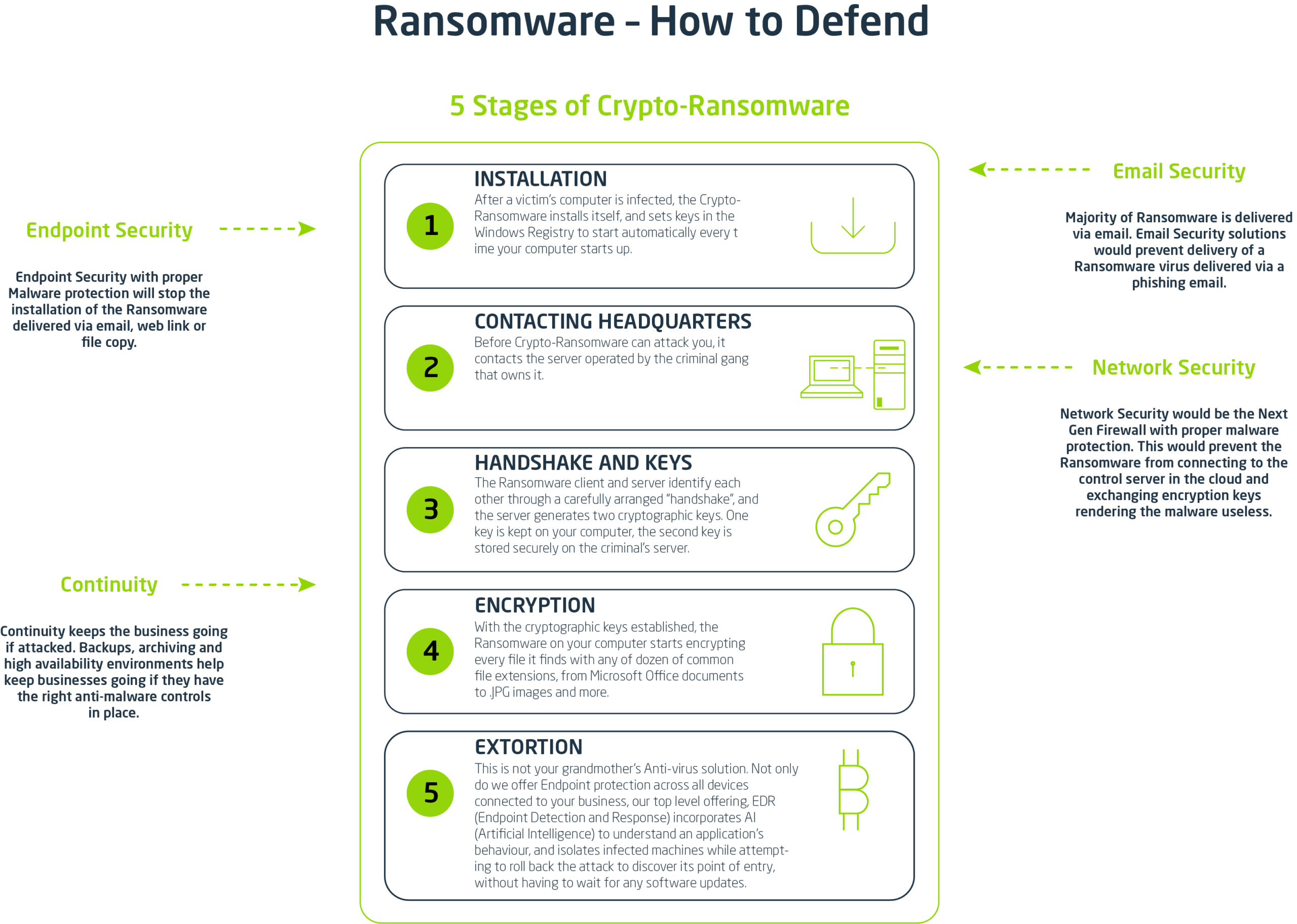
How to defend against Ransomware diagram with Vox's Level 1 Security offering | Vox Cyber Security | png

Email Security

Over 306 billion emails were sent and received in 2020, and that number is expected to grow to 376 billion by 2025. It’s no wonder email phishing attacks are on the rise – and becoming more sophisticated by the day. Thanks to its ability to bypass Firewalls, a company’s email acts as the main portal for malware, accounting for 95% of all infections, which means email security should be a top priority when it comes to preventing costly Ransomware attacks.

A dedicated email security solution safeguards against the risk of everything from malware to inbox-clogging spam, phishing emails, DHA (Directory Harvest Attack) and DDoS (Distributed Denial of Service) attacks as accidental data leaks. All of which can bring your business to a grinding halt as your essential data is literally taken hostage/encrypted and held for ransom.

Endpoint Security

This is not your grandmother’s Anti-virus solution. Not only do we offer Endpoint protection across all devices connected to your business, our top level offering, EDR (Endpoint Detection and Response), incorporates AI (Artificial Intelligence) to understand an application’s behaviour, and isolates infected machines while attempting to roll back the attack to discover its point of entry, without having to wait for any software updates.

Where EDR really shines is in the prevention of Zero Day Attacks – where hackers waste no time in finding any unknown software weakness or flaw ripe for exploitation before a patch can be made.

Network Security

Firewalls are your first line of defence when it comes to protecting your network from any unauthorised access and, like Endpoint Security, they’ve evolved to meet the demands made on them by 21st century threat actors.

Next-generation firewalls can provide real-time views into your network activity as well as actionable application and risk dashboards and reports, all without sacrificing any of your network performance. More than just a barrier between your network and online threats, next generation firewalls, are purpose-built and scalable, including everything from VPNs (Virtual Private Networks) for data encryption and remote working opportunities to application control and advanced threat protection.

In the face of a Ransomware attack, a Next-generation firewall cuts malware off at the knees by preventing it from connecting to the hacker’s control server and exchanging encryption keys to begin encrypting your data.

Managed Backup

Should all of the above fail – because anything that can and will happen, usually does – then your ultimate insurance policy against a Ransomware attack is a data backup and recovery plan. By keeping a copy of your data safely stored in a separate location, you’re not only shielding yourself from having to pay ransom for access to your data, with an efficient recovery plan in place, you’re also ensuring business can carry on as usual without the need for costly downtime.

That said, a backup solution is something that needs to be monitored constantly – not only to ensure your backups are error-free and constantly updated, but also to guarantee it’s free from malware too.

Clearly, when it comes to Cyber Security, the whole is greater than the sum of its parts.

Why Co-Location is an Ideal Stepping Stone to the Cloud

Driven by the ongoing pandemic as well as long-standing loadshedding concerns, increasing numbers of South African organisations have had to enable remote working. While moving to the cloud is often presented as the solution, it is not possible in some cases due to a variety of factors. In these instances, Co-Location doesn’t just provide a secure and reliable environment to maintain servers, but also a more seamless path to the cloud when the time comes to shift.

Many organisations might have made investments in modernising their IT infrastructure (which is now capable to meet their requirements and still within manufacturer warranty), and will first need to sweat these assets while others might have adopted more stringent security policies that prevent the storage of certain types of data on shared infrastructure or in public clouds – all of which means that they are still maintaining their equipment on premise.

At a time when offices are being downscaled (or being abandoned altogether in favour of work from anywhere), these organisations are forced to hold on to their costly server rooms, which come with several risks. The biggest is the spectre of a return to sustained loadshedding, and mitigating against this means additional expense on UPS systems, generators, maintenance and fuel needed to keep infrastructure running and properly cooled to ensure optimal performance.

More than just causing a disruption to business activity, unreliable electricity supply can also result in power spikes that can cause damage to electronic equipment including UPS systems, which could possibly result in a loss of data. Then, there’s the possibility that the Fibre line to the office premises could be damaged, leaving employees without access to data, which can be equally damaging – reputationally and financially.

 To address this market, Vox has partnered with Teraco to provide them with colocation services at data centre facilities in Gauteng, Western Cape and KwaZulu-Natal, which are operated at global best practice standards. Co-Location provides customers with rack or sub-rack space, power, cooling and connectivity, be it a direct connection from on-premise to the cloud using Vox Fibre, a direct connection to the internet, through Multiprotocol Label Switching (MPLS), or a Virtual Private Network (VPN).

The facilities are equipped with features including CCTV monitoring, as well as early smoke detection and advanced fire suppression to ensure the physical safety of IT equipment, and dual independent power feeds to ensure 99.999% guaranteed power uptime. Getting set up with Co-Location depends on the size of the business and the complexity of their systems, but this can be as little as a few days for a small business with two or three servers.

Apart from reducing on-site maintenance overheads and providing organisations with peace of mind that their infrastructure is safe and secure in an off-site location, Co-Location allows organisations to efficiently maximise their existing investment into server infrastructure, before acting as a stepping stone for their move into a cloud platform, such as a virtual data centre.

With direct peering to NAPAfrica and connection to the Vox Backbone, which ensures the best performance and cross-connections to major service providers and hyperscalers. This means that when organisations decide to migrate to the cloud, such as when their existing infrastructure approaches end of life, they have a direct high-speed connection to cloud providers, making their migration process more seamless and with reduced downtime.

What do Hybrid Workspaces mean for the Future of FTTB?

Two years ago, “I’m working from home” meant a phone call to HR. Now, it’s an instruction.

Truth be told, the conventional office space has been gradually phased out worldwide for a good few years. People talk about Google and their nap pods, slides instead of stairs, open plan stations and collaborative, unregulated work environment as if it’s the adult Disneyland but, truth be told, there are even agencies in South Africa who’ve implemented gamification in their offices.

The reasoning behind this is that we’ve seen a shift in mindset and increased realisation that conventional ‘desk-and-cubicle’ workspaces, while cost-effective, aren’t conducive to motivated employees or relaxed state of mind. As such, the pandemic-accelerated process of redefining the way employees should work has been an eye opener to say the least.

Enter the Hybrid Workspace, today’s topic of discussion.

Lockdown completely scrapped the rulebook to show us that what we thought was ‘impossible’ was actually pretty flexible.

‘I can’t work if I’m not at a desk, it’s impossible’

‘I can’t stay at home, it’s impossible’

‘I can’t just sit at my desk working without talking to people, it’s impossible’.

Fast-forward a few months and we’ve all had to reassess what the word ‘impossible’ really meant, and re-evaluate when, where and how our employees should work.

Initially, Work from Home was the phrase of the day, if not out of necessity more than anything else. As regulations and fear around the virus has eased, however, we’ve seen a more flexible, Hybrid work model which combines the best of both worlds and is sure to drive the next wave of office regulations.

Said Hybrid model amalgamates stay at home principles with occasional, sometimes necessity-only in person interactions. It’s driven by the Internet and digitisation, but rather than negating the entire value of conventional office spaces entirely, has simply allowed its purpose to evolve.

True, remote working isn’t a fit for everyone, but it’s here to stay, and companies will need to maintain flexi-environments for at least the foreseeable future. There’s substance in the Data as well, as a recent SMB Group Study has indicated the following insights:

  • 47% of South African businesses are investing in technology to support remote working
  • 51% have created long-term strategies to incorporate more flexible workstyles
  • 59% of SME’s have expanded their WFH programs to become more inclusive

For better or worse (well, we say for better) it’s here to stay. And, with a spread-out workforce (employees sometimes clock in from different cities or countries), the focus is no longer “how will we do it?” but facilitating an inclusive environment. This environment needs to enable collaboration yet provide quality remote access to all necessary Data and tools while meeting deliverables. And, as vital as technology is in the process, the incorrect platforms could prove to be a hindrance rather than your greatest asset.

Here’s an outline of all the areas you need to focus on, and how FTTB can play a role in making it easier.

  1. A fluctuating office environment means your Network needs to be flexible.

At any given time, your office demands may be minimal or operating at capacity. Sure, more often than not you should be able to survive unscathed, but on days where people come in, you can expect higher demand and strain on your bandwidth.

But, you ask, it managed fine before, what’s the issue now? Well, you need to facilitate that just because your staff is in, doesn’t mean everyone else is. Take Vox, for example, with over 1700 employees nationwide. A team such as Marketing may come in for the day, but everyone they communicate with both internally and externally still needs to connect remotely. As such, the bandwidth is tested, as the majority of meetings previously held in person now need to be done remotely.

This means increased video demand, increased web browsing and, of course, more strain on your Fibre. Ever tried browsing while the kids are playing Call of Duty (or vice versa)? You’d know that a standard FTTH package starts lagging at 3 users, so imagine what a dedicated team of constantly connected professionals can do to a lower end one?

  1. Users on private connections can pose a security threat.

Ever wondered why we’re seeing an increased amount of phishing attacks and ransomware headlines? It’s not because the virus gives you hacking powers (although that might explain why Bill Gates is in the spotlight…).

Employee and company Data are now at increased risk, as accessing content remotely can sometimes happen on unsecure networks. Plus, it’s significantly easier to hack into ‘John Smith’s Home Wi-Fi’ than it would be to even go near our Vox Firewall (we know what we’re doing, in fact, we’re experts in the field). As such, you need to ensure that your Fibre connection and the resultant security are world-class and leave no room for compromise.

You also need to factor in that many remote workspaces make use of a VPN, which in turn presents its own share of risks. With an influx of employees dialling in remotely, the amount of secure VPN connections will ultimately have an impact on your brands vulnerability online.

  1. You’ll need to get your head out the Clouds.

We’re big advocates for Cloud solutions, and with good reason. You already know the drill and how much it makes life simpler to be able to access your Data from anywhere, but did you factor in that performance can be impacted by speed and reliability?

Your Cloud tools and related applications can really only be as good as the network they’re delivered from. More so, many brands are installing new services which need to be integrated effectively and managed correctly. Much like your head office needs to be running properly in order for franchisees to benefit, your business network needs to be on point to deliver the resources required effectively.

You’re probably past the stage where you’re reliant to adopt a Hybrid Space (it’s about time!), but the only way to keep your employees motivated and productive is through adequate support. Your Business Fibre needs to be on point in order for your team to function the way it should, which is why you can’t take any chances when it comes to your network.


Will Satellite Internet Ever Replace Fibre?

Estimated Reading Time: 3 Minutes

The race for faster, better bandwidth is going to infinity and beyond, but that doesn’t mean we’re ever going to cut ties with the king of fixed line.

In the 21st century, access to reliable broadband has almost become as important to daily life as electricity and clean water. And yet, for various reasons, only 60% of the world’s population have access to the Internet. As the pandemic has proven, connectivity is an essential service – one that has allowed most to continue to work and learn safely from home during lockdown.

Where traditional fixed line and wireless options like ADSL, Fibre, LTE and 5G continue to fail to reach, satellite promises to fill that void.

Let’s be honest – satellite Internet just sounds cool.

And, with Elon Musk leading the charge in new generation LEO (Low Earth Orbit) satellite connectivity with the promise of providing high-speed broadband to all parts of the globe, it might seem as though Fibre is about to be overshadowed by tens of thousands of shiny faux-stars glimmering in the sky.

The truth is satellite will never replace Fibre, here’s why:

Price and Performance

To really have a chance at competing with Fibre on a large scale, satellite Internet will have to be as fast, reliable and affordable as its fixed line competitor.

As we’ve seen in the past year, Fibre is becoming more widely available (believe us, we’re working on it) and more affordable than ever before and this is a trend that’s set to continue. Fibre allows for the delivery of incredible link capacities that can be easily increased in short timeframes. It also exhibits an extremely low latency, which, up till now, satellite really couldn’t compete with.

Traditional GEO (Geostationary Earth Orbit) satellites are ‘parked’ at a staggering altitude of 36000km above Earth’s equator, which means the signal has quite a journey before breaking out in your home, resulting in a round-trip latency of 700ms (that’s milliseconds) compared to Fibre’s latency of seven to 15ms (Fibre is access circuit dependent).

Musk’s Starlink LEO satellites are only about 645km away, which means they’ll close the gap on both latency and speed. Here’s the catch: it costs R7000 to buy a Starlink Internet terminal and the monthly subscription will be at least R2000 per month. If you already have access to uncapped, unshaped high-speed broadband at a fraction of that cost, opting for satellite over Fibre really makes no sense.

Fibre will also remain the terrestrial backhaul for fixed line services for years to come, not to mention provide backhaul for the other buzz-worthy wireless disruptor: 5G cellular networks. Unfortunately, Fibre will never be everywhere.

The Future of Satellite

Satellite Internet is invaluable for closing the digital divide in areas where fixed line and traditional wireless connectivity just can’t and, frankly, might never, reach. LEO satellites are also going to play an even greater role in the widespread adoption of IoT (Internet of Things) technology.

If it moves, LEO satellite Internet will be able to cover and connect it – plane, train, or automobile. Oh yes, ships too.

As the only truly global connectivity, LEO satellite Internet will act as the carrier, allowing companies to remotely monitor and manage their assets anywhere in the world and finally help usher in the new era of self-driving trucks and cars.

LEO satellites also offer myriad of applications for military use, particularly for the US, whose Space Force (yes, it’s real) is already looking into its potential use cases, including data collection for surveillance, reconnaissance and missile detection to send in real-time to soldiers on the ground.

If you ask us, everyone should have access to the best connectivity possible – whether it’s satellite, Fibre, wireless, LTE or DSL.

Let’s Talk Cloud with Vox Fibre

Recent events have put our business needs into perspective.

Be it a shift in priorities as brands migrate into an almost entirely virtual workspace, or an added emphasis on security due to the increased risk of both physical and remote attacks, the brands of today can no longer rely on the solutions of yesterday.

We find ourselves at a crossroads, one wherein a failure to adapt can drastically impede our business moving forward. Cyber threats are on the rise, the new hybrid working world has created a need to access your information on-the-go and, most of all, the conventional concepts of hard storage and in-person server solutions now present more risks than solutions.

We know the challenges that the modern organisation faces on all fronts, but the question we’re asking is “what can we do about it?”

The answer, you may be surprised to know, lays in the Clouds (or should we say Cloud?)

Before we get into it, let’s look at the numbers:

  • Since the onset of Covid-19, the Cloud computing industry has skyrocketed, seeing an upward trajectory with regards to adoption, infrastructure, spend and development.
  • Studies suggest that by the year 2025, there will be over 100 zettabytes (spoiler: that’s a LOT more than your server room can handle) of information stored in the Cloud.
  • As of 2020, the market value of the Cloud computing industry is estimated at around $371.4 billion.
  • Around 48% of businesses worldwide choose to store their most important classified Data in the Cloud.
  • The average person uses at least 36 Cloud-related services every single day (where do you think your Facebook recommendations and Gmail history are stored?)

All the above indicates a very simple truth: Cloud Computing is on the rise, and with good reason. So much so, in fact, that 80% of companies who’ve adopted a strategy denote an almost instant positive effect on their business and see massive improvements within the first few months. SME’s in particular have noted that a third-party platform can prove 40% more cost-effective than traditional in-house systems, while a resounding 94% of brands worldwide have seen significant online security improvements since making the jump.

The numbers don’t lie. Not only is the technology here to say, but the Data indicates that brands who have made the switch have benefitted tremendously from doing so.

Sadly, there are numerous concerns (and myths) when it comes to all things Cloud (which we’ve also touched on here) that are factually incorrect. Any new technology faces its share of detractors – remember the whole WhatsApp and Telegram debacle? However, the improvements and testimonials of major industry leaders who attest to the security, efficiency, reliability and cost-effectiveness of adopting the new normal are all indicative of the validity (or lack thereof) of these theories.

The reality is that in most cases, the misconceptions are actually polar opposites from what’s actually true. Take security, for example. Many believe that because your Data is stored off-site where you can’t see it, it becomes vulnerable and an easy target for Cyber Criminals. However, the research indicates that at least 95% of Cloud Security failures can actually be traced back to an error on the end users’ side. ISP’s stake their reputation (and in turn their livelihood) on the reliability of their services, and a breach in firewalls which exposes customer Data can often prove fatal to an industry standing. Couple this with the now mandatory protocols outlined in the new POPIA act, and you have a watertight recipe for an almost guaranteed focus on protecting your Data.

True, many brands are hesitant to get on board due to the aforementioned misconceptions, but an unbiased view of our redefined working world and the challenges physical servers face tell us that it’s the only natural solution – and it wouldn’t be so were it not worth the hassle. Facebook, Amazon, Netflix, YouTube and even Google were some of the earliest adopters of Cloud technology, and the heights to which their brands have soared should serve only to reinforce our vote of confidence.

The sad reality is that, in today’s day and age, a compromise on your Digital Security can be the endgame for your brand. Furthermore, with employees being in a constant state of flux and the workspace of tomorrow guaranteed to be a hybrid one, you need a solution that allows your Data to be easily accessible from anywhere, anytime. Were it not for Cloud solutions, many brands (including our own) would not have survived this difficult lockdown period. However, instead of reeling from the damage, the adoption of said migration allowed us to kick off from day one and our employees to be productive no matter where they resided.

Today’s brand challenges require modern solutions – solutions which facilitate for a rapidly changing work environment and the difficulties we encounter. Truth be told, your brand is already worried about so much that an added stress is the last thing you need. However, with a Cloud migration eliminating the fear of Data loss, theft, storage and expenses, you can keep your eyes on the prize while our tech guys keep their heads in the Cloud.


What About Vox?

What do you get when you combine innovation with expertise and service excellence?

Truth be told, you could get any one of a hundred ISP’s. However, factor in passion, diversity, expertise, a wealth of products catering for people from all walks of life and some out-the-box thinking, and you arrive at Vox. See, we’ve been here a while (23 years to be exact) and in the process, we’ve touched the lives of South Africans everywhere – in doing so revolutionising the digital working world of our humble country.

But let’s scale it back a bit, because you can’t know where you’re going if you don’t know where you’ve been…

We were launched way back in 1988, the same year that satellite hand-held phones were introduced (and a few years before USB Flash Drives and Wikipedia – which makes us feel pretty old). From day one, we were at the forefront of our industry, becoming the first business to launch a company Email Service which utilised a single Dial-Up. Today, we’re one of the largest black-owned telecommunications companies in South Africa, acquiring a handful of strategic partners (most notably Frogfoot) along the way, which has allowed us to grow from strength to strength.

Many brands talk about innovation, but we’ve made it a building block of our success from the very start. We pioneered uncapped ADSL a whole year before any other South African ISP, launched the first Voice Service over ADSL, been at the forefront of Fibre implementation across the country and, when disaster hit, helped revolutionised our working world by championing Work from Home solutions.

Not only have we facilitated the rollout of fast, reliable Internet through cities and ‘dorpies’ across SA, we’ve made a concerted effort to make our presence felt around our country (so much so, you’ll notice we’re proud sponsors of the Emirates Lions Rugby Union). However, while we’re primarily known as the guys you call when you need Internet, we like to believe that our company is so much more…

When talking Vox, you’re actually talking about uniqueness, scalability and a product offering that surpasses anyone else in our industry.

We’ve made it our mission to provide world-class solutions for, well, pretty much anything and anyone.

Each product is part of a bigger picture and surrounded by some of the greatest minds in the industry. Said products aspire to offer value, innovation and cutting-edge advancements to 100% of the country, 100% of the time.

We don’t base these products around connectivity, but rather analyse our unique landscape to determine real problems and offer viable solutions. We’re in the business of making our customers lives better, be it an avid gamer who can’t afford a console to a concerned individual wanting to keep an eye on an elderly loved one.

While our product scope is unparalleled in its vastness, there’s never been a compromise on quality. Instead, we ensure that each division is equipped with the best industry experts to ensure nothing short of excellence. It’s this insistence on quality on every aspect of our business, no matter how big or small, that has allowed us to see consistent growth and a continued delivery of tried, trusted and best-in-class solutions which redefine what an ISP can provide.

Need Fibre for your home? We’ve got you covered, but we’ll also look after your business needs.

Can’t access Fibre? We’ll hook you up with LTE-A, Satellite or DSL.

No power? There’s a UPS for that.

Weak signal? Try a Home Mesh or Cell Booster.

See where we’re going with this?

Our services range from consulting (in the form of Braintree, one of our subsidiaries), to Cloud, Security, Managed Services, Communication, Collaboration, Connectivity and Beyond. Let’s get into it:

  • As far as Managed Services go, our portfolio consists of everything from Managed IT to Hardware Rentals, IT Advisory, Audits and beyond.
  • We boast a team of Security experts, who offer Endpoint, Network Infrastructure, Training, Email Solutions, Risk Compliance and General Assessments (amongst a wealth of others)
  • Looking at Cloud, we can take care of your Computing, Cost Management, Audits, Co-location or Domains/Hosting (in fact, we’re pretty passionate about Cloud, as you can see here).
  • It doesn’t stop there, as our Communications and Collaboration portfolio talks about (see what we did there?) Voice, PBX, Telephone Expertise, Email, Fax – even Gaming (it’s a long list)
  • And, of course, our pride and joy: Fibre (to the Home AND Business), Wireless, LTE, Wi-Fi, Satellite, DSL, SD-WAN – we’re in the business of knowing our business, but we’re also in the business of knowing our connectivity.

(Check out our full Vox Product Stack here)

Our brand has helped small start-ups reach new heights with equipment and software designed with progress in mind. In fact, Vox have facilitated Cloud migration, ushered in a new layers to Email or Web Hosting and made inroads in everything from communication to collaboration, security, mobile, voice and support.

That being said, there’s more to being Vox than purely awesome products.

We find ourselves in a challenging, unprecedented time, one which has proved an eye-opening exercise in introspection. During this previously unfathomable paradigm shift, we as a brand were forced to relook at what defined our organisation, which in turn allowed us to understand what truly matters.

Despite financial and economic restrictions, our Vox brand is immensely proud of the fact that we were never forced to retrench an employee. We persevered, we adapted, we adopted (and advocated for) the concept of Working from Home in its infancy and this, to us, indicates unparalleled brand strength and adaptability. We may have shut our physical doors, but our wheels keep spinning.

It’s this ability to think on our feet and share this knowledge with the world that, to us, is the best indicator of our brand dexterity. We’ve taken the idea of progress made simple and dialled it to 100, in doing so allowing students, employees, businesses and beyond to live easier, work smarter and do better.

Our brand ethos is rooted in an understanding of the unique, diverse nature of our wonderful country – and our mix of staff from all walks of life reflects exactly this. No other organisation in South Africa offers the amalgamation of specialist solutions in a one-stop, easy-to-find shop the way we do. To this day we continue to push out new solutions. Vox is at the forefront of expansion, product development, digital excellence and redefining our local working landscape.

We believe that our brand, our team, our products and our services are bringing world-class digital solutions to the whole of South Africa – and we wouldn’t have it any other way.

The Cloud is Calling

Estimated Reading Time: 2 Minutes 46 Seconds

Streamline your communications, cut down on costs and enjoy the flexibility and scalability that only the cloud can offer with 3CX Cloud.

It might sound like a pitch for a product ‘as seen on TV’ but cloud PBX (Private Branch Exchange) offers companies so much more than the ability to cut through cans without blunting their steak knives.

With a cloud-hosted PBX, not only will they be able to enjoy all the benefits of a Unified Communications solution (we’re talking voice, web conferencing, chat and content sharing in one) wherever their employees happen to be working from, it also means cutting down on huge expenses when it comes to hardware and specialised IT maintenance too.

Cut Down on Costs

Of all the benefits cloud computing offers businesses, avoiding large sums of capital outlay must be one of the best. You don’t have to worry about buying and installing new hardware with cloud PBX as everything is hosted in secure, off-site data centres, monitored and controlled by a central team of experts.

This means you can wave goodbye to space-hogging servers filled with masses of cables and complicated switches while still enjoying the functionality of your traditional PBX solution, and then some, as cloud PBX runs through your Internet connection. Desk phones are also an optional extra as the solution operates through smartphones and PCs with ease, which all adds up to an extremely low total cost of ownership.

As the solution is hosted off-site, set up is incredibly easy on your end and all upgrades and additional features are added to your phone system immediately without you having to lift a finger – not even the one you use to dial.

Besides all the above, by hosting your PBX solution off-site, you won’t have to worry about power outages at home or the office interrupting your business calls as the off-site data centres offer full redundancy. This also means cutting down on the costs for backup power solutions of your own to keep those servers running.

Pay as you Grow

A communications solution simplified, cloud PBX really shines when it comes to offering the flexibility for companies to literally communicate from wherever they happen to be working from – be it at the office, at home or on the road – and the scalability of adding or removing users with little to no fuss in no time.

We couldn’t be more excited about our 3CX Cloud offering, which is broken down into three separate packages, all with unlimited users, jam-packed with features and billed according to the amount of simultaneous calls your company will need to make – and by that we mean the amount of incoming, outgoing and internal calls your company makes at the same time. Did we mention we offer the Standard Edition 3CX licence for free for the first year? Because we do.

Our 3CX Cloud offerings are tiered according to the Standard, Professional and Enterprise Editions to suit your specific needs and the size of your company. Each Edition is customisable based on the number of your simultaneous calls, fully managed by Vox and connects to the Vox network to allow you to enjoy the most competitive, industry-leading voice rates for additional savings. If you need more functionality, an upgrade is a simple call away.

When it comes down to it, cloud PBX is an absolute no-brainer.

Why Game with Vox?

By now, you’re probably tired of all the reasons you should love gaming.

You’ve likely read about it more than Uncle Cyril’s ever-changing lockdown regulations. It’s fun, it’s a means of escapism and it’s not just for kids- we get it.

Look, we’re not saying that a new console will cure the blues, but we are saying that blowing off some steam is an essential part of dealing with today’s external world. We speak from personal experience when we say that while the concept of gamers may scream spotted pre-teens and Fortnite, the reality is a mix of countries, ages and demographics combining in one of the few truly unbiased, free-to-join examples of multi-culturalism in the world.

However, the economic impact of the world we live in has created a similarly universal need to tighten belts and pinch rand and cents. In other words, outright purchasing a console is, to many, an unattainable dream at this stage.

But does that need to be true?

Vox’s rental model aims to eradicate this issue altogether and make the possibility of gaming a reality for everyone. You don’t have to put out a massive capital outlay to partake in fun and relaxation. Gone are the days of kids wishing they had what their friends do or feeling left out on the playground as everyone talks about new releases.

With our Xbox Rental options, you don’t have to spend an arm and a leg buying something you only use occasionally. Instead, you can put that money to better use, settling only for a small monthly fee until you’re ready to upgrade, renew or move on to something else.

The magic of gaming is that anyone can enjoy it.

Guys, girls, parents, even grandparents- there’s no age limit to who can have fun. With the Vox rental model, there’s no stressing about purchasing either. Just press play and you’re good to go.

It’s that simple- but isn’t that what gaming is all about?

A common misconception, however, is that gaming is only for “serious” gamers. The words “noob” and tales of pro-players destroying all challengers are greatly exaggerated. Yes, there is a competitive element should you wish to partake in it, but gaming has never lost its purity in that all it takes to enjoy is a console, the right game, and some free time. Young, old, it’s all good- pick up and play is a thing of the present.

And, for those of you who know you’ll be greeted with eyerolls at the suggestion of a new console, here’s some facts to back up your motivation:

  • Studies have shown that not only do action games enhance attention spans, they assist with language learning and decision making.
  • Gaming in general has been scientifically proven to overcome bias and cognitive dissonance.
  • Again, studies have shown that regular gameplay can improve overall mental health and have an uplifting effect on moods.
  • More studies (people have really investigated this) indicate that gaming has a positive impact on both cognitive and social skills.
  • Gaming has also been proven to assist with the following:
    • Foundation Skills: achievement drive, self-awareness, critical thinking and self-confidence.
    • Performance Skills: Perceptual, Motor, Attentional and Timing.
    • Problem Solving: Personal Development, Identity, Creativity, EQ and Self-Esteem.
    • Decision Making: Team Skills, Leadership, Communication, Cohesion and People Management.

The question we haven’t asked, however, is why do it with Vox? Well, there are actually a multitude of reasons we’ve been too humble to tell you about (until now, that is) …

  1. Let’s start with Latency, Optimised Network Design and Peering Links:

Simply put, Latency impacts the speed at which your game responds to your inputs. If you’ve ever wondered how pressing the X button makes an Internet connected feature respond, pay attention (we promise, it’s a lot more interesting than you think).

Your gaming software signals your input to the server via networking packets, which must travel through an Internet connection provided by an ISP. Before we put you to sleep, this basically means that when your response time is lowered (also known as the “Ping”), the gameplay becomes smoother and more responsive. Perfect for an FPS, where a split second of lag or game jitter can be the difference between victory and a controller flying through a window.

We’re not in the business of window repair, but our international backbone network and Internet peering was delivered specifically with this in mind. In 2019, we added the South American Cable System to the USA for the lowest latency and best gaming experience to main servers. Why should we care about South America, you ask?

Well, we appreciate that many of our customers will be using servers abroad. Our conservative strategy is designed to ensure these links never run into congestion. In simple English, your gameplay will be smoother, more reliable and involve less lag, all thanks to low Latency.

  1. Gaming Quality of Service on Last Mile:

We all know the pain of trying to concentrate on an online game while someone else in the house hogs the Wi-Fi. Aside from the noise and constant shouts of “are you on the Internet?”, both you and the other party are almost guaranteed to experience delays, frustration and, ultimately, a vastly inferior connectivity experience.

Or are you? Through configuration with our fully managed MikroTik routers, we’ve implemented the ability to gain optimal speeds and connectivity via Vox FTTH service for Gaming.

In English? You can separate your gaming and streaming, allowing everyone to live their lives in complete harmony. While the rest of your household is free to Netflix and chill while you enjoy unaffected gameplay. This is achieved by foregoing a small portion of your link to gaming traffic. We will allocate 1Mbps on a 50Mbps line or 2Mbps on a link greater than 50Mpbs. This will ensure that your gaming is unaffected by any other household Internet traffic.

  1. Bundled Offerings and Discounted Prices

You are now able to save on your Xbox Series X or S console rental and your Vox Fibre to the home subscription by selecting a bundled solution that matches your gaming needs. Starting from only R1,293pm* you can rent an Xbox console and get a 50/50 uncapped, low latency Fibre line for uninterrupted gaming. (Available speeds and pricing dependent on feasible Fibre network operator in your area.)

Get the most out of your gaming time with a 24-month Xbox and Vox Fibre bundle rental:

  • A fully managed service for the term for your Xbox console rental.
  • Flexible end-term options to upgrade your console to the then current version.
  • Low latency Network Design with transit routes throughout South Africa, North America, South America, Europe and the rest of the World.
  1. Vox UPS

We all know the drill.

You’re working or playing from home and load shedding strikes. Although it is gone for now; we know that before you blink your eyes – it’s back and you’re left sitting in the dark. Not only are your unsaved documents and gaming progress probably lost and your momentum killed, but productivity and entertainment drops to level zero.

We’ve all been there, and we’ve felt your pain. With working from home being the new normal and online gaming requiring connectivity, we’re all heavily reliant on technology such as routers, laptops, mobile phones, consoles and printers staying online for us to keep our fingers on the pulse.

Fear not, because we offer two affordable UPS models designed specifically for the consumer market. Each one will allow you to stay connected when the power goes down, and features the following benefits:

  • Up to four hours of uptime
  • Automatic activation
  • Small and compact devices
  • Plug and play installation
  • 24/7 support

All of this is just the tip of the iceberg, it’s a beginning of a journey with Vox as your technology provider. The saying goes that a journey starts with a single step and we have a range of product offering for home and office. All you have to do is click on over to www.vox.co.za and take the first step into a world of endless possibilities.